


Why investing in mid-cap and small-cap funds one of the potential investment strategies?
Written by Akshay Kumar Rao
09 Sep 2025 • 9 minutes read


Market capitalisation (commonly known as “market cap”) represents the total value of a company’s outstanding shares. It is calculated by multiplying the company’s share price by the total number of shares available in the market.
Now, based on this value, companies are grouped into three categories:
Large cap: Mature companies with the highest market value.
Mid-cap: Mid-sized businesses that are usually growing.
Small-cap: Younger companies (say start-ups) or smaller businesses
Several moderate to high-risk investors nowadays prefer investing in small-cap and mid-cap companies as they may offer higher growth opportunities compared to large-cap firms. Though they carry a higher risk, they may also offer the possibility of higher returns over the long term.
Are you in the same league? In this article, let’s understand what is small-cap and mid-cap. Next, we will see what small & mid-cap funds are and how they work. Lastly, we will check out some mutual fund plans you can consider in 2025.
Table of Content

What are Small-cap and Mid-cap?
In 2017, SEBI (Securities and Exchange Board of India) introduced a rule to classify companies based on their market capitalisation. This classification allows investors to clearly understand the size, risk, and growth potential of different companies.
For more clarity, let’s check out the simple comparison of mid-cap and small-cap companies:
| Category | SEBI Rank (in terms of full market capitalisation) | Mutual Fund Type | Key Characteristics |
| Mid-cap companies | 101st to 250th | Mid-cap Funds |
|
| Small-cap companies | 251st onwards | Small-cap Funds |
|
What Small & Mid-Cap Funds Are?
Small-cap funds are mutual funds that invest in small companies, ranked 251st and beyond by SEBI in terms of market capitalization ranking. These companies are usually new or still developing. Since they are smaller and less established, their stock prices can fluctuate sharply. This makes them riskier, but they can also carry the possibility of higher growth.
On the other hand, mid-cap funds invest in mid-sized companies, ranked 101st to 250th in terms of market capitalization ranking by SEBI. These companies maybe more established than small-caps but are not as mature as large-cap businesses.
Small-Cap and Mid-cap Mutu al Fund Plans You Can Consider in 2025!
Investors often use both small-cap and mid-cap funds to spread their investments across different company sizes. Such a diversification reduces their dependence on large-cap stocks alone. Furthermore, by combining both, investors can maintain a better mix of risk and stability in their portfolios.
For your reference, below are some small-cap funds and mid-cap funds you can consider in 2025:
Tata Small-Cap Fund
An open-ended equity scheme predominantly investing in small-cap stocks
| Exit Load | Risk Level | Benchmark |
| Redemption/Switch out/SWP/STP: 1. On or before 30 days from the date of allotment: 0.50%. 2. After 30 days from the date of allotment: NIL | Very High Risk | Nifty Smallcap 250 TRI |
The Tata Small Cap Fund invests in smaller companies that can have the potential to grow over mid to long term period. The primary focus is on businesses with:
Strong balance sheets
Good cash flows
Shares that are available at reasonable prices
The fund follows a “growth at a reasonable price” approach. Its portfolio is built around three principles:
Picking long-term growth companies (“compounders”)
Keeping portfolio changes minimal (“low churn”)
Selecting stocks based on company fundamentals (“bottom-up”)
Moreover, the fund avoids global commodity businesses due to their cyclical and unpredictable nature.
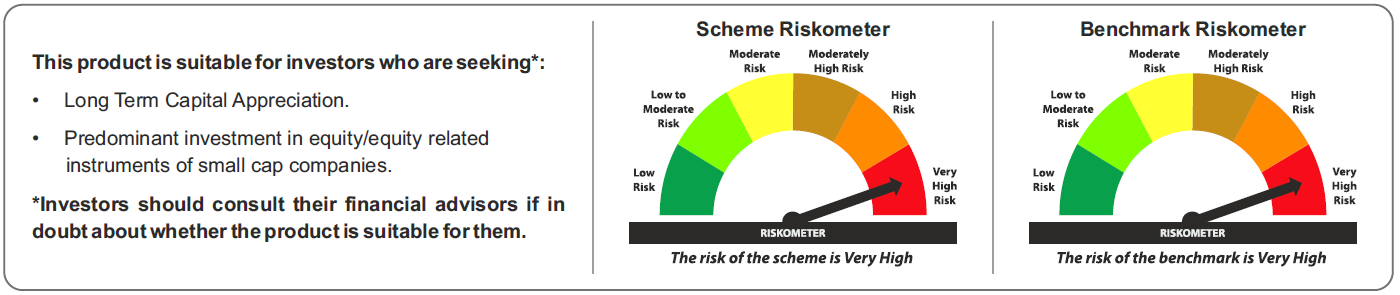
It may be noted that risk-o-meter specified above is based on internal assessment. The same shall be updated as per provision no. 17.4.1.i of SEBI Master Circular on Mutual Fund dated 27.06.2024, on Product labelling in mutual fund schemes on ongoing basis.
Tata Nifty Mid-Cap 150 Index Fund
An open-ended fund replicating/tracking the Nifty Midcap 150 Index (TRI)
| Exit Load | Risk Level | Benchmark |
| NIL (0.25%, if redeemed on or before 15 days from the date of allotment). | Very High Risk | Nifty Midcap 150 Index (TRI) |
The Tata Nifty Midcap 150 Index Fund invests in companies ranked 101 to 250 by full market capitalisation. This fund tracks the Nifty Midcap 150 Index and tries to replicate its performance. By investing in this fund, you can get exposure to mid-cap companies. The portfolio is rebalanced twice in March and September.
Furthermore, the fund can offer diversification benefits as it invests in companies spread across various sectors such as:
Industrials
Financials
Consumer goods
Healthcare
Information technology, and more
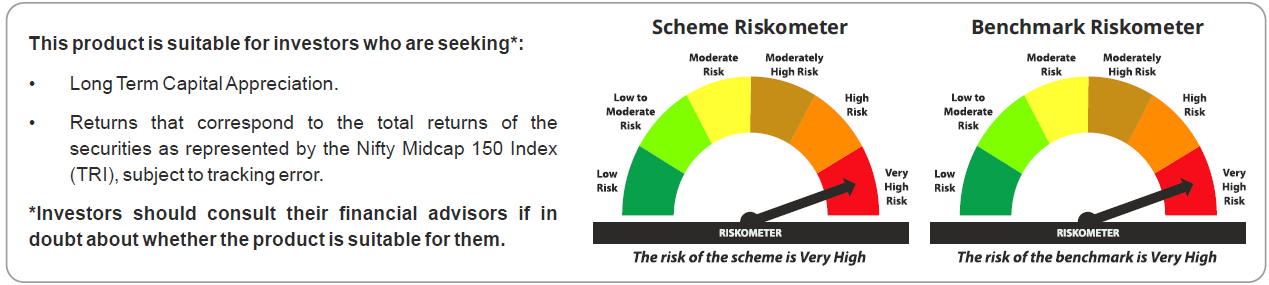
(The above product labelling assigned during NFO is based on internal assessment of the scheme characteristics and the same may vary post NFO when the actual investments are made. The same shall be updated as per provision no. 17.4.1.i of SEBI Master Circular on Mutual Fund dated June 27, 2024, on Product labelling in mutual fund schemes on ongoing basis.)
A Path to Long-Term Wealth Creation - Tata Large & Mid Cap Fund

Tata Value Fund
An open-ended equity scheme following a value investment strategy.
| Exit Load | Risk Level | Benchmark |
| NIL (0.50% when redeemed on or before 30 days from the date of allotment) | Very High Risk | Nifty 500 TRI |
The Tata Value Fund follows a value-investing approach and tries to buy strong companies at prices lower than their true worth. At least 70% of its portfolio can be invested in stocks with a rolling price-to-earnings (P/E) ratio lower than that of the BSE Sensex, at the time of investment.
The fund does not buy just “cheap” stocks. Instead, it looks for quality businesses that are temporarily undervalued but can have growth potential. Selection is based on several factors, such as:
Sector growth opportunities
Market leadership
Consistent return ratios
Better use of capital
Stock liquidity
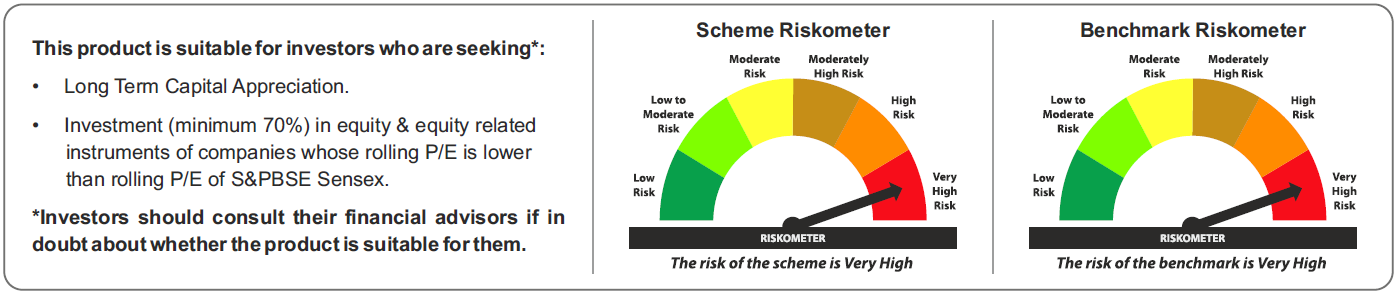
It may be noted that risk-o-meter specified above is based on internal assessment. The same shall be updated as per provision no. 17.4.1.i of SEBI Master Circular on Mutual Fund dated 27.06.2024, on Product labelling in mutual fund schemes on ongoing basis.
Tata Nifty Mid-Small Healthcare Index Fund
An open-ended scheme replicating/tracking nifty mid-small healthcare index (TRI)
| Exit Load | Risk Level | Benchmark |
| NIL (0.25%, if redeemed on or before 15 days from the date of allotment). | Very High Risk | Nifty MidSmall Healthcare index TRI |
The Tata Nifty MidSmall Healthcare index fund tracks the performance of the Nifty MidSmall Healthcare Index (subject to tracking error). It invests across the healthcare sector and can cover both preventive and curative areas, such as:
Pharmaceuticals
Hospitals
Diagnostics
Medical equipment
Research and analytics
Furthermore, the index is drawn from the Nifty MidSmallcap 400 and can include up to 30 stocks. No single stock can exceed 33% weight, and the top three together cannot exceed 62%. The index is reviewed and rebalanced every six months to maintain diversification.
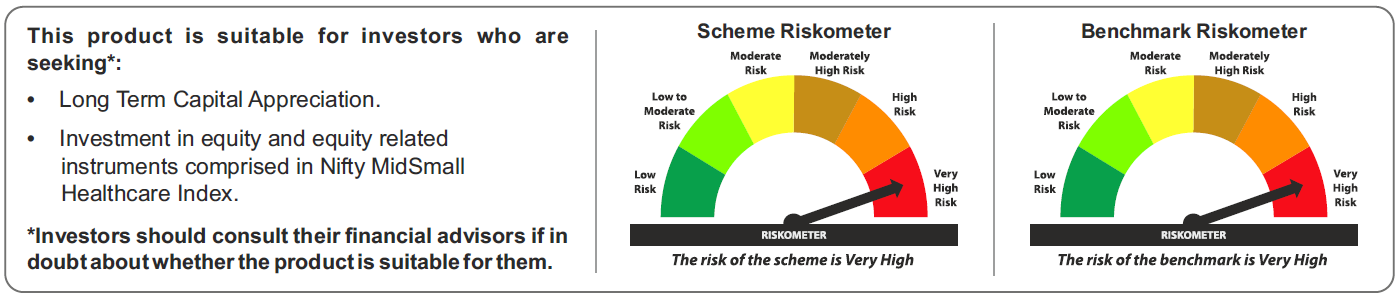
It may be noted that risk-o-meter specified above is based on internal assessment. The same shall be updated as per provision no. 17.4.1.i of SEBI Master Circular on Mutual Fund dated 27.06.2024, on Product labelling in mutual fund schemes on ongoing basis.
Conclusion
Till now, you must have understood that mid-cap and small-cap funds may offer potentially better returns than large-cap funds but with comparatively higher risk because they invest in growing companies that still have room to expand.
As per SEBI’s classification, mid-cap funds invest in companies ranked 101 to 250 by market capitalisation, while small-cap funds invest in companies ranked 251 and beyond. Please note that these funds carry higher risk but may also offer greater growth opportunities.
If you are looking to explore this segment, you can consider Tata’s range of mutual fund options, such as the Tata Small-Cap Fund, Tata Nifty Midcap 150 Index Fund, Tata Value Fund, and Tata Nifty MidSmall Healthcare Index Fund.
*Mutual Fund Investments are subject to market risks, please read all scheme related documents carefully.
Author Bio

Akshay Kumar Rao

Loading Form...
Loading Similar Blogs...