


Understanding Equity Mutual Funds For Long-Term Probable Wealth Creation in India
Written by Akshay Kumar Rao
09 Sep 2025 • 11 minutes read


An equity mutual fund scheme invests in shares of companies. The goal is to grow your money over the long term. These funds can be suitable for investors with a higher risk appetite and those who are willing to stay invested for several years.
There are multiple types of equity funds, with some schemes investing in specific industries like technology or banking, while others following a particular style of investing, such as picking undervalued stocks (value investing) or stocks of companies expected to grow in the future (growth investing).
Please note that equity funds can be suitable when you are looking to build potential wealth in the future and not earn quick returns. In this article, let’s learn about its various types and check out some equity funds in mutual funds you can consider for investing.
Table of Content

Types of Equity Funds
As per SEBI guidelines on “Categorisation and Rationalisation of Mutual Fund Schemes”, equity funds are divided into different categories so that investors know where their money is being invested.
Each category has clear rules on how much the fund must invest in specific types of stocks. Let’s understand in detail through the table below:
| Category | Where the Fund Invests | Key Point for Investors |
| Multi-Cap Fund | At least 75% in equity and equity related instruments across large, mid, and small companies, with minimum investment of 25% in each of these companies | Diversified exposure to all company sizes
|
| Flexi Cap Fund | At least 65% in equity and equity related instruments with allocation across large, mid, and small-cap stocks. | Fund manager decides allocation based on market conditions
|
| Large Cap Fund | At least 80% in equity and equity related instruments of Large cap companies (top 100 companies by market size)
| Major focus is on relative stable and established companies |
| Large and Mid Cap Fund | At least 35% in equity and equity related instruments of large caps and 35% in mid caps companies | Balanced exposure to relative stability (large-cap) and growth potential (mid-cap)
|
| Mid Cap Fund | At least 65% in equity and equity related instruments of mid-sized companies (101st to 250th companies by market capitalization)
| Higher growth potential but more risker than large caps |
| Small Cap Fund | At least 65% in equity and equity related instruments of small cap companies (251st and below companies by market capitalization)
| Highest growth potential, but also comes with the highest risk
|
| Dividend Yield Fund | At least 65% in companies with dividend yielding stocks
| Stocks with a dividend history are preferred
|
| Value Fund | At least 65% of total assets in equity and equity related instruments, scheme follow a value investment strategy. (investing in companies with undervalued stocks) | The strategy is to buy stocks trading below their true worth or intrinsic value
|
| Contra Fund | At least 65% in equity and equity related instruments picked with a contrarian investment strategy | Invests against prevailing market trends (carries a higher risk)
|
| Focused Fund | At least 65% in equity and equity related instruments, with a focus on maximum of 30 stocks in specified focus criteria.
| Concentrated portfolio with fewer companies |
| Sectoral / Thematic Fund | At least 80% in equity and equity related instruments of a single sector or theme (say, IT or Pharma) | High risk as performance depends on one sector/theme
|
| ELSS (Tax Saving Fund) | At least 80% in equity and equity related instruments. This scheme follows the ELSS rules under the Income Tax Act | Provides tax benefit under Section 80C under old regime, but comes with a 3-year lock-in period |
Tata Equity Mutual Fund Schemes

Tata Mutual Fund offers a wide range of equity schemes that can let you build potential wealth and create a corpus for financial goals. The options include thematic funds, small-cap funds, multi-cap funds, and other categories.
As an investor, you can choose an equity fund based on your risk appetite and investment objectives. For your reference, below are some equity mutual funds you can consider:
Tata Banking and Financial Services Fund
An open-ended equity scheme investing in banking & financial services sector
| Risk Level | Exit Load | Benchmark |
| Very High Risk | 0.25% of NAV if redeemed/switched out before 30 days from the date of allotment | Nifty Financial Services TRI |
This equity mutual fund is an open-ended sectoral fund that invests mainly in companies from the banking and financial services sector. At least 80% of its money can go into such stocks. Usually, the fund manager selects companies with:
Strong growth potential
Sound management
Good governance
Reasonable valuations
The minimum investment amount you can start with is ₹100 in SIP mode and ₹5,000 in a lump sum.
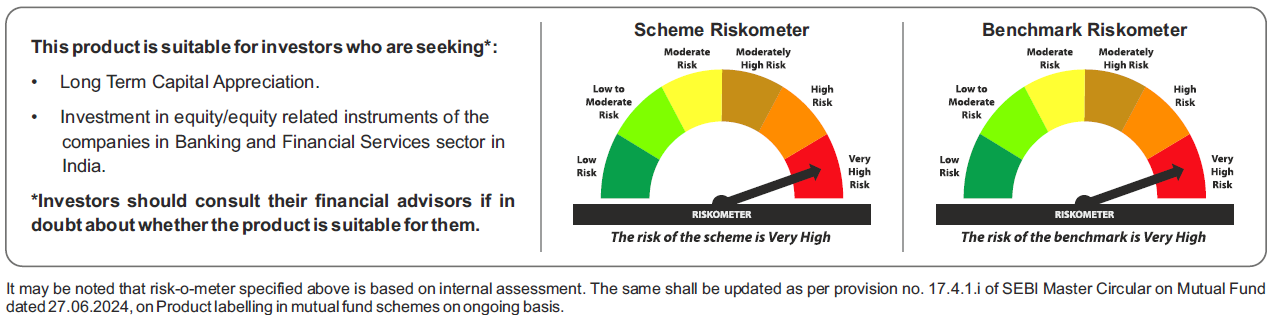
It may be noted that risk-o-meter specified above is based on internal assessment. The same shall be updated as per provision no. 17.4.1.i of SEBI Master Circular on Mutual Fund dated 27.06.2024, on Product labelling in mutual fund schemes on ongoing basis.
Tata Small Cap Fund
An open-ended equity scheme predominantly investing in small-cap stocks
| Risk Level | Exit Load | Benchmark |
| Very High Risk | NIL (0.50% if redeemed on or before 30 days from the date of allotment) | Nifty Smallcap 250 TRI |
Tata Small Cap Fund invests mainly in small-sized companies in terms of market capitalization that can have the potential to grow over the years. This equity fund looks for businesses with:
Strong balance sheets
Low debt
Steady cash flow
Availability at reasonable prices
It follows a long-term “buy and hold” approach and focuses on strong fundamentals. This scheme specifically avoids global commodity companies.
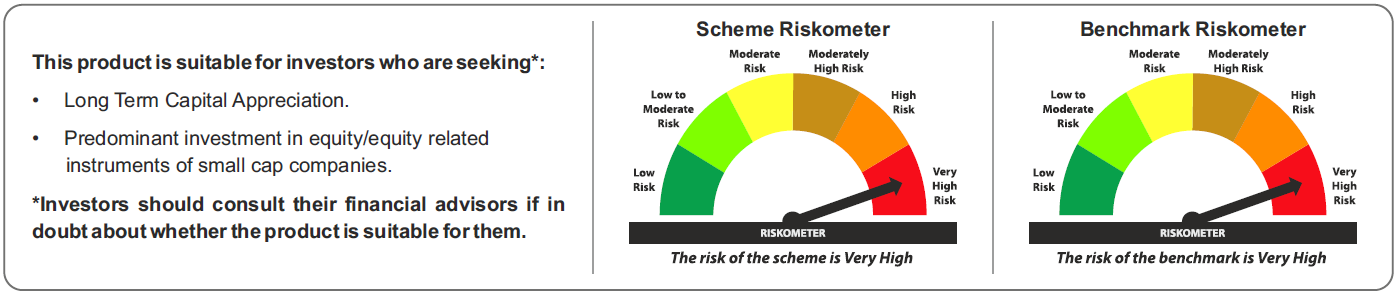
It may be noted that risk-o-meter specified above is based on internal assessment. The same shall be updated as per provision no. 17.4.1.i of SEBI Master Circular on Mutual Fund dated 27.06.2024, on Product labelling in mutual fund schemes on ongoing basis.
Tata Large and Mid-Cap Fund
An open-ended equity scheme investing in both large cap and mid cap stocks
| Risk Level | Exit Load | Benchmark |
| Very High Risk | NIL (0.50% if redeemed on or before 30 days from the date of allotment) | Nifty Large Midcap 250 TRI |
Tata Large and Mid Cap Fund is an open-ended and actively managed equity scheme that invests in both large and mid-sized companies. The fund can look for opportunities in businesses with:
Relative Stable performance
Low debt
Strong cash flows
It follows a “growth at a reasonable price” approach Also, the portfolio is flexible across s caps and not restricted to the benchmark.
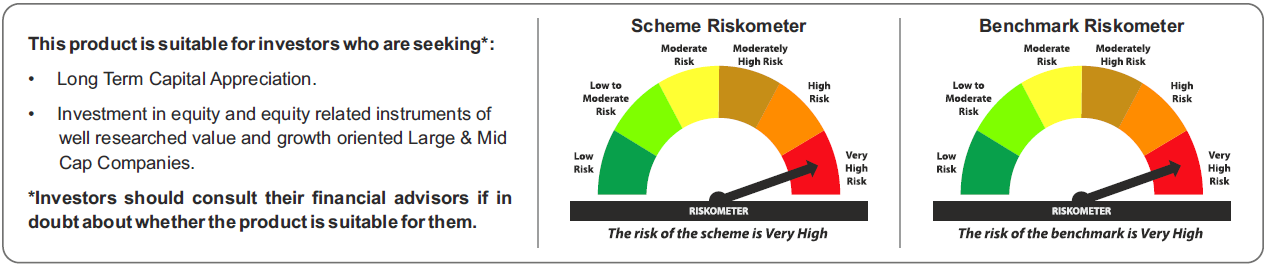
It may be noted that risk-o-meter specified above is based on internal assessment. The same shall be updated as per provision no. 17.4.1.i of SEBI Master Circular on Mutual Fund dated 27.06.2024, on Product labelling in mutual fund schemes on ongoing basis.
Tata Mid Cap Fund
An open-ended equity scheme predominantly investing in mid-cap stocks
| Risk Level | Exit Load | Benchmark |
| Very High Risk | NIL (0.50% if redeemed on or before 30 days from the date of allotment) | Nifty Midcap 150 TRI |
Tata Mid Cap Fund is an open-ended equity scheme that mainly invests in mid-sized companies with growth potential. The portfolio is built around three areas:
Sectors with strong future themes (like China +1, EVs, outsourcing, Production Linked Incentive (PLI))
Sectors with low penetration but high growth potential (like insurance, healthcare)
Cyclical sectors showing recovery (like banks and industrials)
This equity fund can prefer to invest in the potential leaders of the segment and follow a “buy and hold” approach.
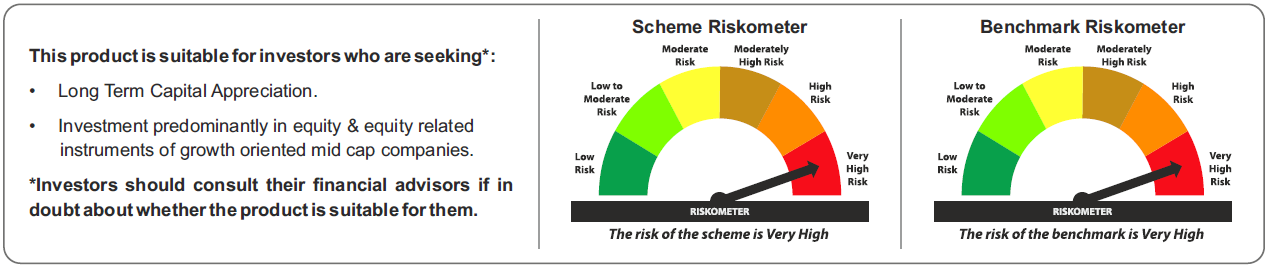
It may be noted that risk-o-meter specified above is based on internal assessment. The same shall be updated as per provision no. 17.4.1.i of SEBI Master Circular on Mutual Fund dated 27.06.2024, on Product labelling in mutual fund schemes on ongoing basis.
Conclusion
Through disciplined investing in equity mutual fund schemes, you can build a targeted corpus and accumulate potential wealth in the long term. There are various types of equity funds, such as large-cap, mid-cap, small-cap, multi-cap, flexi-cap, sectoral/thematic, value, and ELSS. You can choose among them depending on your risk appetite and investment goals.
If your focus is long-term potential wealth creation, Tata Mutual Fund offers several options. Some of these include:
Tata Large and Mid Cap Fund
Tata Mid Cap Fund
Tata Small Cap Fund
Tata Banking and Financial Services Fund (thematic)
Disclaimer:
The views mentioned above are for information & educational purposes only and do not construe to be any investment, legal or taxation advice. Investors must do their own research before investing. The views expressed in this article are personal in nature and in is no way trying to predict the markets or to time them. Any action taken by you on the basis of the information contained herein is your responsibility alone and Tata Asset Management Pvt. Ltd. will not be liable in any manner for the consequences of such action taken by you. Please consult your Mutual Fund Distributor before investing. The views expressed in this article may not reflect in the scheme portfolios of Tata Mutual Fund. There are no guaranteed or assured returns under any of the scheme of Tata mutual Fund.
*Mutual Fund Investments are subject to market risks, please read all scheme related documents carefully.
Author Bio

Akshay Kumar Rao

Loading Form...
Loading Similar Blogs...