


What is a Mutual Fund Riskometer? Learn About the Different Risk Levels
Written by Ashish Suryakant Pawar
17 Oct 2026 • 7 minutes read


The Mutual Fund Riskometer is a “speedometer” style indicator that shows how risky a mutual fund scheme is. It grades the risk level into 6 different categories, which are:
- Low
- Low to Moderate Risk
- Moderate
- Moderately High
- High
- Very High
Using the Riskometer, investors can assess whether a mutual fund scheme’s risk level aligns with their personal risk appetite/ tolerance limit.
Every mutual fund scheme carries some degree of risk, which depends on factors, such as (illustrative):
- Its underlying investments
- Market fluctuations
- Credit quality, and
- Sensitivity to interest rate changes
A Mutual Fund Riskometer considers these factors and categorises the perceived risk into six levels, ranging from “Low” to “Very High”. Want to understand in detail? Read this article to learn what a riskometer is and what its six Riskometer levels (along with colour codes) are.
Table of Content

What is a Mutual Fund Riskometer?
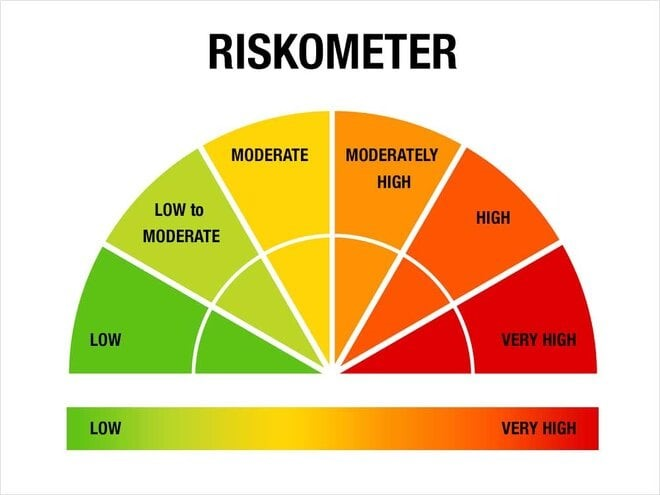
Image Credit: https://investor.sebi.gov.in/riskometer.html
A Riskometer is a “visual tool” mandated by the Securities and Exchange Board of India (SEBI) that indicates the level of risk associated with a mutual fund scheme. Designed like a car’s speedometer, it uses 6 risk categories, which range from “Low” to “Very High”.
These categories show how much risk the scheme carries. By analysing them, investors may assess whether the scheme’s risk level matches their risk appetite and investment objectives.
Note: The Riskometer does not predict how much potential return a mutual fund may generate. It only indicates the level of risk associated with the scheme’s investments.
Learn More Ways of How to Assess a Scheme’s Risk!
Read more educational blogs on various “risk metrics”, such as Sharpe Ratio, Alpha, Standard Deviation, Maximum Drawdown, and similar topics.
What are the Six Different Mutual Fund Risk Levels?
Each risk level of a mutual fund riskometer represents the “degree of risk” associated with a scheme’s investments. The categories are also colour coded (ranging from Irish Green to Red), which makes it easier to identify a scheme’s risk level.
Let’s understand them in detail:
Riskometer Level | Colour Code | What It Indicates |
Low | Irish Green |
|
Low to Moderate | Chartreuse |
|
Moderate | Neon Yellow |
|
Moderately High | Caramel |
|
High | Dark Orange |
|
Very High | Red |
|
Investors can use these categories to compare the risk levels of mutual fund schemes and assess whether a scheme’s risk profile is consistent with their:
- Risk appetite
- Investment horizon, and
- Financial objectives
However, the Riskometer only indicates the risk level of a mutual fund scheme. It does not predict or guarantee returns.
What Determines a Mutual Fund’s Riskometer Level?
a mutual fund’s Riskometer level is determined by assessing the risks associated with its underlying investments. Usually, such an assessment considers the type of assets held by the scheme and the factors that may influence their value.
Some major factors include:
- Underlying Asset Class: The scheme’s investments in different asset class such as equity shares, debt securities, gold, or overseas securities, have different risk characteristics that influence the risk assessment.
- Market Volatility: Changes in market conditions can cause fluctuations in the value of a scheme’s investments. The “extent” of these fluctuations may be considered when assessing risk.
- Credit Risk: For debt investments, credit risk refers to the possibility that an issuer may fail to pay interest or repay the principal as agreed. The credit quality of the securities held influences the scheme’s risk level.
- Interest Rate Risk: Changes in interest rates can impact the market value of debt securities. The extent of this impact may be considered when assessing the risk level of a debt mutual fund scheme.
Conclusion
So, now you know what a mutual fund Riskometer is and its six different risk levels. To recap, a Riskometer is a “speedometer-style” visual tool that indicates the risk associated with a mutual fund scheme across six categories, ranging from “Low” to “Very High”. As per SEBI guidelines, these risk levels are colour-coded as follows:
- Low Risk: Irish Green
- Low to Moderate Risk: Chartreuse
- Moderate Risk: Neon Yellow
- Moderately High Risk: Caramel
- High Risk: Dark Orange
- Very High Risk: Red
Using the Riskometer, investors can assess whether a scheme’s risk level aligns with their risk appetite. The assessment may consider factors related to the scheme’s underlying investments, including:
- Market volatility
- Credit risk, and
- Interest-rate risk, where applicable.
However, the Riskometer only indicates the assessed risk level. It does not predict or guarantee returns. Investors should consider their investment objectives and consult a financial advisor before making investment decisions.
For more information, you can visit www.tatamutualfund.com/deshkarenivesh. The Investor Service Centre of Tata Asset Management Pvt. Ltd. is located at Mulla House, Ground Floor, 51, M.G. Road, Near Flora Fountain, Mumbai – 400 001, Maharashtra. The office hours are Monday to Friday, 9:00 AM to 5:30 PM. For assistance, you can also call (022) 6282 7777 from Monday to Saturday, 9:00 AM to 5:30 PM, or email service@tataamc.com
Mutual Fund Riskometer FAQs
1. Can a mutual fund with a Low Riskometer level still lose money?
Yes, a mutual fund with a Low Riskometer level can still incur losses. The rating only indicates the scheme’s assessed risk level and is NOT a guarantee against losses.
Changes in market conditions, interest rates, or other factors can influence the value of its underlying investments and NAV (Net Asset Value).
2. Does a “Very High” Riskometer level mean a mutual fund have potential for higher returns?
No, a Very High Riskometer only indicates that the scheme carries a higher level of risk. Actual returns depend on market conditions, the scheme’s investments, and other factors.
3. Can a mutual fund’s Riskometer level change after I invest?
Yes, a scheme’s Riskometer level can change as its portfolio composition and risk characteristics change.
4. What is the difference between a “scheme” and a “benchmark” Riskometer?
The scheme Riskometer indicates the risk level of a mutual fund scheme based on its own portfolio and risk characteristics. In comparison, the benchmark Riskometer shows the risk level of the index, which is used to compare a mutual fund’s performance.
For example,
- Suppose a large cap fund uses the Nifty 50 as its benchmark.
- Now, the benchmark Riskometer shows the risk level of the Nifty 50.
- Whereas, the scheme Riskometer shows the risk level of the mutual fund scheme itself.
5. Where can I check the Riskometer of a mutual fund scheme?
You can check a scheme’s Riskometer on the mutual fund house’s official website, in its latest monthly factsheet.
Disclaimer:
An Investor Education and Awareness Initiative by Tata Mutual Fund.
To know more about KYC documentation requirements and procedure for change of address, phone number, bank details, etc., please visit: https://www.tatamutualfund.com/deshkarenivesh
Please deal only with registered Mutual Funds, details of which can be verified on the SEBI website under ‘Intermediaries / Market infrastructure institutions.’
All complaints regarding Tata Mutual Fund may be directed to service@tataamc.com and/or https://scores.sebi.gov.in/ (SEBI SCORES portal) and/or https://smartodr.in/login
Nomination is advisable for all folios opened by an individual, especially with sole holding, as it facilitates an easy transmission process.
This communication is a part of the investor education and awareness initiative of Tata Mutual Fund.
*Mutual Fund Investments are subject to market risks, please read all scheme related documents carefully.
Author Bio

Ashish Suryakant Pawar

Loading Form...
Loading Similar Blogs...