


Still Calculating Your SIP Returns Using CAGR? Understand Why XIRR May be More Appropriate
Written by Ashish Suryakant Pawar
14 Oct 2026 • 8 minutes read


XIRR (Extended Internal Rate of Return) is a measure of the “annualised return” on an investment when cash flows happen on different dates. Unlike a regular IRR (Internal Rate of Return), XIRR considers the exact amount and date of each investment, withdrawal, and final value to calculate the annual return earned.
Potentially, XIRR is suitable for SIPs, SWPs, and other investments involving periodic or irregular investments and withdrawals, as it accounts for the exact timing of each cash flow.
A SIP is not a single investment made at one point in time, so using CAGR to measure its returns can give an incorrect estimate. That’s largely because CAGR only looks at the beginning and ending values without considering when individual instalments were invested.
A potentially better option? “XIRR” factors in the exact amount and date of each cash flow and may be more appropriate for measuring the actual return earned on SIPs, SWPs, and other investments with multiple cash flows.
Read this article to understand what CAGR is in a mutual fund and why it may be misleading for SIPs. Next, learn how XIRR accounts for the timing of individual cash flows and can be a more appropriate return measure. Finally, compare CAGR vs XIRR returns through a hypothetical example.
Table of Content

What is CAGR in Mutual Funds?
The CAGR full form is “Compounded Annual Growth Rate”. It is a return metric, which assumes one inflow at the start and one value at the end. Thus, this method is designed to measure the annualised growth of a “single investment” made at the beginning of a period.
Mathematically, it can be calculated using the following CAGR formula:

Let’s understand better through an example:
- Suppose ₹1 lakh were invested as a lump sum.
- They potentially became ₹1.50 lakh after 3 years.
- Here, CAGR can be used to calculate the annualised growth as the entire ₹1 lakh was invested from the start.
- In this case, the CAGR would be:

Why CAGR Can Be Misleading for SIPs
An SIP involves multiple investments made on different dates. For example, in a monthly SIP:
- The first instalment may remain invested for almost the entire investment period.
- The next instalment remains invested for comparatively less time.
- The most recent instalment may have been invested for only a few months.
Therefore, there is no single beginning value that was invested for the entire period. Also, each instalment may also purchase mutual fund units at a different NAV.
Now, when you apply CAGR to your SIP investments, you are basically assuming that the total amount invested through SIPs is invested at the beginning of the period. This can result in an “inaccurate return percentage” because CAGR does not account for the different dates on which each SIP instalment was invested.
An instalment invested earlier has more time to earn returns than one invested later, but CAGR treats the entire invested amount as if it had been invested for the full period.
What is XIRR, an Why it May Potentially Be More Appropriate for SIPs?
XIRR is designed for investments where cash flows occur on different dates. It uses the amount and exact date of every cash flow to calculate the annualised return. Mathematically, XIRR can be calculated using the following formula:
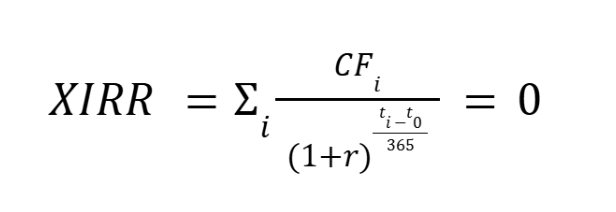
Where,
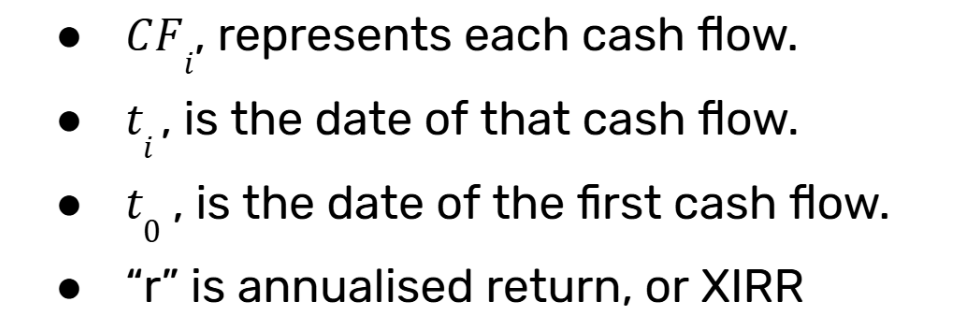
Conceptually, the XIRR formula solves for the rate “r” that makes the present value of all cash outflows and inflows equal to zero.
For an SIP, the investments are generally treated as “cash outflows”, while the final redemption value is treated as a “cash inflow”. Since XIRR considers the exact date of each SIP instalment, it is potentially an appropriate method to calculate the SIP returns.
Want to Know More Mutual Fund Concepts? Continue building your financial knowledge by reading more educational blogs on SIP return calculations, Standard Deviation, Maximum Drawdown, and similar topics. |
CAGR vs XIRR: Understand The Difference Through a Hypothetical Example
Suppose an investor invests ₹10,000 every month for 6 months and makes a total investment of ₹60,000. At the end of the sixth month, the investment is potentially worth ₹65,000.
Now, these two return methods can produce very different results since they treat the timing of the investments differently. Let’s understand in detail:
A) CAGR Calculation
CAGR assumes that the entire ₹60,000 was invested at the beginning and remained invested for the full six-month period. It can be calculated as follows:
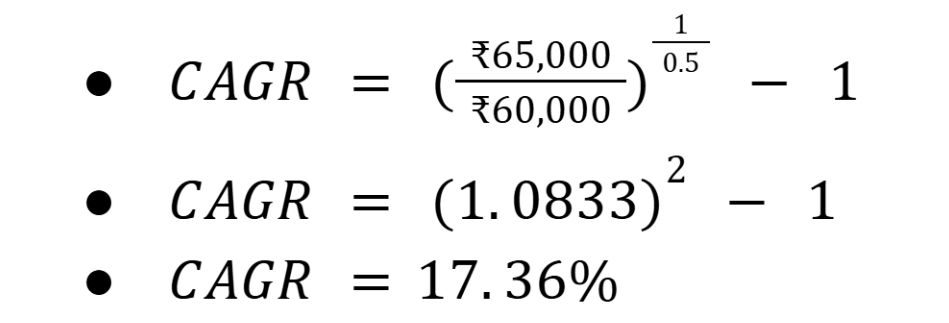
Here, 0.5 represents 6 months expressed in years.
So, using the CAGR method, the annualised return would be approximately 17.36%.
However, this calculation does not reflect the actual investment pattern. The investor did not invest ₹60,000 on Day 1.
The ₹10,000 instalments were invested one month apart. Consequently, the first instalment was invested for the longest period, while the last instalment was invested for only a short period.
B) XIRR Calculation
XIRR accounts for the exact date of every cash flow. For example, assume the six ₹10,000 SIP instalments were made on January 1, February 1, March 1, April 1, May 1, and June 1, and the final value of ₹65,000 was received on June 30.
The cash flows would be:
Date | Cash Flow |
January 1 | -₹10,000 |
February 1 | -₹10,000 |
March 1 | -₹10,000 |
April 1 | -₹10,000 |
May 1 | -₹10,000 |
June 1 | -₹10,000 |
June 30 | +₹65,000 |
In any spreadsheet software, the XIRR can be calculated using the formula “=XIRR(B2:B8, A2:A8).” Here:
- “B2:B8” contains the cash flows, including the six negative SIP investments and the positive maturity value.
- “A2:A8” contains the corresponding dates.
Using these dates and cash flows, the XIRR is approximately 31.79% per year.
An Important Observation
CAGR gives approximately 17.36%, while XIRR gives approximately 31.79%. That’s largely because XIRR recognises that the entire ₹60,000 was not invested for six months. The later SIP instalments had a much shorter investment period.
Therefore, when calculating the investor's actual annualised return, XIRR is potentially more appropriate because it matches each cash flow with the period for which that money was actually invested.
Conclusion
So, now you know what CAGR and XIRR are and which method may potentially be more appropriate for calculating SIP returns. To revise, CAGR is a “point-to-point” return method that measures the annualised growth between a beginning value and an ending value.
In contrast, XIRR calculates annualised returns by considering the amount and exact date of each cash flow. This makes the timing of investments and withdrawals part of the calculation.
Therefore, for SIPs, SWP withdrawals, or any investment involving periodic or irregular cash flows, XIRR may potentially be more appropriate. That’s largely because it accounts for when each amount was invested or withdrawn and the length of time for which it remained invested.
For more information, you can visit www.tatamutualfund.com/deshkarenivesh. The Investor Service Centre of Tata Asset Management Pvt. Ltd. is located at Mulla House, Ground Floor, 51, M.G. Road, Near Flora Fountain, Mumbai – 400 001, Maharashtra. The office hours are Monday to Friday, 9:00 AM to 5:30 PM. For assistance, you can also call (022) 6282 7777 from Monday to Saturday, 9:00 AM to 5:30 PM, or email service@tataamc.com
CAGR FAQs
1. What is the difference between CAGR and XIRR for SIP returns?
CAGR measures annualised growth between a beginning and ending value. It treats the investment as a single amount held throughout the period. In contrast, XIRR considers the amount and exact date of each cash flow.
Therefore, CAGR is potentially more suited to point-to-point investments, while XIRR is generally more appropriate for SIPs involving multiple instalments.
2. Why is CAGR not ideal for calculating SIP returns?
CAGR does not account for the timing of individual SIP instalments. It effectively treats the total invested amount as though it were invested at the beginning of the period.
Since different instalments remain invested for different durations, this assumption can produce a return percentage that does not accurately represent the investor’s actual annualised return.
3. How does XIRR account for multiple cash flows in a SIP?
XIRR uses both the amount and date of every cash flow. Each SIP instalment is treated as a separate cash “outflow”, while the redemption value is treated as an “inflow”.
XIRR then calculates the annualised rate that equates the “present value” of these cash flows by considering their different investment periods.
Disclaimer:
An Investor Education and Awareness Initiative by Tata Mutual Fund.
To know more about KYC documentation requirements and procedure for change of address, phone number, bank details, etc., please visit: https://www.tatamutualfund.com/deshkarenivesh
Please deal only with registered Mutual Funds, details of which can be verified on the SEBI website under ‘Intermediaries / Market infrastructure institutions.’
All complaints regarding Tata Mutual Fund may be directed to service@tataamc.com and/or https://scores.sebi.gov.in/ (SEBI SCORES portal) and/or https://smartodr.in/login
Nomination is advisable for all folios opened by an individual, especially with sole holding, as it facilitates an easy transmission process.
This communication is a part of the investor education and awareness initiative of Tata Mutual Fund.
*Mutual Fund Investments are subject to market risks, please read all scheme related documents carefully.
Author Bio

Ashish Suryakant Pawar

Loading Form...
Loading Similar Blogs...