


A Mutual Fund NAV is ₹20, and Another is ₹500: Does a Lower NAV Mean a Cheaper Fund?
Written by Ashish Suryakant Pawar
19 Oct 2026 • 8 minutes read


The NAV full form is Net Asset Value. It represents the “per unit” value of a mutual fund scheme and is calculated by dividing its net assets by the total number of units outstanding. A higher or lower NAV does not indicate whether a scheme is better, undervalued, or overvalued.
A mutual fund with an NAV of ₹20 is not necessarily a better bargain than one with an NAV of ₹500. Yet, many investors mistake a lower NAV for:
- A lower investment cost
or
- Greater potential for returns
To assess mutual funds correctly, it is important to understand what NAV actually represents and how it is calculated. Read this article to first understand what mutual fund NAV is and its formula. Next, understand why NAV alone cannot determine whether a mutual fund is cheap, expensive, or suitable for investment.
Table of Content

NAV is the value of “one unit” of a mutual fund scheme. As per SEBI Master Circular for Mutual Funds, dated March 20, 2026, Chapter 9, Section 9.1.2, specifies that NAV is calculated by:
- Adding the market or fair value of scheme investments and current assets
- Subtracting current liabilities and provisions from these “gross assets”, and finally
- Dividing the result by units outstanding on the valuation date. (Source: SEBI Circular, dated March 20, 2026).
Mathematically, this can be represented using the following formula:

Where,
- “Investments” are the current fair value of securities held by the scheme.
- “Current Assets” represent cash, accrued interest, dividends receivable, and other similar-nature assets.
- “Liabilities and Provisions” represent expenses payable, amounts owed, and provisions created for expenses.
- “Units Outstanding” represent the total units held by investors in the scheme.
SEBI requires index funds and debt-oriented schemes to round NAV to “four” decimal places. Other schemes may round the NAV to “two” decimal places, although they may disclose additional decimal places if the relevant disclosure requirements are met. (Source: SEBI Circular, dated March 20, 2026).
To gain more clarity, let’s study an example.
Hypothetical Example Related to the Calculation of NAV
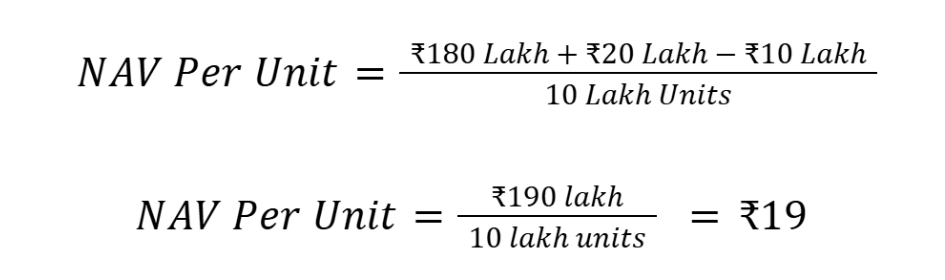
Suppose a mutual fund scheme has the following financial details on a valuation date:
Fair Market Value (FMV) of Investments | Current Assets | Liabilities and Provisions | Units Outstanding |
₹180 lakh | ₹20 lakh | ₹10 lakh | 10 lakh units |
Now, its NAV could be:
Keep Improving Your Financial Terminology? Read more educational blogs on NAV, CAGR, XIRR, expense ratios, and various return + risk metrics. |
To several investors, a mutual fund with an NAV of ₹10 or ₹20 appears cheaper than one with an NAV of ₹100 or ₹500. However, a lower NAV does not indicate a mutual fund is undervalued, just as a higher NAV does not represent it is overvalued.
Two schemes with similar portfolios (and net assets) can have different NAVs just because they have different numbers of units outstanding. If a scheme has a lower NAV:
- It only shows that investors may receive more units for the same investment amount.
- It DOES NOT mean they receive greater value or that the scheme has more potential to generate returns.
For a better understanding, let’s consider the following example.
Hypothetical Example
Suppose two mutual fund schemes have net assets worth ₹1 crore each. However, the outstanding units of Scheme A are 10 lakh units, whereas for Scheme B, these are 1 lakh units.
Now, let’s see how dividing the same net assets among different numbers of outstanding units results in different mutual fund NAVs:
A) Different NAVs of Identical Funds
Particulars | Scheme A | Scheme B |
Net Assets (A) | ₹1 crore | ₹1 crore |
Units Outstanding (B) | 10 lakh | 1 lakh |
NAV Per Unit (AB) | ₹10 | ₹100 |
So, you can observe that Scheme A has an NAV of ₹10, while Scheme B has an NAV of ₹100, even though both have similar net assets of ₹1 crore.
B) Similar Economic Worth of Investments
In continuation with the above example, now let’s assume you make an investment of ₹10,000 in both the schemes:
Particulars | Scheme A | Scheme B |
Investment amount (A) | ₹10,000 | ₹10,000 |
NAV per unit (B) | ₹10 | ₹100 |
Units Allotted (AB) | 1,000 units | 100 units |
Although Scheme A provides 1,000 units and Scheme B provides only 100, both investments are worth ₹10,000. Thus, the difference only lies in the number of units allotted and not in the economic value received.
C) Similar % Gain When the NAV Increases
Now, suppose the underlying portfolios of both schemes appreciate by 10%. Scheme A's NAV rises to ₹11, while Scheme B's NAV rises to ₹110.
Particulars | Scheme A | Scheme B |
New NAV (A) | ₹11 | ₹110 |
Units Held (B) | 1,000 | 100 |
Investment Value (A x B) | ₹11,000 | ₹11,000 |
Potential Gain | ₹1,000 (10%) | ₹1,000 (10%) |
You can observe that both investments generate the same percentage return of 10%, with a gain of ₹1,000 each. Therefore, a lower NAV does not give Scheme A an advantage over Scheme B in terms of returns.
Conclusion
So, now you know that a mutual fund scheme with an NAV of ₹20 is not necessarily cheaper or undervalued compared with a scheme with an NAV of ₹500. If we were to revise, NAV is calculated by dividing the net assets of a mutual fund scheme by its outstanding units. It measures the “value per unit” and not the attractiveness of the investment.
As demonstrated in the examples above, two schemes can have different NAVs but generate similar percentage returns (when their portfolios perform identically).
A lower NAV may result in more units being allotted for the same investment amount, but it does not guarantee higher returns or greater investment value.
Therefore, comparing mutual funds solely by their NAVs is not a sound way to assess their relative attractiveness. Instead, investors may assess:
- Portfolio composition
- Investment strategy
- Scheme and Benchmark riskometer, and
- Performance against an appropriate benchmark.
For more information, you can visit www.tatamutualfund.com/deshkarenivesh. The Investor Service Centre of Tata Asset Management Pvt. Ltd. is located at Mulla House, Ground Floor, 51, M.G. Road, Near Flora Fountain, Mumbai – 400 001, Maharashtra. The office hours are Monday to Friday, 9:00 AM to 5:30 PM. For assistance, you can also call (022) 6282 7777 from Monday to Saturday, 9:00 AM to 5:30 PM, or email service@tataamc.com
1. Why are liabilities subtracted when calculating NAV?
Liabilities represent amounts the mutual fund scheme owes or the expenses and obligations for which provisions have been made. These amounts reduce the scheme's net assets. For example,
- Suppose a scheme has total assets of ₹100 crore and liabilities + provisions of ₹5 crore.
- Now, its net assets amount to ₹95 crore
This net asset value is then divided by the total units outstanding to calculate NAV per unit.
2. Is it better to invest in a mutual fund with a lower NAV?
By investing in a mutual fund scheme with a lower NAV, investors may receive more units for the same investment amount. A low NAV does not indicate the scheme is better, undervalued, or has greater potential to generate returns.
3. Can two mutual fund schemes with similar net assets have different NAVs?
Yes, it can happen if both the schemes have different numbers of outstanding units. For example,
- Suppose two schemes have net assets of ₹10 crore each.
- Now, a scheme with 20 lakh units will have an NAV of ₹50, while a scheme with 50 lakh units will have an NAV of ₹20.
The difference in NAV does not indicate that one scheme is cheaper or offers better returns.
Disclaimer:
An Investor Education and Awareness Initiative by Tata Mutual Fund.
To know more about KYC documentation requirements and procedure for change of address, phone number, bank details, etc., please visit: https://www.tatamutualfund.com/deshkarenivesh
Please deal only with registered Mutual Funds, details of which can be verified on the SEBI website under ‘Intermediaries / Market infrastructure institutions.’
All complaints regarding Tata Mutual Fund may be directed to service@tataamc.com and/or https://scores.sebi.gov.in/ (SEBI SCORES portal) and/or https://smartodr.in/login
Nomination is advisable for all folios opened by an individual, especially with sole holding, as it facilitates an easy transmission process.
This communication is a part of the investor education and awareness initiative of Tata Mutual Fund.
*Mutual Fund Investments are subject to market risks, please read all scheme related documents carefully.
Author Bio

Ashish Suryakant Pawar

Loading Form...
Loading Similar Blogs...