


IDCW Payout vs Growth Plan: Which Option Can Accumulate a Higher Potential Corpus?
Written by Ashish Suryakant Pawar
19 Oct 2026 • 7 minutes read


Under the Growth Plan, the scheme retains its earnings, which remain invested and exposed to market fluctuations. These earnings may potentially compound and lead to a comparatively higher corpus than an IDCW Payout Plan, where a portion of the distributable surplus is paid out to investors.
When investing in mutual funds, choosing between an “IDCW Payout” and a “Growth Plan” can influence how returns accumulate.
- In an IDCW, the scheme may distribute a portion of its distributable surplus to investors.
- Whereas in a Growth Plan, the scheme may retain earnings, allowing them to potentially compound over time.
But under which option can you build a larger corpus? Read this article to first learn what IDCW and growth plan in mutual funds are, and then see how these approaches influence the potential value of an investment over time.
Table of Content

What is IDCW Payout in Mutual Funds?
IDCW full form is Income Distribution cum Capital Withdrawal. Effective April 1, 2021, SEBI replaced the earlier “Dividend Option” in mutual fund schemes with IDCW. (Source: SEBI Circular - Review of Dividend Option)
Under the IDCW Payout option, a mutual fund scheme may distribute a portion of its “distributable surplus” to investors, subject to the scheme’s provisions and the fund manager’s decision. This distributable amount may arise from the following sources:
Source | Explanation |
Income Earned By the Scheme |
|
Realised Capital Gains |
|
Capital Invested in the Scheme |
|
However, an IDCW payout should not be considered an additional return earned by the investor. When the scheme distributes IDCW, the NAV is usually reduced by the amount distributed. As a result, the investor receives the IDCW amount in their bank account, while the value of their remaining mutual fund investment decreases.
Continue Building Your Financial Knowledge? Read more educational blogs to understand different mutual fund concepts, such as NAV, compounding, portfolio diversification, CAGR, XIRR, and similar topics. |
What is a Growth Plan in Mutual Funds?
A growth plan in mutual funds is an investment option in which the income and gains earned by the scheme are retained within the fund instead of being distributed to investors as IDCW. These earnings remain invested in the scheme and contribute to its portfolio value, which is reflected in the Net Asset Value (NAV).
Investors generally realise returns by redeeming their units at the prevailing NAV, subject to applicable charges and taxes. However, returns are not guaranteed, and the investment value may also decline due to market movements.
IDCW vs Growth Plan: How Do They Differ?
The primary difference lies in how a mutual fund scheme handles its distributable surplus. While an IDCW Payout Plan may distribute a portion of the surplus to investors, a Growth Plan retains the scheme’s earnings within the fund.
Neither option guarantees returns, and the choice depends on an investor’s cash flow requirements and investment objectives. To gain more clarity, let’s check out a detailed IDCW vs Growth Plan comparison:
Basis of Difference | IDCW Payout Plan | Growth Plan |
Treatment of Earnings | The scheme may distribute a portion of its distributable surplus to investors. | The scheme retains its earnings within the fund. |
Cash Flow to Investors | Investors may receive periodic distributions, subject to the availability of distributable surplus and the fund’s decision to distribute it. | Investors generally receive money by redeeming units. The scheme does not distribute its surplus under this option. |
NAV (Net Asset Value) | The NAV generally falls by the amount distributed | Earnings retained in the scheme contribute to its portfolio value and are reflected in the NAV, subject to market movements and expenses. |
Compounding | The amount distributed no longer remains invested in the scheme. Compounding on that amount stops unless it is reinvested. | Earnings remain invested in the scheme, and may potentially compound. |
How Returns are Received | Through direct monetary distributions | Primarily through the appreciation in unit value. It is realised when units are redeemed. |
Which Option Between IDCW Payout and Growth Plan Can Accumulate a Higher Potential Corpus?
Under an IDCW Plan, the mutual fund scheme pays out a portion of its distributable surplus to investors. If investors “do not reinvest” these payouts, the distributed amount no longer contributes to compounding within the scheme.
Consequently, the investment may accumulate a lower corpus than the Growth Plan of the same mutual fund scheme over the same period. To illustrate this difference, let’s consider an example.
Hypothetical Example
Investment Amount | Assumed Annual Rate of Return | Investment Period |
₹5,00,000 | 10% p.a. | 10 years |
1. Growth Plan
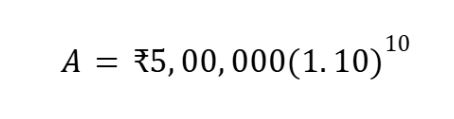
Under the Growth Plan, the scheme retains its earnings and allows the investment to benefit from potential compounding. Using the compound interest formula:
Now, the potential value after 10 years could have been ₹12,96,871 with an approximate gain of ₹7,96,871.
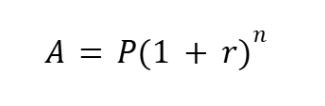
Where:
- P = ₹5,00,000
- r = 10% or 0.10
- n = 10 years
2. IDCW Plan
Let’s assume that the scheme distributes/pays out all its annual investment gains. Now, if the investment earns 10% p.a. on an original investment value of ₹5,00,000, the investor may receive ₹50,000 annually. The remaining investment would stay at approximately ₹5,00,000.
IDCW vs Growth Plan: The Return Potential
Particulars | Growth Plan | IDCW Plan (Illustrative Assumption*) |
Initial Investment | ₹5,00,000 | ₹5,00,000 |
Investment Value After 10 Years | ₹12,96,871 | ₹5,00,000 |
Total Distributions Received | ₹0 | ₹5,00,000 |
Total Value (Investment + Distributions) | ₹12,96,871 | ₹10,00,000 |
*For illustration purposes, it has been assumed that IDCW distributions are equal to the scheme's annual gains.
Disclaimer: This example is provided only for educational purposes. The assumed annual rate of return of 10% and the IDCW distribution of ₹50,000 per year are illustrative and are not guaranteed. Actual returns, IDCW distributions, and investment values may vary depending on market conditions and the scheme's performance. This illustration does not represent actual or expected returns from any mutual fund scheme.
Conclusion
So now you know what IDCW Payout and Growth Plans are in mutual funds. If we were to revise, “IDCW Payout” is an option under which a mutual fund scheme may distribute a portion of its distributable surplus to investors.
In contrast, a Growth Plan retains the scheme’s earnings within the fund instead of distributing them to investors. Due to such retention, these earnings may potentially compound over time and contribute to a higher investment corpus.
Consequently, a Growth Plan may accumulate a potentially higher corpus than an IDCW Payout Plan over the same investment period, particularly when IDCW distributions are not reinvested.
However, neither option guarantees returns, and actual outcomes depend on the scheme’s performance, distribution decisions, and market conditions.
For more information, you can visit www.tatamutualfund.com/deshkarenivesh. The Investor Service Centre of Tata Asset Management Pvt. Ltd. is located at Mulla House, Ground Floor, 51, M.G. Road, Near Flora Fountain, Mumbai – 400 001, Maharashtra. The office hours are Monday to Friday, 9:00 AM to 5:30 PM. For assistance, you can also call (022) 6282 7777 from Monday to Saturday, 9:00 AM to 5:30 PM, or email service@tataamc.com
IDCW vs Growth Plan FAQs
1. Is IDCW income guaranteed in mutual funds?
No, IDCW income is NOT a guaranteed payout. A mutual fund scheme may distribute a portion of its distributable surplus, subject to the scheme’s provisions and the fund manager’s decision.
The amount and frequency of distributions may vary, and there could be situations when a scheme does not declare IDCW.
2. Does the NAV decrease after an IDCW payout?
As per general market understanding, the NAV may decrease by an amount corresponding to the IDCW distribution, subject to market movements and other factors.
Consequently, investors receive the declared distribution, but the value of their remaining investment may reduce accordingly.
3. Can investors switch from an IDCW Payout Plan to a Growth Plan in Mutual Funds?
Investors can generally switch between IDCW and Growth options within the same mutual fund scheme, subject to the scheme’s provisions.
However, a switch is usually treated as a “redemption” from the existing option and a fresh investment in the other option. Thus, capital gains tax and applicable exit loads may apply.
Disclaimer:
An Investor Education and Awareness Initiative by Tata Mutual Fund.
To know more about KYC documentation requirements and procedure for change of address, phone number, bank details, etc., please visit: https://www.tatamutualfund.com/deshkarenivesh
Please deal only with registered Mutual Funds, details of which can be verified on the SEBI website under ‘Intermediaries / Market infrastructure institutions.’
All complaints regarding Tata Mutual Fund may be directed to service@tataamc.com and/or https://scores.sebi.gov.in/ (SEBI SCORES portal) and/or https://smartodr.in/login
Nomination is advisable for all folios opened by an individual, especially with sole holding, as it facilitates an easy transmission process.
This communication is a part of the investor education and awareness initiative of Tata Mutual Fund.
*Mutual Fund Investments are subject to market risks, please read all scheme related documents carefully.
Author Bio

Ashish Suryakant Pawar

Loading Form...
Loading Similar Blogs...