


What is a Value Mutual Fund? Strategy, Risks, and Who Should Invest
Written by Akshay Kumar Rao
24 Feb 2026 • 7 minutes read


Market movements often push some stocks into the spotlight while others fall out of favour, even when their underlying businesses remain strong. This is where a value fund approach becomes relevant, focusing on potential opportunities created by market mispricing rather than momentum.
Before considering a value mutual fund, it’s important to understand how the strategy works, the risks involved, and which investors it may suit within a long-term portfolio.
Table of Content

What are Value Funds?
SEBI defines a value mutual fund as an open-ended equity scheme that follows a value investment strategy and invests at least 65% of its portfolio in equity and equity-linked instruments.
This means that value mutual funds invest in undervalued stocks. These are stocks trading at a discount to their intrinsic value or at prices that don’t truly reflect their true worth. Value funds believe these stocks may be undervalued due to various market factors but have strong fundamentals and the potential for future growth.
Understanding the Value Fund Investment Strategy
Value funds use the key tenets of a value investing strategy to select stocks for investment. So, it’s important that you understand this strategy clearly first.
Value investing was pioneered by Benjamin Graham (often called the father of value investing) and popularised by investors like Warren Buffett. Graham believed that stock prices can often fluctuate irrationally and may not reflect their intrinsic value.
According to value investors, the market may occasionally misprice stocks, failing to recognise their true value and potential. When that happens, the idea is to pick overlooked stocks with strong fundamentals and hold them until the market pricing aligns with their perceived true values to book profits.
Here are the core elements of a value investment strategy:
Identifying stocks trading below intrinsic value
Analysing price-to-earnings and price-to-book ratios
Assessing earnings stability and cash flows
Evaluating debt levels and balance sheet strength
Looking for recovery or turnaround potential
So, value mutual fund managers also use this strategy to select stocks for the scheme. They focus on businesses that may be temporarily overlooked but have sustainable long-term prospects.
Note: Every value mutual fund has a distinctive investment strategy. Please read the Scheme Information Document carefully to understand these details before investing.
Key Features of a Value Mutual Fund
Now that you understand the meaning of value mutual funds, let’s have a look at their key features:
1. Focus on the Fundamentals
As mentioned earlier, thorough fundamental analysis is a key aspect of the value investing strategy. That’s why value funds rely on a detailed fundamental analysis to identify which companies have:
Strong business models
Healthy balance sheets
Sustainable earning
In short, the fund’s stock selection decision is based on the business quality and future potential rather than short-term price momentum.
2. Search for Reasonable Valuations
Value funds seek stocks trading at relatively reasonable valuations. That’s how these funds aim to build a margin of safety, which may be helpful during periods of market correction.
3. Portfolio Diversification
Another key feature of value mutual funds is portfolio diversification. These funds typically invest across sectors and market capitalisations to spread risk rather than relying on a single theme or trend. By selecting undervalued opportunities across industries, value funds aim to reduce concentration risk while maintaining a valuation-focused approach.
4. Potential for Long-Term Wealth Creation
Value mutual funds aim to buy undervalued stocks at their current discount price and hold them until the market re-prices them once it recognises their true potential. The fund aims to profit from the price difference. But since such re-rating can take a long time, value funds typically focus on potential long-term wealth creation.
Why Do Investors Choose Value Funds?
There may be several potential advantages of investing in value mutual funds. Here’s are some that make investors choose value funds:
Potential for Return
Value funds can potentially deliver returns when the prices of the undervalued stocks they invest in rise as the market recognises their true worth.
Safety Margin
Value investing is built on the concept of a margin of safety—buying stocks at prices below their estimated intrinsic value. By investing in companies that are already trading at relatively reasonable valuations, value funds aim to limit downside risk compared to overpriced stocks. While this does not eliminate risk, it tries to provide a cushion if market conditions turn volatile.
Capitalising on Missed Opportunities
Value funds can help you find potential opportunities in overlooked stocks. If the fund manager chooses the right stocks and they perform well, the potential for long-term growth can be optimistic.
Risks Associated with Value Mutual Funds
While value funds seek to limit downside risk to an extent, they are not completely risk-free. There are several risks associated with value mutual funds, which you should understand before investing in them:
Delayed Market Recognition
The potential returns from value funds depend on the market recognising the true worth of the undervalued stocks. But if the market takes longer than expected to do so, the fund may underperform.
Short-Term Volatility
This is one of the key risks associated with value funds. Since value funds may invest in companies that are out of step with current themes or trends (and therefore underpriced), they may experience short-term volatility and further price declines.
Value Traps
Value traps occur when a stock appears to be a bargain because of low valuation metrics but continues to decline. The truth is that not all undervalued companies eventually recover. Some continue to lose value due to factors such as debt, long-term business deterioration, and poor management decisions. Even with detailled assessment, a value fund may pose the risk of investing in such value traps.
Cyclical Performance
The value investing strategy may perform better when the market is slow and shows a bearish trend. But it may lag during bull runs when growth stocks tend to rally. This cyclical nature of value funds also poses a risk to returns.
Who Should Invest in Value Funds?
A value mutual fund may be suitable for investors who:
Have a long-term investment horizon
Are comfortable with short-term market volatility
Understand cyclical performance differences
Prefer valuation-driven investing
Seek diversification across investment styles
Investors having very high risk appetite
But value funds may not be suitable for all investors. They may not be ideal for:
Short-term investors
Those seeking quick returns
Investors who are uncomfortable with temporary underperformance
Those with low risk appetite
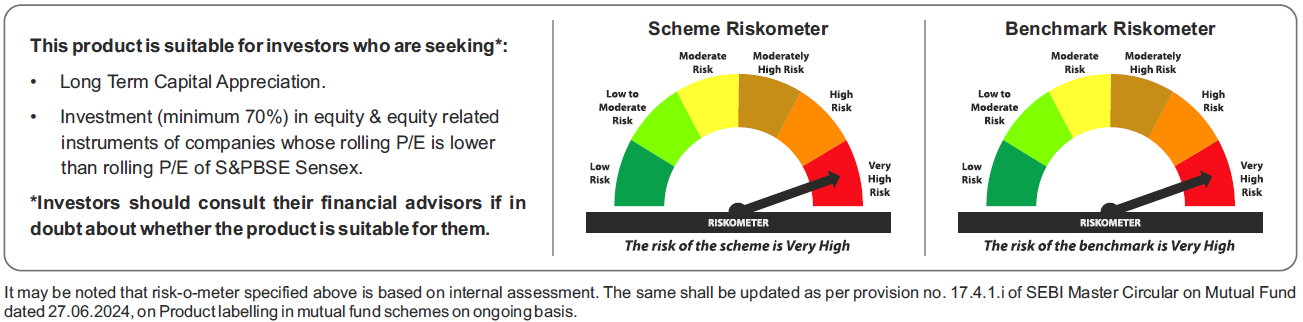
Tata Value Fund: An Example
(An open-ended equity scheme following a value investing strategy)
| Exit Load | Benchmark | Scheme Riskometer | Benchmark Riskometer |
| Nifty 500 TRI | Very High Risk | Very High Risk |
The investment objective of the Tata Value Fund scheme is to provide reasonable and regular income and/or possible capital appreciation to its Unitholder. However, there is no guarantee or assurance that the scheme’s objectives will be achieved. The scheme does not assure or guarantee any returns
Here are a few highlights of how the Tata Value Fund operates:
The Tata Value Fund follows a value investing strategy for portfolio management.
The scheme seeks to identify undervalued companies in the market.
It predominantly invests in companies with a rolling P/E lower than the BSE Sensex's (The company itself may or may not be part of the BSE Sensex).
The Tata Value Fund can also invest in equity shares of other companies (up to 30%) and in debt and money market instruments (up to 20%).
Conclusion
So now you know all about value mutual funds, their investing strategy, benefits, risks, and suitability. The key thing to remember about value funds is that they are not about chasing what is popular in the market right now. Instead, it is about trusting strong fundamentals and staying patient, because value-investing outcomes typically take time.
If the fund manager’s strategy works, then value funds aim to offer:
Long-term growth potential
Diversification benefits
So, the bottom line is that you need to evaluate your own risk appetite, investment goals, and investment strategy alignment before deciding if value funds work for you.
Disclaimers:
The views mentioned above are for information & educational purposes only and do not construe to be any investment, legal, or taxation advice. Investors must do their own research before investing. The views expressed in this article are personal in nature and in is no way trying to predict the markets or to time them. Any action taken by you on the basis of the information contained herein is your responsibility alone, and Tata Asset Management Pvt. Ltd. will not be liable in any manner for the consequences of such action taken by you. Please consult your Mutual Fund Distributor before investing. The views expressed in this article may not reflect in the scheme portfolios of Tata Mutual Fund. There are no guaranteed or assured returns under any of the schemes of Tata Mutual Fund.
*Mutual Fund Investments are subject to market risks, please read all scheme related documents carefully.
Author Bio

Akshay Kumar Rao

Loading Form...
Loading Similar Blogs...