


What is a Corporate Bond Fund? – Benchmark, Features and Benefits
Written by Akshay Kumar Rao
26 Sep 2025 • 9 minutes read


Debt mutual funds form an important category for investors seeking exposure to fixed-income instruments rather than equities. Within this space, corporate bond funds are a distinct type of scheme that primarily invests in bonds issued by companies with AA+ and above credit ratings. These funds are designed to balance relative stability with the income opportunity, making them an effective way to diversify a portfolio within fixed-income assets.
In this article, we explore what corporate bond funds are and focus on their features, benefits, risks, and benchmarks in detail.
Table of Content

What is a Corporate Bond Fund?
A corporate bond fund is a category of debt mutual fund that invests mainly in bonds issued by companies. Regulations require that at least 80% of its assets be allocated to corporate bonds with credit ratings of AA+ or above. These bonds are typically issued by large, established businesses looking to raise funds for purposes such as managing working capital, refinancing debt, or meeting operational needs.
Since these corporate bonds carry a high credit rating, they are generally considered to have lower credit risk, and the likelihood of default by the issuer is relatively reduced. However, credit ratings are not guarantees, and these funds remain subject to market risk, interest rate movements, and potential downgrades in the creditworthiness of issuers, which could impact returns.
How Do Corporate Bond Funds Work?
Corporate debt funds collect money from investors and allocate it to a basket of corporate bonds. These funds primarily generate value in two ways:
Interest Accruals: Bonds pay periodic interest (coupon), which contributes to income for the fund.
Price Changes: Bond values may fluctuate depending on interest rate movements and credit events.
Thus, corporate bond mutual fund returns are market-linked and can vary with rate cycles and credit outlook. Investors do not receive any guaranteed income but rather share in the overall performance of the scheme.
Features of Corporate Bond Mutual Funds
Regulated Allocation: As per SEBI, these funds are mandated to invest at least 80% of their assets in corporate bonds rated AA+ or above. This ensures a focus on creditworthy issuers and adherence to SEBI’s guidelines.
Diversification: Corporate bond mutual funds generally spread investments across issuers and sectors. This can help reduce concentration in any single borrower or industry, lowering overall portfolio risk while maintaining exposure to multiple opportunities.
Professional Management: Fund managers actively monitor credit ratings, interest rate movements, and sector outlooks. Their expertise can help maintain an optimized balance between risk and potential income.
Liquidity: Being open-ended, these funds allow investors to enter or exit at NAV-based prices on business days. This flexibility provides access to invested money, subject to any applicable exit load.
Choice of Plans/Options: Investors can choose between direct and regular plans, as well as growth or IDCW (Income Distribution cum Capital Withdrawal) options. These variations help align the scheme with different investment preferences.
Benefits of Corporate Debt Funds
Higher Income Potential: Corporate bond funds invest primarily in bonds offering higher coupon rates compared to traditional deposits or government securities. Alongside interest accrual, investors may also experience capital appreciation if bond prices rise in secondary markets.
Easy Liquidity: These funds generally allow redemptions on business days at prevailing NAV, making them more liquid than directly holding bonds. However, investors should note that an exit load may apply as mentioned in offer document of scheme (SID/KIM) for early withdrawals.
Comparatively Lower Credit Risk: By regulation, corporate bond mutual funds allocate most of their portfolio to highly rated securities. This reduces the risk of default compared to lower-rated bonds, though delays or downgrades are still possible.
Variety of Options: Investors can access corporate bond funds of different maturity tenures and credit exposures. This flexibility allows them to align choices with financial goals, ranging from short-term to longer investment horizons.
Risks in Corporate Bond Fund Investments
Even if corporate bond funds are exposed to certain risks, investors should be aware of these risks before investing in a corporate bond mutual fund:
Interest Rate Risk: Corporate bond funds are sensitive to interest rate changes. When rates rise, bond prices generally fall, reducing NAV. Longer-duration portfolios are typically more exposed compared to short-term allocations.
Credit Risk: Even though these funds invest mostly in highly rated issuers, a downgrade or default can impact NAV and returns. Credit events affect fund performance, though regulatory norms help mitigate concentrated exposure to single issuer.
Liquidity Risk: In stressed market conditions, trading activity in bonds may reduce, making it harder to buy or sell securities at favorable prices. This limited liquidity can temporarily affect NAV movements.
Market Risk: Bond prices may fluctuate due to economic conditions, political changes, or shifts in global trends. Such volatility can influence NAV in the short term, though long-term fundamentals may differ.
Benchmarks for Corporate Bond Funds
A benchmark is a standard index that represents the performance of a specific market segment. For corporate bond funds, it acts as a reference point to assess how the scheme has performed against a comparable set of securities. Benchmarks help investors understand whether fund returns are in line with, above, or below the broader market trend. They also provide context for evaluating risk-adjusted performance and consistency over time.
Commonly used benchmarks for corporate bond mutual funds in India include:
NIFTY Corporate Bond Index A-IICRISIL Corporate Debt A-II Index
Source: AMFI India List of Benchmark Indices
Who May Consider Corporate Bond Funds?
Corporate bond mutual funds may suit:
Investors seeking a fixed-income allocation in their portfolios.
Those comfortable with market-linked returns and moderate risk.
Investors with a short- to medium-term horizon.
Individuals aiming for diversification beyond traditional bank deposits.
Tata Corporate Bond Fund: An Example
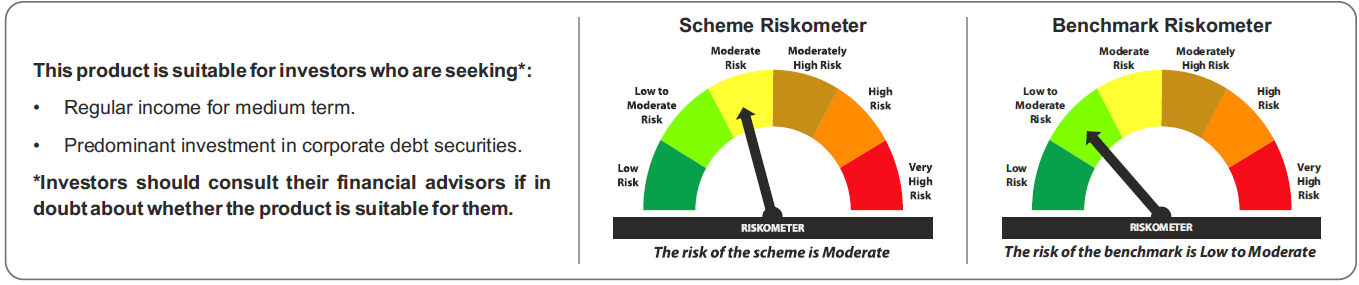
| Exit Load | Benchmark | Scheme Riskometer | Benchmark Riskometer |
| NIL | CRISIL Corporate Bond A-II Index | Moderate Risk | Low to Moderate Risk |
The Tata Corporate Bond Fund is an open-ended debt scheme that invests mainly in corporate bonds with a credit rating of AA+ or above. The investment strategy of the fund focuses on generating accrual-based income over the short to medium term, while also exploring opportunities across the credit curve when market conditions permit. In addition to corporate bonds, the scheme may allocate a portion of assets to money market instruments, REITs, InvITs, and other debt-related securities for diversification and liquidity management.
Key Highlights of Tata Corporate Bond Fund:
Fund Type: (An open-ended debt scheme predominantly investing in AA+ and above rated corporate bonds, with flexibility of any Macaulay Duration and relatively high interest rate risk and moderate credit risk. Pursuant to SEBI approval dated April 26, 2024 Tata Banking PSU Debt Fund is merged with Tata Corporate Bond Fund w.e.f. June 15, 2024)
Fund Objective:
The investment objective of the scheme is to generate returns over short to medium term by investing predominantly in corporate debt instruments.
Asset Allocation:
80%–100% in AA+ and above-rated corporate bonds .
0%–20% in other debt and money market instruments .
0%–10% in units of REITs and InvITs
Bond Selection:
Active selection of securities based on credit rating history, financial strength of issuers, governance standards, liquidity, and prevailing interest rate trends.

Disclaimer: The Potential Risk Class (PRC) Matrix is in terms of provision no. 17.5 of the SEBI Master circular on Mutual Fund dated June 27, 2024.
The Role of Debt Funds in Building a Well-Diversified Portfolio: A Guide for Indian Investors

Conclusion
A corporate bond fund is a SEBI-defined debt mutual fund category focusing on highly rated corporate issuers. These funds aim to offer relative stability, diversification, and accessibility within fixed-income investments, though they remain subject to market risks.
The Tata Corporate Bond Fund is one such scheme in this category that’s structured to invest predominantly in rated bonds. Investors evaluating corporate bond mutual funds may consider such schemes as part of their overall allocation strategy, keeping in mind their financial goals, risk appetite, and investment horizon.
*Mutual Fund Investments are subject to market risks, please read all scheme related documents carefully.
Author Bio

Akshay Kumar Rao

Loading Form...
Loading Similar Blogs...