


Want to Benefit from India’s Growing Economy? Learn How Mid-Cap Funds Can Help You in 2026?
Written by Akshay Kumar Rao
04 Feb 2026 • 7 minutes read


Recent surveys and research reports show that India’s economy is expected to grow strongly in the coming years. By 2027, India is projected to reach a GDP of ₹4,26,45,000 crore, or about US$5 trillion, and is likely to overtake Germany by 2028. By 2030, India may become the world’s third-largest economy with a GDP of $7.3 trillion.
Source: Press Information Bureau (PIB).
Similar views were echoed by SBI Research, stating that India could reach $5 trillion by FY28 and $10 trillion by FY36. Want to benefit from India’s impressive economic growth? In 2026, you may consider investing in India’s small and medium-sized businesses (SMEs) of the country’s $5 trillion economy.
But how? Mid-cap mutual funds can be one of the preferred route in 2026. Read this article to first understand the mid-cap fund meaning and then check out its several benefits. Lastly, you will learn about the Tata Mid-Cap Fund and its primary features.
Table of Content

What are Mid-Cap Mutual Funds?
A mid-cap fund is a type of equity scheme that invests at least 65% of its total assets in equity and equity-related instruments of mid-cap companies. In India, these companies are defined by SEBI as those ranked from 101st to 250th based on their total market value (market capitalisation).
The remaining 35% of the fund’s assets can be invested in:
Large-cap stocks for relative stability
Small-cap stocks for growth potential
Debt instruments, such as bonds or money market instruments, to reduce volatility
Cash or cash equivalents to manage liquidity or market uncertainty
SEBI allows this flexibility in allocation of fund, so that the fund can handle market fluctuations better and even take advantage of opportunities outside mid-cap stocks when needed.
Mid-Cap Companies Are Usually In A “Growth Stage”
It is worth mentioning that mid-cap companies may have an “already established business”. However, they still have scope to:
Expand their operations
Increase revenues
Gain market share
Due to this, mid-cap mutual funds may offer higher growth potential than large-cap funds. At the same time, they carry more risk, as mid-sized companies are more sensitive to market changes.
5 Major Benefits of Investing in Mid-Cap Funds in 2026
In a recent session, the Union Minister of Commerce & Industry stated that India has moved from being “fragile five” to becoming one of the world’s top five economies. Today, the country has:
Strong foreign exchange reserves of about ₹6 lakh crore (US$698 billion) as on June 25, 2025
A stable banking system
Low inflation
Additionally, trade agreements with countries like the UK, Australia, and the EU further support “MSMEs” and exporters. [Source: IBEF (a trust established by the Ministry of Commerce)]. All these factors suggest that mid-cap funds may present a compelling investment opportunity in 2026. To gain a better understanding, let us now look at some additional benefits you may realise:
1. Growth Through Expanding Companies
Mid-cap mutual funds invest in companies that are past their early survival stage but still growing. Such companies are still:
Expanding into new markets
Adding products
Increasing capacity
When these companies grow, their share prices could increase, which may positively impact the NAV of a mid-cap fund holding them.
2. A Middle Path Between Large Cap & Small Cap companies
Mid-cap funds sit between large-cap and small-cap funds in terms of risk and return. How?
Large companies potentially grow slowly but are relatively more stable while
Small companies have potential to grow fast, but can be unpredictable
Now, mid-cap companies offer a “balance”. They are established enough to survive market pressure but still young enough to potentially grow faster than large firms. Thus, when investing in mid-cap mutual funds, you accept risk higher than large cap stocks but lesser than small cap stocks, but not extreme uncertainty either ways.
3. Less Volatile Than Small Companies
Mid-cap mutual funds usually show less price fluctuation than small-cap funds. Why? That’s because mid-sized companies may have:
Better balance sheets
Regular revenues
Better access to funding than smaller firms
As a result, their stock prices do not move sharply on every market event. This makes mid-cap funds comparatively less volatile than small-cap funds, though not as stable as large-cap funds. For investors, this lower volatility can provide more comfort.
4. Spreading Money Instead of Investing in a Single Company
When you invest in a mid-cap mutual fund, your money is not placed in a single company. It is spread across many mid-sized companies from different sectors, such as (illustrative list as per industry understanding) but not limited to:
Manufacturing
Finance
Technology
Healthcare
Consumer goods
As a result, if one company or one sector faces distress, the impact on your overall investment is limited. This reduces the risk compared to buying shares of one or two companies directly if that stressed sector.
5. Expert Decision-Making Without Direct Involvement
Mid-cap mutual funds are managed by professional fund managers who study:
Company financials
Business models
Market conditions
They decide which stocks to buy, hold, or sell based on research and data. As an individual investor, you do not need to track company results or market movements daily. The fund manager handles these decisions on your behalf.
The primary advantage? You get to participate in the mid-cap market without requiring deep financial knowledge or constant monitoring.
Searching Schemes? You May Prefer the Tata Midcap Fund in 2026
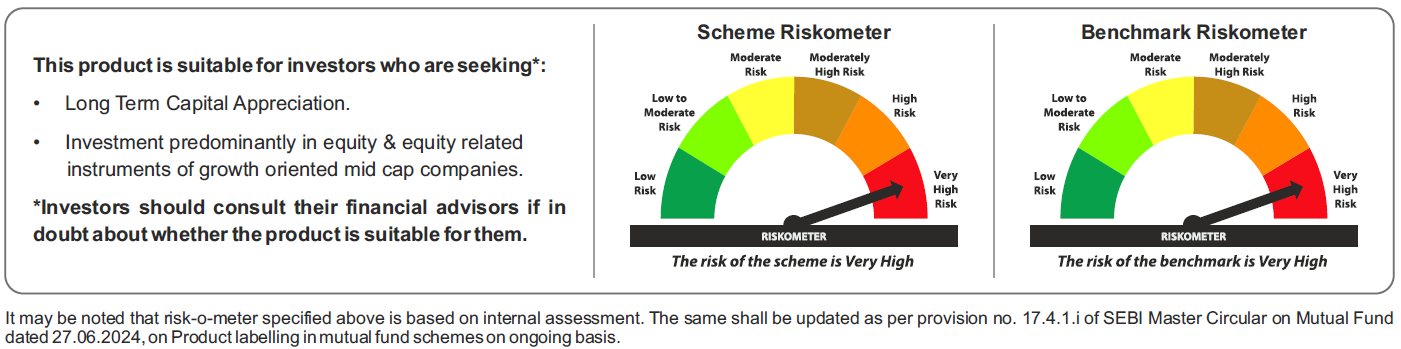
The Tata Midcap Fund is an open-ended equity scheme predominantly investing in mid-cap stocks. The investment objective of the scheme is to provide income distribution and/or medium to long-term capital gains. Investment would be focused on mid-cap stocks. However, there is no assurance or guarantee that the investment objective of the scheme will be achieved. The scheme does not assure or guarantee any returns.
For more clarity, let’s check out some primary features of this financial product:
| Feature | Details |
| Name of the Scheme | Tata Mid Cap Fund (earlier known as Tata Mid Cap Growth Fund) |
| Category | Mid Cap Fund |
| Tata Midcap Fund Direct Plan- Growth Option Inception Date | July 1, 1994 |
| Plans Available |
|
| Options Available |
|
| Risk Level | Very High Risk |
| Exit Load |
|
| Equity and Equity-Related Instruments of Mid-cap Companies | Minimum 65% to Maximum 100% |
| Other Equity and Equity-Related Instruments | Minimum 0% to Maximum 35% |
| Debt and Money Market Instruments, including Cash/ Cash Equivalents | Minimum 0% to Maximum 35% |
Conclusion
So now you know how to get probable benefit from the potential growth of Mid Cap Companies. One way is to invest in the Mid Cap Category Funds which invests in medium-sized businesses. But how to gain exposure to such businesses?
You may consider mid-cap mutual funds. As per SEBI norms, these schemes must invest at least 65% of their total assets in equity and equity-related instruments of mid-cap companies, ranked from 101st to 250th, in terms of full market capitalisation. Investing through mid-cap funds offers several potential advantages, such as:
Professional fund management
Diversification across sectors
Aim to Balance between growth potential and risk
But always remember that these funds carry higher volatility than large-cap funds. Thus, they might be suitable if you have a long-term investment horizon and can tolerate very high risk.
Disclaimer
The views mentioned above are for information & educational purposes only and do not construe to be any investment, legal, or taxation advice. Investors must do their own research before investing. The views expressed in this article are personal in nature and in is no way trying to predict the markets or to time them. Any action taken by you on the basis of the information contained herein is your responsibility alone, and Tata Asset Management Pvt. Ltd. will not be liable in any manner for the consequences of such action taken by you. Please consult your Mutual Fund Distributor before investing. The views expressed in this article may not reflect in the scheme portfolios of Tata Mutual Fund. There are no guaranteed or assured returns under any of the schemes of Tata Mutual Fund.
*Mutual Fund Investments are subject to market risks, please read all scheme related documents carefully.
Author Bio

Akshay Kumar Rao

Loading Form...
Loading Similar Blogs...