


Multi-Asset vs. Hybrid vs. Dynamic Asset Allocation Fund: Choosing the Right Hybrid Fund
Written by Akshay Kumar Rao
24 Nov 2025 • 11 minutes read
According to SEBI Circular - Rationalisation and Categorisation of Mutual Fund Schemes, dated February 26, 2026, all three funds are grouped under the “Hybrid” category. However, they differ in their asset mix, allocation requirements, and portfolio management approach.
- A Multi Asset Allocation Fund invests in at least three asset classes, with a minimum allocation of 10% to each of the three chosen assets.
- A Balanced Hybrid Fund invests 40%–60% of its total assets in equity and equity-related instruments and 40%–60% in debt instruments. Arbitrage is not permitted in this category.
- A Dynamic Asset Allocation Fund dynamically invests in equity and debt according to the prevailing market conditions and the scheme’s investment strategy.
Multi-asset, hybrid, and Dynamic Asset Allocation Fund (DAAF), are all types of hybrid mutual funds that invest in a mix of asset classes, such as equity, debt, arbitrage, and commodities. If we specifically talk about their differences:
- Hybrid funds may combine equity and debt in fixed or flexible ratios based on their risk profile.
- DAAFs take this a step further by “dynamically shifting” between equity and debt depending on market conditions.
- Multi-asset funds go beyond these two, and add a third asset like gold or commodities for broader diversification and stability.
So, as an investor, you must note that while hybrid funds follow set ratios, balanced advantage funds change their allocations dynamically, and multi-asset allocation funds diversify even beyond the common buckets of equity and debt.
But which financial product may suit you? Read this article to first understand the meaning of all these schemes and then see how they differ from each other. Next, you will learn how to choose the right hybrid fund, and lastly, explore the various mutual fund options offered by Tata Mutual Fund™.
Table of Content

What are Multi-Asset Allocation Funds?
Multi-asset allocation funds invest at least 10% each in three different asset classes, which could be:
Equity
Debt
Commodities [say, metals (gold, silver), crude oil, wheat]
This mix allows the fund not to rely on just one source of return. Also, it may balance risk better, as when one asset type performs poorly, another may set off the losses.
What are Dynamic Asset Allocation Fund (DAAF)?
A DAAF is a mutual fund scheme that dynamically invests in stocks (equity) and bonds (debt), changing its mix or allocation percentage as per the prevailing market conditions. Let’s see how it happens:
Market Situation | Valuations | Market Risk Level | Potential Fund Action | Reason |
Bull Market (rising prices) | Expensive | High |
| To protect gains and lower risk when markets are overheated. |
Bear Market (falling prices) | Affordable | Low |
| To buy stocks at lower prices and position for future growth. |
This constant adjustment is called “dynamic allocation” and allows the DAAF to balance growth and safety. Additionally, the fund may also use arbitrage (buying and selling similar assets to capture minor price differences) strategies to add further stability.
What are Hybrid Mutual Funds?
Hybrid funds combine equity (stocks) and debt (bonds) in a single portfolio to potentially provide investors with:
Capital appreciation from equities and
Stability + regular income from debt
This allocation strategy may reduce volatility and spread risk across various sectors. Usually, hybrid fund managers actively rebalance the portfolio based on market conditions and the fund’s objective.
Now, let’s check out the various types of hybrid funds differentiated based on their mix of equity and debt:
| Type of Hybrid Fund | Equity Allocation | Debt Allocation | Arbitrage Allowed | Main Focus / Nature |
| Conservative Hybrid Fund | 10% to 25% of total assets | 75% to 90% of total assets | Yes | Invests mostly in debt instruments with a small portion in equity for limited growth. |
| Balanced Hybrid Fund | 40% to 60% of total assets | 40% to 60% of total assets | No | Keeps a balanced mix of equity and debt. It may maintain a moderate risk. |
| Aggressive Hybrid Fund | 65% to 80% of total assets | 20% to 35% of total assets | Yes | Invests primarily in equity and related instruments, with some debt for support. |
| Arbitrage fund | At least 65% of total assets | 35% or less of total assets | Yes | Tries to find and exploit arbitrage opportunities |
| Equity Saving Fund | At least 65% of total assets | At least 10% of total assets | Yes | Invests in equity, arbitrage, and debt |
| Balanced Advantage Fund | No fixed proportion | No fixed proportion | Yes | Investments are rotated dynamically based on prevailing market conditions |
| Multi-asset allocation fund | May invest at least 10% of total assets | May invest at least 10% of total assets | Yes | Invests in at least three asset classes (say equity, debt, or commodities) with a minimum allocation of at least 10% in the three chosen asset classes. |
Multi-Asset vs. Hybrid vs. Dynamic Asset Allocation Fund (DAAF): How do they differ?
Multi-Asset, Hybrid, and BAFs all mix different types of investments, but differ as to how they diversify and manage risk. If we talk about the primary difference:
Hybrid funds combine equity + debt in fixed or flexible proportions.
DAAFs are dynamic and actively change the mix between equity and debt based on market conditions.
Multi-Asset Funds go a step further by including at least three asset classes (like equity, debt, and gold).
For more clarity, check out the comparison table below:
| Type of Fund | Main Asset Mix | Allocation Style | Number of Asset Classes | Key Feature |
| Hybrid Fund | Equity + Debt | Fixed or flexible | 2 | Balances growth and income using a mix of two assets. |
| Dynamic Asset Allocation Fund (DAAF) | Equity + Debt + Arbitrage | Dynamic and changes based on market valuations | 2 to 3 | Actively adjusts between equity and debt to manage volatility |
| Multi-Asset Fund | Equity + Debt + commodities+ any other asset class | Fixed minimum 10% in 3+ assets | 3 or more | Diversifies across multiple markets for stability |
How to choose the right Hybrid Fund in 2025?
As a mutual fund investor, the right hybrid scheme depends on your risk tolerance, investment horizon, and financial goals. Let’s see how you can make a professional selection:
Assess Your Comfort with Risk
If you prefer relatively stable investments and wish to avoid large market swings, a conservative hybrid fund may be suitable since it invests mostly in debt.
However, if you’re comfortable with higher volatility for long-term gains, a balanced or an aggressive hybrid fund may fit better.
Consider Your Flexibility Needs
If you want a fund that automatically adjusts between equity and debt based on market conditions, a balanced advantage fund may be ideal. It could take care of asset allocation for you. There is no need for manual switching.
Assess Your Diversification Requirement
If you want exposure beyond to multiple asset categories, a multi-asset allocation fund may suit you. It can offer broader diversification within one scheme and reduce your portfolio risk.
Match It To Your Time Horizon
For short-term goals, you may choose conservative options. But for long-term goals, you can prefer aggressive or BAFs as they might offer better growth potential.
Some Tata Mutual Fund ™ Schemes You May Consider in 2025
If you are searching for hybrid schemes, Tata Mutual Fund™ offers a range of options across categories, such as:
Multi-asset allocation fund
Balanced advantage fund
Aggressive hybrid funds
Each scheme is available in both Growth and IDCW (Income Distribution cum Capital Withdrawal) options, with regular and direct plans to choose from. You can start investing through a Systematic Investment Plan (SIP) or make a one-time lump-sum investment. Let’s understand them in detail:
Tata Multi Asset Allocation Fund
(An open-ended scheme investing in equity, debt, and exchange-traded commodity derivatives)
| Inception | Exit Load | Benchmark | Scheme Riskometer | Benchmark Riskometer |
| 04 March 2020 | On or before 30 days from the date of allotment: 0.50%. | 65% BSE 200 TRI + 15% CRISIL Short Term Bond Index + 20% iCOMDEX Composite Index | Very High Risk | Very High Risk |
This scheme aims to offer long-term capital appreciation by investing in different types of assets. The fund’s performance is compared against a benchmark index made up of:
65% BSE 200 (large Indian companies representing equity)
15% CRISIL Short Term Bond Fund Index (debt instruments)
and 20% iCOMDEX Composite Index (commodities)
This benchmark is used to track how the multi-asset allocation fund performs across equity, debt, and commodity markets. However, the fund does not guarantee any returns or that its investment objectives will always be met.
The investment objective of the scheme is to generate long term capital appreciation. However, there is no assurance or guarantee that the investment objective of the scheme will be achieved. The scheme does not assure or guarantee any returns.
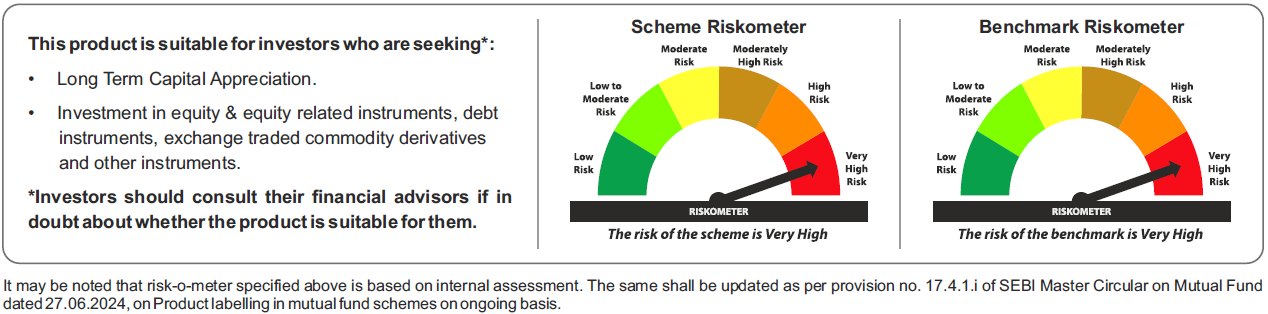
Disclaimer: It may be noted that the risk-o-meter specified above is based on an internal assessment. The same shall be updated as per provision no. 6.16.1.j of SEBI Master Circular on Mutual Fund dated 20.03.2026, on Product labelling in mutual fund schemes on an ongoing basis.
Tata Balanced Advantage Fund
(An open-ended dynamic asset allocation fund)
| Inception | Exit Load | Benchmark | Scheme Riskometer | Benchmark Riskometer |
| 28 January 2019 | On or before 30 days from the date of allotment: 0.50% | CRISIL Hybrid 50+50 - Moderate Index | High Risk | High Risk |
This mutual fund aims to offer investors both capital appreciation and income distribution by using:
Equity derivatives strategies
Arbitrage opportunities
Pure equity investments
The performance of this balanced advantage fund (BAF) is measured against the CRISIL Hybrid 50+50 – Moderate Index(TRI), which tracks a balanced mix of 50% equity and 50% debt. However, the fund does not guarantee any returns.
The investment objective of the scheme is to provide capital appreciation and income distribution to the investors by using equity derivatives strategies, arbitrage opportunities and pure equity investments. However, there is no assurance or guarantee that the investment objective of the scheme will be achieved. The scheme does not assure or guarantee any returns.
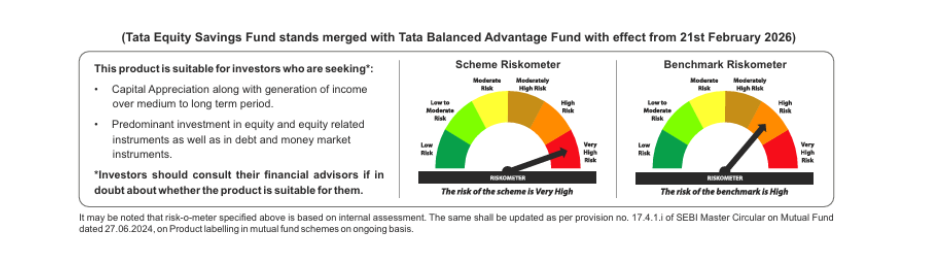
Disclaimer: It may be noted that the risk-o-meter specified above is based on an internal assessment. The same shall be updated as per provision no. 6.16.1.j of SEBI Master Circular on Mutual Fund dated 20.03.2026, on Product labelling in mutual fund schemes on an ongoing basis.
Tata Aggressive Hybrid Fund
(An open-ended hybrid scheme investing predominantly in equity and equity-related instruments)
| Inception | Exit Load | Benchmark | Scheme Riskometer | Benchmark Riskometer |
| 08 October 1995 | On or before 30 days from the date of allotment: 0.50%. | CRISIL Hybrid 35+65 Aggressive Index | Very High | Very High |
The investment objective of this aggressive hybrid fund is to provide:
Income Distribution cum capital withdrawal
and/orCapital appreciation over the medium to long term
The performance of this scheme may be measured against the CRISIL Hybrid 35+65 Aggressive Index. For those unaware, the “35+65” refers to the mix of assets in the index, which is around:
35% in debt instruments (like bonds)
and65% in equities (stocks).
The term “aggressive” indicates that the index invests more heavily in equities and may aim for higher long-term growth. However, this mutual fund scheme does not assure or guarantee any returns.
The investment objective of the Scheme is to provide Income Distribution cum capital withdrawal and or capital appreciation over medium to long term. However, there is no assurance or guarantee that the investment objective of the Scheme will be achieved. The scheme does not assure or guarantee any returns.
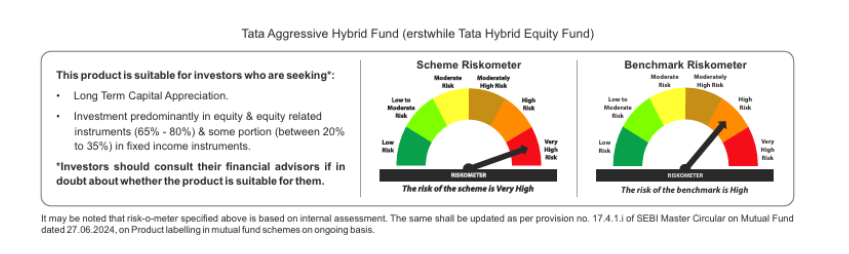
Disclaimer: It may be noted that the risk-o-meter specified above is based on an internal assessment. The same shall be updated as per provision no. 6.16.1.j of SEBI Master Circular on Mutual Fund dated 20.03.2026, on Product labelling in mutual fund schemes on an ongoing basis.
Conclusion
So now you know the meaning of different hybrid schemes:
A hybrid fund combines equity + debt to balance risk and return.
A BAF adjusts between equity and debt depending on market conditions
A multi-asset fund invests in at least three asset classes (say, equity, debt, and gold) for wider diversification.
The right selection depends on your risk appetite and investment objectives. If you want to explore such options, Tata Mutual Fund™ offers several hybrid schemes across these categories.
FAQs
1. What is a hybrid multi-asset allocation fund?
As per SEBI regulations, a multi-asset allocation fund is a hybrid scheme that invests in at least three asset classes, with a minimum allocation of 10% to each chosen asset class.
2. What is a dynamic asset allocation fund?
A dynamic asset allocation fund is a hybrid scheme that invests dynamically in equity and debt instruments. There are no fixed asset allocation percentages, and the fund manager can adjust the portfolio mix based on the scheme’s investment strategy and prevailing market conditions.
3. How do I choose a hybrid fund?
As an investor, you may consider the scheme’s:
- Asset allocation
- Investment objective, and
- Scheme + Benchmark Risk-o-Meter.
The above information could be reviewed from scheme documents, such as the SID (Scheme Information Document) and KIM (Key Information Memorandum). Additionally, you may review the fund’s portfolio and assess whether it aligns with your financial goals.
4. What is a balanced hybrid mutual fund scheme?
As per SEBI guidelines, a balanced hybrid fund invests between 40-60% of its total assets in equity and equity-related instruments and 40-60% of its total assets in debt instruments, with no arbitrage permitted.
Investors may assess the scheme’s investment objective, portfolio, and Risk-o-Meter before investing.
Disclaimer:
The views mentioned above are for information & educational purposes only and do not construe to be any investment, legal, or taxation advice. Investors must do their own research before investing. The views expressed in this article are personal in nature and in is no way trying to predict the markets or to time them. Any action taken by you on the basis of the information contained herein is your responsibility alone, and Tata Asset Management Pvt. Ltd. will not be liable in any manner for the consequences of such action taken by you. Please consult your Mutual Fund Distributor before investing. The views expressed in this article may not reflect in the scheme portfolios of Tata Mutual Fund. There are no guaranteed or assured returns under any of the schemes of Tata Mutual Fund.
*Mutual Fund Investments are subject to market risks, please read all scheme related documents carefully.
Author Bio

Akshay Kumar Rao

Across Market Cap, Sector, and Index Funds — Explore Opportunities with Tata Mutual Fund
Written by Akshay Kumar Rao
31 Oct 2025 • 11 minutes read

Get closer to your financial goals
Start InvestingLoading Form...
Loading Similar Blogs...