


Multi-Asset Allocation: The 2025 Winner's Strategy for 2026
Written by Akshay Kumar Rao
24 Jan 2026 • 7 minutes read


In 2025, Indian equity markets experienced intense volatility and recorded a flat to modest performance. While debt markets offered stable returns, precious metals like gold and silver, reached their all-time highs, driving portfolio gains.
In this context, multi-asset allocation funds become the star strategic tool. Multi-asset mutual funds, especially those with gold and silver exposure, were able to capture diversification benefits, along with rallies in the precious metals.
But will this strategy continue to shine in 2026? Many market reviewers think so. Since multi-asset allocation funds will likely continue to interest investors, let’s understand why this strategy still remains relevant this year.
Table of Content

What is Multi-Asset Investing Strategy?
Before we move to multi-asset allocation funds, let’s first understand what is a multi-asset allocation strategy. It is simply a strategy where you invest in different types of asset classes, rather than just one. This may include investing in:
Equity stocks of companies (for potential growth)
Debt assets like bonds and debentures (for potential stability)
Commodities like gold and silver (for potential inflation hedging)
The idea behind multi-asset allocation is simple: Don’t put all your eggs into one basket. If one asset class performs poorly, others (especially low correlation ones) may perform better to balance things out.
Multi-asset allocation funds offer investors an easy way to achieve this goal.
Understanding Multi-Asset Allocation Funds
Multi-asset allocation funds are open-ended mutual fund schemes that invest in a minimum of three asset classes like equities, debt assets, commodities, REITs and InvITs, with at least 10% allocation in each asset class.
Fund managers of a multi-asset fund also has the flexibility to adjust asset allocations as per the market conditions and the fund’s investment objectives. So, apart from basic exposure to various asset classes, you also get to tap into dynamic asset allocation probable benefits.
Why Multi-Asset Allocation Funds May Shine in 2026?
In 2025, multi-asset allocation funds managed to deliver notable outcomes despite volatility in the equity markets. Here’s why experts believe multi-asset mutual funds may also shine in 2026:
Balanced diversification and better volatility management.
Balanced diversification helps multi-asset allocation fund returns not be dependent on any single asset class. MAAF spread investments across assets that do not typically move in tandem (like equities and gold). So, when there is weakness in some segments, it may be offset with potential gains in others.
For instance, in 2025, the broader equity indexes either declined or delivered single digit gains, while gold and silver experienced strong rallies. So, when equity performance lagged, the precious metal component of multi-asset funds may have helped them better manage this volatility and reduce the impact on returns.
Possibility of benefiting from market changes
Fund managers of multi-asset allocation funds (MAAF) have the flexibility to revise the allocation to each asset class within the fund’s portfolio (as long as they maintain the minimum 10% exposure rule). This possibility of dynamic allocation can work in your favour, especially when markets are experiencing volatile periods.
For instance, if equities experience a slow-down, the fund manager may review the market outlook and adjust small and mid-cap allocations in favour of commodities and debt. So, this dynamic allocation flexibility allows the fund’s portfolio to be adjusted based on market outlook. This may be done aiming to capture benefits of market changes and for better risk-adjusted multi-asset allocation fund returns.
Tackling different phases of market cycles
Markets move in cycles. So, stocks may rally during bull markets and stumble during bear runs, while commodities like gold & silver may shine during periods of geopolitical tensions, but stay flat during calmer times.
Since multi-asset allocation funds invest in these different types of asset classes, they may potentially benefit from uptrends in each cycle. To put it simply, hybrid funds like the MAAF funds may help investors capture opportunities across different market cycles.
Tata Multi-Asset Allocation Mutual Fund: An Example
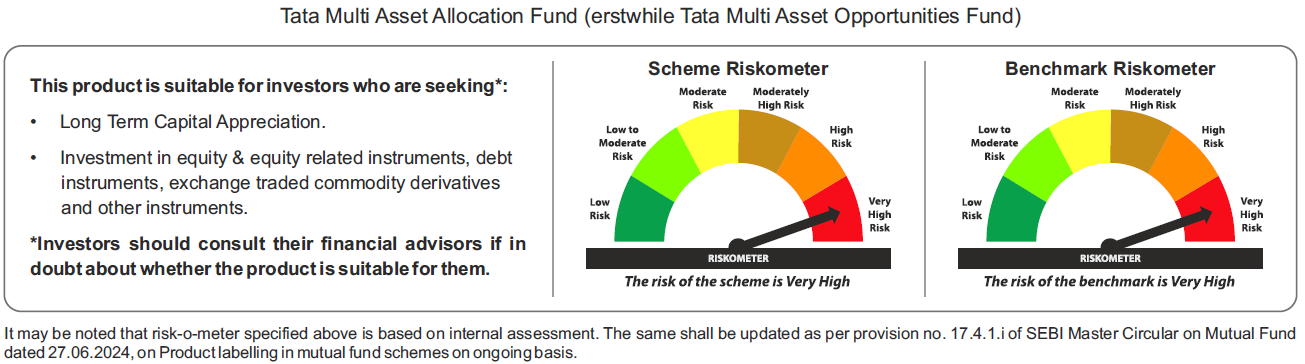
So, if you’re looking to adopt the multi-asset allocation strategy for 2026, you can consider a fund like the Tata Multi-Asset Allocation Fund. The key details of the fund are outlined below:
| Scheme Type |
|
| Investment Objective |
|
| Scheme Benchmark |
|
| Scheme Riskometer |
|
| Benchmark Riskometer |
|
| Exit Load |
|
| Asset Allocation (under normal circumstances) |
|
Be Prepared for Short-Term Underperformance: If there are sharp equity rallies, multi-asset funds may lag in comparison to pure equity funds. But remember that this is the cost of downside protection the fund offers.
Know the Macro Risks: Before you invest in multi-asset allocation funds, please understand the macro risk factors like global trade tensions, currency depreciation, inflation, and interest rate changes. All these factors can impact equity, debt, and commodity returns.
Focus on Full Market Cycles: Just like for any other fund, you need to assess multi-asset allocation fund returns across a 3-5 year cycle. Reviewing multi-asset fund returns over the past year does not show you the accurate picture.
Understand the Difference between Active and Passive Multi-Asset Funds: Active MAAF funds have the liberty to shift allocations, while passive multi-asset FoFs track specific market indexes. While fund managers actively rebalance portfolios for the former, rebalancing happens systematically for the latter.
What are Hybrid Mutual Funds? Meaning, Types & Why you should consider them?

Conclusion
2025 saw flat equity performance and rising geopolitical tensions, making multi-asset allocation funds the winning strategy for the year. Market experts suggest that multi-asset funds may continue on this path in 2026 as well, given the continued trade deal tensions, possibility of conflict, and rising inflation levels.
But even this doesn’t happen, MAAF funds have the edge of dynamic allocation adjustment (with the minimum 10% rule in place) that can help them navigate market uncertainties and cycles better. To put it simply, multi-asset funds may lag in compared to pure equity funds during bull markets, but they can potentially help better cushion downturns when waters are choppy. Regardless of what the year holds, a multi-asset allocation strategy may be one of the ways to go.
Disclaimer:
The views mentioned above are for information & educational purposes only and do not construe to be any investment, legal, or taxation advice. Investors must do their own research before investing. The views expressed in this article are personal in nature and in is no way trying to predict the markets or to time them. Any action taken by you on the basis of the information contained herein is your responsibility alone, and Tata Asset Management Pvt. Ltd. will not be liable in any manner for the consequences of such action taken by you. Please consult your Mutual Fund Distributor before investing. The views expressed in this article may not reflect in the scheme portfolios of Tata Mutual Fund. There are no guaranteed or assured returns under any of the schemes of Tata Mutual Fund.
*Mutual Fund Investments are subject to market risks, please read all scheme related documents carefully.
Author Bio

Akshay Kumar Rao

Loading Form...
Loading Similar Blogs...