


What are Hybrid Mutual Funds? Meaning, Types & Why you should consider them
Written by Akshay Kumar Rao
04 Jun 2025 • 15 minutes read


Hybrid mutual funds are one of the three broad categories of mutual fund schemes, alongside equity and debt funds. As per SEBI categorisation, there are seven different types of hybrid funds:
- Conservative Hybrid Fund
- Balanced Hybrid Fund
- Aggressive Hybrid Fund
- Dynamic Asset Allocation Fund (DAAF)/ Balanced Advantage Fund
- Multi-Asset Allocation Fund
- Arbitrage Fund, and
- Equity Savings Fund
These schemes invest across equity, debt, and/or other permitted asset classes, with the asset allocation varying by category.
Investing in mutual funds often presents a common challenge - should one opt for the growth potential of equities or the relatively stable debt instruments? What if it were possible to embrace both options? A hybrid mutual fund offers a good solution.
The hybrid mutual funds are investment vehicles that merge the advantages of both categories. Whether you are a novice investor seeking balance or an experienced one looking to diversify, hybrid funds provide a versatile and comprehensive solution designed to accommodate different risk tolerances and financial objectives.
This article elucidates the nature of hybrid mutual funds, their operational mechanisms, the various types available, and the reasons they might be a valuable addition to your investment portfolio.
Table of Content

What are Hybrid Mutual Funds?
A hybrid mutual fund is a mutual fund scheme that allocates investments across a combination of equity (stocks) and debt (bonds, fixed-income securities), and may also include other asset classes such as gold or international equities. The objective is to establish a balanced investment approach that harnesses the growth potential of equities while ensuring the stability provided by debt.
By diversifying among various asset classes, hybrid funds seek to mitigate the volatility typically linked to equity-dominant portfolios, while providing a more favorable return potential compared to solely debt-focused funds.
How do Hybrid Funds Work?
Hybrid funds strategically distribute their investments between stocks and bonds, adapting to the fund's strategy and market conditions. The proportion of stocks to bonds can differ based on the specific type of hybrid fund. For example, a fund might maintain a 70% equity and 30% debt allocation during a bullish market but adjust to a more conservative mix when market volatility increases.
This strategy aids in risk management while keeping investments actively engaged throughout various market cycles. The fund manager is essential in maintaining and adjusting the portfolio as necessary.
Why Choose Hybrid Funds?
There are several important reasons that suggest hybrid mutual funds could be appropriate for a diverse range of investors:
- Risk and Reward Balance: Equities aim to foster growth, whereas debt provides relative stability, resulting in a more balanced investment portfolio.
- Diversification: By incorporating various asset classes, hybrid funds minimise reliance on a single market segment.
- Flexibility: Certain hybrid funds permit dynamic rebalancing in response to market fluctuations.
- Suitable for All Investors: There are different hybrid schemes designed separately for conservative, moderate, and aggressive risk profiles.
- Reduced Volatility Compared to Pure Equity Funds: The debt element mitigates the effects of declines in the equity market.
Types of Hybrid Mutual Funds
The Association of Mutual Funds in India (AMFI) and SEBI classify hybrid mutual funds into several categories based on their equity-debt allocation. Here's a breakdown:
1. Conservative Hybrid Funds
- Equity Allocation: 10–25% of total assets
- Debt Allocation: 75–90% of total assets
- Suitable For: Investors with a low-risk tolerance seeking relatively stable returns.
- Key Benefit: Regular income with minimal equity exposure.
2. Balanced Hybrid Funds
- Equity Allocation: 40–60% of total assets
- Debt Allocation: 40–60% of total assets
- Suitable For: Investors looking for equal exposure to equity and debt.
- Note: Balanced funds do not invest in arbitrage opportunities.
3. Aggressive Hybrid Funds
- Equity Allocation: 65–80% of total assets
- Debt Allocation: 20–35% of total assets
- Suitable For: Investors with very high-risk tolerance seeking equity-style growth with debt allocation.
4. Dynamic Asset Allocation Fund (DAAF)
- Equity Allocation: 0–100% of total assets (dynamically managed)
- Debt Allocation: 0–100% of total assets
- Suitable For: Investors who want the fund manager to make allocation calls based on market valuations.
- Key Benefit: Responsive to market changes; aims to optimise risk-adjusted returns.
5. Multi-Asset Allocation Funds
- Invest in three or more asset classes (e.g., equity, debt, gold)
- Suitable For: Investors seeking broad diversification within a single fund.
- Benefit: Hedge against sector-specific or market-specific risks.
6. Arbitrage Funds
- Exploit price differences in equity cash and derivatives markets.
- Minimum Equity Exposure: 65% of total assets
- Suitable For: Conservative investors who want tax-efficient income and low volatility.
Who Should Invest in Hybrid Mutual Funds?
Hybrid funds are suitable for a wide spectrum of investors depending on the sub-category they choose. Here's a guide:
- For novice investors, conservative or balanced hybrid funds provide a gentle introduction to equity markets and relatively stable debt instruments.
- For retirees or risk-averse investors, conservative hybrid or arbitrage funds may present improved tax efficiency relative to fixed deposits.
- Moderate investors may find aggressive hybrid funds to be a growth-focused option with very high risk.
- For those who time the market, dynamic asset allocation funds enable professionals to manage market fluctuations on their behalf.
Things to Consider Before Investing
Before investing in hybrid funds, keep the following in mind:
Risk Level
- While hybrid funds entail less risk than pure equity funds, they still possess inherent risks. Equity-focused hybrid funds may undergo considerable fluctuations.
- While hybrid funds entail less risk than pure equity funds, they still possess inherent risks. Equity-focused hybrid funds may undergo considerable fluctuations.
Investment Horizon
- Short-term (<3 years): Consider conservative hybrid or arbitrage funds.
- Medium to Long-term (3–5+ years): Balanced, aggressive hybrid, or dynamic asset allocation funds are more appropriate.
Taxation
- Equity-oriented hybrid funds (where equity >65%):
- STCG (if held <1 year): Taxed at 15%
- LTCG (if held >1 year): Taxed at 10% for gains exceeding ₹1.25 Lakh /year (from FY 2024-25)
- Debt-oriented hybrid funds:
- Taxed as per individual’s income tax slab under new rules.
- Equity-oriented hybrid funds (where equity >65%):
Always check the fund’s current allocation and consult a tax advisor if needed.
Example: How a Hybrid Fund Performs in Real Life
Let’s say you invest ₹1,00,000 in an aggressive hybrid fund. The fund allocates 70% to equity and 30% to debt.
- If equity markets deliver 12% returns and debt offers 6%, your blended portfolio return might be around 10%.
- In a down year, where equities drop by 5% but debt earns 6%, your portfolio decline could be cushioned to around –1% or less, depending on the debt proportion.
This simplified example illustrates the stabilising role debt plays in volatile equity markets.
Benefits of Tata Aggressive Hybrid Fund
Tata Mutual Fund provides a variety of hybrid fund options, each designed to meet distinct investment requirements. A notable example is the Tata Aggressive Hybrid Fund. It is an open-ended hybrid scheme investing predominantly in equity & equity related instruments. The investment objective of the scheme is to provide Income Distribution cum capital withdrawal and or capital appreciation over medium to long term. However, there is no assurance or guarantee that the investment objective of the scheme will be achieved. The scheme does not assure or guarantee any returns.
Tata Aggressive Hybrid Fund – Quick Overview:
- Inception: October 8, 1995
- Benchmark: CRISIL Hybrid 35+65 Aggressive Index
- Expense Ratio (Direct Plan): 1.01%
- Top Holdings: HDFC Bank, Reliance, ICICI Bank, Bharti Airtel, SBI
- Key Strategy: Combination of bottom-up stock picking and active sector rotation
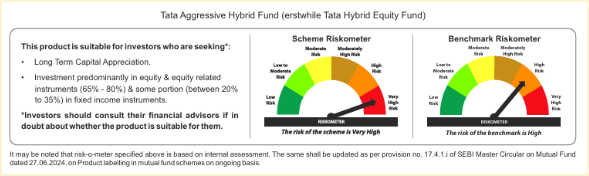
Disclaimer: It may be noted that the risk-o-meter specified above is based on an internal assessment. The same shall be updated as per provision no. 6.16.1.j of SEBI Master Circular on Mutual Fund dated 20.03.2026, on Product labelling in mutual fund schemes on an ongoing basis.
Why Choose Tata Aggressive Hybrid Fund?
It offers a balance between capital growth and income generation.
It invests in premium equities and income-generating debt securities.
It is suitable for medium- to long-term investors who desire both growth and stability.
Common Myths About Hybrid Funds
Myth 1: Hybrid funds guarantee capital protection.
Reality: Although hybrid funds seek to minimise volatility, they do not ensure the protection of the principal amount.
Myth 2: Hybrid funds are too conservative.
Reality: Certain hybrid funds, such as aggressive or dynamic types, are focused on growth and entail risks similar to those associated with equities.
Myth 3: One hybrid fund fits all.
Reality: Each category of hybrid fund fulfills a distinct objective - understand your investment goals prior to committing.
Conclusion
Hybrid mutual funds offer an effective solution for investors aiming to achieve a balance between growth and stability. They merge the potential for higher returns associated with equities and the risk-reducing qualities of debt, making them an attractive choice for both novice and seasoned investors.
With various options such as conservative, aggressive, dynamic, and multi-asset allocation, hybrid funds address diverse risk profiles and investment timelines. As with any investment, it is crucial to evaluate your financial objectives, risk tolerance, and seek advice from a financial advisor before deciding.
If you wish to streamline your investment experience while seeking performance, hybrid mutual funds could be one of the choices for you to consider.
For more information, you can visit www.tatamutualfund.com. The Investor Service Centre of Tata Asset Management Pvt. Ltd. is located at Mulla House, Ground Floor, 51, M.G. Road, Near Flora Fountain, Mumbai – 400 001, Maharashtra. The office hours are Monday to Friday, 9:00 AM to 5:30 PM. For assistance, you can also call (022) 6282 7777 from Monday to Saturday, 9:00 AM to 5:30 PM, or email service@tataamc.com.
FAQs
1. What are hybrid mutual funds?
Hybrid mutual funds invest across two or more asset classes, primarily equity and debt, with the allocation depending on the scheme category and investment mandate. As per general market understanding, hybrid schemes combine equity’s growth potential with the relative stability of debt.
As per SEBI circular - Rationalisation and Categorisation of Mutual Fund Schemes, dated February 26, 2026, there are seven different hybrid mutual fund categories. Each may suit different risk profiles, investment horizons, and investment objectives.
2. How do hybrid mutual funds work?
Hybrid funds invest across equity, debt, and, depending on the scheme category, other permitted asset classes. Generally, the asset allocation is determined by the funds category and scheme’s stated investment objective.
3. What are the different types of hybrid mutual funds?
As per SEBI categorisation, there are seven different types of hybrid funds:
- Conservative Hybrid Fund
- Balanced Hybrid Fund
- Aggressive Hybrid Fund
- Dynamic Asset Allocation Fund (DAAF)/ Balanced Advantage Fund
- Multi-Asset Allocation Fund
- Arbitrage Fund, and
- Equity Savings Fund
Each category has specific investment limits, which allow potential investors to select a scheme based on their risk tolerance and investment objectives.
4. What are the benefits of hybrid mutual funds?
Hybrid funds provide diversification across asset classes. Equity exposure may support potential long-term capital appreciation, while debt can provide relative portfolio stability.
Also, hybrid funds are generally considered less volatile than pure equity schemes as they divide their investments between equity and other asset classes. When equity markets decline, the allocation to debt or other assets may potentially cushion or moderate the impact of equity market fluctuation on the portfolio.
However, such an allocation does not eliminate market risk. Also, the returns generated by hybrid schemes are market-linked and not guaranteed. .
5. Are hybrid mutual funds suitable for beginners?
Hybrid funds may suit investors looking for a “mixed exposure” to both equity and debt. However, suitability varies by funds category and depending on risk tolerance, investment objectives and investment horizon of investors.
6. What factors should you consider before investing in hybrid funds?
Potential investors may evaluate the:
- Type of hybrid fund
- Asset allocation
- Investment objective
- Portfolio composition
- Scheme and Benchmark Risk-o-Meter.
The above information can be obtained from the scheme information documents, such as the Scheme Information Document (SID), Key Information Memorandum (KIM), and more. Additionally, they may assess their risk appetite and investment objective before investing.
8. How does debt exposure help in a hybrid fund?
As per general industry understanding, debt exposure aims to offer “relative stability” to a portfolio that also contains equity allocation. During periods of market volatility, debt investments may reduce the portfolio’s sensitivity to market movements, depending on the type, quality, and duration of the debt securities held.
However, note that debt investments also carry risks (including credit and interest-rate risk).
9. Are hybrid funds less risky than equity mutual funds?
Generally, hybrid funds are considered less risky than pure equity schemes due to the allocation to the “debt component”, which may relatively stabilise a portfolio during adverse market conditions.
However, note that the risk varies substantially across different types of hybrid fund schemes. For example, a conservative hybrid fund may have lower equity exposure, while an aggressive hybrid fund can carry significant equity-market risk.
Thus, investors should assess the specific scheme’s Risk-o-Meter, portfolio composition, and personal risk appetite before investing.
Disclaimer:
The views mentioned above are for information & educational purposes only and do not construe to be any investment, legal, or taxation advice. Investors must do their own research before investing. The views expressed in this article are personal in nature and in is no way trying to predict the markets or to time them. Any action taken by you on the basis of the information contained herein is your responsibility alone, and Tata Asset Management Pvt. Ltd. will not be liable in any manner for the consequences of such action taken by you. Please consult your Mutual Fund Distributor before investing. The views expressed in this article may not reflect in the scheme portfolios of Tata Mutual Fund. There are no guaranteed or assured returns under any of the schemes of Tata Mutual Fund.
*Mutual Fund Investments are subject to market risks, please read all scheme related documents carefully.
Author Bio

Akshay Kumar Rao

Loading Form...
Loading Similar Blogs...