


The 2026 "Move to Quality": Why Large-Cap Funds are leading?
Written by Akshay Kumar Rao
24 Jan 2026 • 7 minutes read


Large-cap mutual funds are schemes that invest at least 80% of their total assets in equity and equity-related instruments of large-cap companies. As per SEBI, such businesses are ranked within the top 100 in terms of full market capitalisation.
The recent AMFI monthly note shows that large-cap funds continue to remain one of the most popular and trusted equity categories among investors. With an AUM (Assets Under Management) of ₹4,18,727 crore in December 2025 (Source: AMFI Monthly Note Dec 2025), they command a significant share of equity assets.
Even over a three-year period, a 72.4% expansion in AUM reinforces their position as a core holding in long-term equity portfolios. So, are you also interested in this “Move to quality”? Read this article to first learn the working and several benefits of large-cap funds. Next, you will see some large-cap equity funds offered by Tata Mutual Fund™.
Table of Content

How do Large-Cap Mutual Funds work?
As mentioned before, at least 80% of a large-cap fund’s portfolio must be invested in the top 100 listed companies (by market value). Usually, these are industry leaders with:
Dominant business positions
Strong balance sheets
Long operating histories
High creditworthiness
Now, because of this investment structure, large-cap funds behave differently across market cycles. Let’s see how:
| During Bull Markets | During Market Downturns |
|
|
As an investor, you must also understand that the performance of large-cap stocks held by a large-cap mutual fund directly impacts its NAV (Net Asset Value).
4 reasons you may consider Large-Cap Funds in 2026
In the third quarter of 2025, large-cap mutual funds witnessed healthy monthly inflows with:
₹972 crore in October
₹1,640 crore in November
₹1,567 crore in December (Source: AMFI Monthly Note Dec 2025)
This data indicates growing investor confidence in large-cap funds, with most of them viewing it as a relatively less volatile equity option compared to Mid & Small caps. Want to know what is driving this preference? Let’s look at some major reasons behind it:
1. Relatively lower Volatility Comes From Strong Businesses
Large-cap funds invest in firms that have strong cash flows + operate across multiple markets. When the economy slows or global events create uncertainty, these companies may have the financial strength to manage pressure better than smaller firms.
Okay, but what does this mean for an investor? There could be fewer fluctuations in your portfolio value. Remember that the prices may still fall during weak markets, but the fall is usually less severe compared to Mid & Small caps.
2. Long-Term Return Potential
Note that large-cap funds are not designed to deliver sudden high returns in a single year. Instead, they focus on regular growth over long periods. The companies they invest in grow gradually by:
Increasing sales
Improving margins
Expanding operations
Thus, when you stay invested for many years, the returns earned each year start generating further returns in the following years. This is called the “compounding effect”. That’s why large-cap equity funds are commonly used for long-term wealth creation. Another reason for their preference is that they may carry lower volatility compared to mid- or small-cap funds.
3. Easy Access to Your Money
Large-cap funds invest in stocks that are traded daily in large volumes. Due to ease of trading, fund managers can buy or sell these stocks without difficulty.
This leads to fewer chances of selling stocks (held by the fund) at an unfavourable price. For investors, this means less drops in fund's NAV.
4. Additional Income Through Dividends
Some large-cap companies try to generate regular profits and share a portion of these profits with investors through dividends. Now, when you invest in a large-cap fund, this dividend income is first received by the fund (not directly by you).
Based on the option you choose, the fund handles this income differently. Let’s see how:
| Under the IDCW (Income Distribution cum Capital Withdrawal) Option | Under the Growth Option |
There may be 2 sub-options:
| The dividend income is reinvested back into the fund, which increases the fund’s NAV over time. |
Such a dividend-paying nature of some large-cap companies adds another layer of comfort for investors.
Searching for Large-Cap Equity Funds? You may consider these schemes in 2026!
If you are considering large-cap investments, Tata Mutual Fund™ offers the Tata Large Cap Fund. This fund is available in “regular” and “direct” plans. Also, investors can choose between “Growth” and “IDCW” options based on their investment needs. For more clarity, let’s understand this large-cap fund in detail:
Tata Large Cap Fund
(An open-ended equity scheme predominantly investing in large-cap stocks)
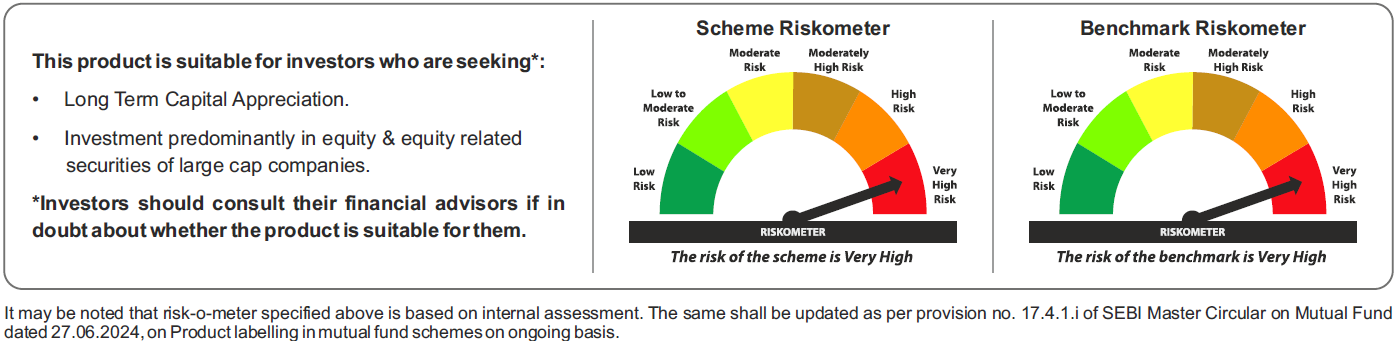
| Inception | Exit Load | Benchmark | Scheme Riskometer | Benchmark Riskometer |
| Tata Large Cap Fund – Regular plan - Growth Option 07 May 1998 | On or before 30 days from the date of allotment: 0.50%. After 30 days from the date of allotment: NIL. | Nifty 100 TRI | Very High Risk | Very High Risk |
The investment objective of the scheme is to provide income distribution and/or medium to long-term capital gains while at all times emphasising the importance of capital appreciation. However, there is no assurance or guarantee that the investment objective of the scheme will be achieved. The scheme does not assure or guarantee any returns.
The benchmark of this large-cap scheme is the Nifty 100 index. It represents the top 100 companies selected from the Nifty 500 (ranking is based on full market capitalisation). Also, the index combines stocks from the Nifty 50 and Nifty Next 50.
Conclusion
So now you know why shifting investments from Small cap and Mid cap funds to large-cap mutual funds is called a move to quality. They invest in large & established companies that tries to withstand economic stress better than smaller firms.
Looking ahead, 2026 is expected to be a year of high uncertainty. Experts suggest it could be negatively influenced by global conflicts, geopolitical tensions, and economic slowdowns. In such an environment, as an investor, you may prefer large-cap funds, which carry relatively lower volatility + liquidity.
Disclaimer:
The views mentioned above are for information & educational purposes only and do not construe to be any investment, legal, or taxation advice. Investors must do their own research before investing. The views expressed in this article are personal in nature and in is no way trying to predict the markets or to time them. Any action taken by you on the basis of the information contained herein is your responsibility alone, and Tata Asset Management Pvt. Ltd. will not be liable in any manner for the consequences of such action taken by you. Please consult your Mutual Fund Distributor before investing. The views expressed in this article may not reflect in the scheme portfolios of Tata Mutual Fund. There are no guaranteed or assured returns under any of the schemes of Tata Mutual Fund
*Mutual Fund Investments are subject to market risks, please read all scheme related documents carefully.
Author Bio

Akshay Kumar Rao

Loading Form...
Loading Similar Blogs...