


What is XIRR in Mutual Funds? How It Differs from CAGR?
Written by Ashish Suryakant Pawar
20 Jul 2026 • 7 minutes read
XIRR means the “annualised rate of return” generated from investments or withdrawals made on different dates (suppose during SIP, STP, or SWP). In comparison, CAGR is the “average” point-to-point annual rate at which an investment grows.
Suppose a mutual fund scheme has delivered an annual return of 9% over the past five years. What exactly does that mean?
- Does it mean that if you had invested five years ago, your investment would have grown by 45% (9% × 5 years)?
- Would you have earned this 45% return regardless of whether you invested a lump sum or through a monthly SIP?
For many beginners, understanding mutual fund returns can be confusing. If terms like CAGR and XIRR seem overwhelming, this article will help you understand CAGR and XIRR meaning, when each metric should be used, and how they differ from one another.
Table of Content

What is XIRR in a Mutual Fund?
The XIRR full form is “Extended Internal Rate of Return”. It is a method of calculating the “annualised return” on investments where money is invested or withdrawn on different dates.
XIRR considers every cash flow and the date on which it occurred. This makes XIRR the preferred return metric for investments such as SIPs, STPs, SWPs, or any investment where multiple transactions take place over time.
Let’s gain more clarity and see why XIRR is widely used by mutual fund investors:
| Reason | Explanation |
| XIRR considers the investment date of every transaction. |
|
| XIRR works with multiple investments and withdrawals. |
|
| XIRR expresses returns as an annual percentage. |
|
How to Calculate XIRR?
Usually, the XIRR is not calculated manually as it is based on an “iterative” mathematical process. Most investors use any spreadsheet software (such as Microsoft Excel or Google Sheets) to repeatedly test different return rates until it finds the one that makes the net present value (NPV) of all cash flows equal to zero.
Alternatively, this may be done using the built-in XIRR formula, accessed using the following syntax:
- “=XIRR(values, dates)”
Here, “values” refers to the range containing all cash flows, while “dates” refers to the corresponding transaction dates. The software automatically performs the calculations and gives the annualised rate of return.
Want to build a stronger understanding of mutual funds and personal finance? Explore more educational blogs on SIPs, mutual fund returns, market concepts, and similar concepts. |
Example
For a better understanding of what XIRR means and how it is calculated, let’s study an example:
- Suppose you invest ₹5,000 every month through an SIP in an equity mutual fund.
- You continue the SIP for six months from January 2025 to June 2025.
- Your total portfolio value is ₹32,450 (assumed) at the end of the calendar year in December 2025.
Now, to calculate XIRR, enter all the investments as “negative values” in the spreadsheet software (because money leaves your account). Next, enter the final portfolio amount as a positive value because it represents the amount you receive.
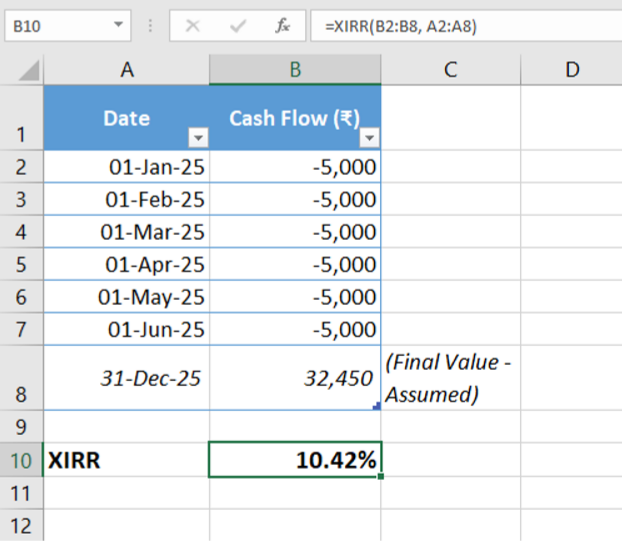
Lastly, click on any empty cell and enter the formula “=XIRR(values, dates)”. In the above example, the formula would be, “=XIRR(B2:B8, A2:A8)”. Press Enter, and the spreadsheet will automatically calculate the annualised rate of return for all the cash flows.
In the above example, the result is 10.42%. Now, this means your investments generated an annual return of 10.42%, after considering the amount and timing of every SIP instalment.
What is CAGR?
So, now you know about the XIRR meaning in mutual funds. At this point, let’s introduce the concept of CAGR, which stands for Compound Annual Growth Rate. It is a method of calculating the “average annual return” on an investment, assuming it grew at a constant rate every year.
Investors potentially use CAGR for the following use cases:
| Use Case | Explanation |
| Lump-sum investments |
|
| Comparing mutual funds |
|
| Benchmark comparison |
|
Furthermore, investors should realise that mutual funds do not generate the same return each year. For example,
- A fund may gain 9% in one year, fall by 7% in the next, and then rise by 10% in the third year.
- Instead of showing these year-wise fluctuations, CAGR combines the different performances into a single annual return.
How to Calculate CAGR?
To calculate CAGR, you need three values:
- Initial investment
- Final investment value
- Investment period (in years)
Generally, the mathematical formula is:

To understand better, let’s study a hypothetical example. Suppose you invest ₹1,00,000 in an equity mutual fund. After 5 years, the investment grows to ₹1,53,862.
Now, we can calculate CAGR as follows:
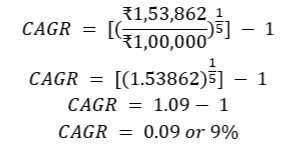
Therefore, the CAGR is 9% per year. This does not mean the mutual fund generated exactly 9% every year. The actual yearly returns may have been different. CAGR only shows the average annual rate at which the investment would have grown to increase from ₹1,00,000 to ₹1,53,862 over five years.
XIRR vs CAGR? How Do They Differ?
Both XIRR and CAGR express returns on an “annualised basis”. But they serve different purposes.
- CAGR is used when there is a single investment (lump sum) made at the beginning and redeemed at the end of the investment period. It assumes one initial cash outflow and one final cash inflow.
- Whereas XIRR is designed for investments involving multiple cash flows occurring on different dates (such as SIPs or SWPs). It factors in the exact timing of every transaction to calculate the annualised return.
Need more clarity on XIRR's meaning? Let’s study a comparative analysis of both these return metrics:
| Basis of Comparison | XIRR | CAGR |
| Full Form | Extended Internal Rate of Return | Compound Annual Growth Rate |
| Mostly Used For | SIPs and other investments involving multiple transactions | Lump-sum investments |
| What It Measures | Annualised return after considering every investment, withdrawal, and the date of occurrences | Average annual growth of an investment over a specific period |
| Cash Flows | Supports multiple investments, withdrawals, and dividend payouts | Assumes a single investment at the beginning and one value at the end |
| Investment Timing | Considers the exact date of every cash flow | Does not consider when additional investments or withdrawals are made |
| Suitable for SIPs | Yes | No |
| Suitable for Lump-Sum Investments | Yes, but CAGR is generally more preferred | Yes |
| Fund Performance Comparison | Not commonly used for comparing funds because every investor may have different investment dates and cash flows | Widely used to compare the performance of mutual funds, indices, and other investments |
Conclusion
So, now you know what CAGR and XIRR mean and how they differ from each other. To summarise, both are return metrics that express investment performance as an annualised return. However, their ideal use cases are different.
As per general market practice, XIRR is primarily used when investments or withdrawals take place on different dates, such as through SIPs, STPs, SWPs, or partial redemptions.
On the other hand, CAGR is used when a single lump-sum investment is made on one date and redeemed on another. It measures the average annual growth of that investment over the holding period. While CAGR can be calculated manually using a single mathematical formula, XIRR is generally calculated using spreadsheet software (such as Microsoft Excel or Google Sheets) through its built-in XIRR function.
For more information, you can visit www.tatamutualfund.com/deshkarenivesh . The Investor Service Centre of Tata Asset Management Pvt. Ltd. is located at Mulla House, Ground Floor, 51, M.G. Road, Near Flora Fountain, Mumbai – 400 001, Maharashtra. The office hours are Monday to Friday, 9:00 AM to 5:30 PM. For assistance, you can also call (022) 6282 7777 from Monday to Saturday, 9:00 AM to 5:30 PM, or email service@tataamc.com
XIRR Means FAQs
1. What is XIRR?
XIRR (Extended Internal Rate of Return) is a method of calculating the annualised return on investments that involve multiple cash flows on different dates. It is commonly used for SIPs, STPs, SWPs, and portfolios with additional investments or withdrawals. This method considers both the amount and timing of every transaction.
2. Should I use CAGR or XIRR for SIP investments?
As per general industry practice, XIRR is considered the correct return metric for SIPs. That’s because each SIP instalment is invested on a different date and remains invested for a different period.
In contrast, CAGR assumes a single investment at the beginning and does not account for multiple cash flows. This may make it unsuitable for SIP return calculations.
3. Can CAGR and XIRR be the same?
Yes, if you make a single lump-sum investment and redeem the entire amount on one date without any additional investments or withdrawals, CAGR and XIRR may produce the same annualised return. Realise that the difference arises only when multiple cash flows are involved.
Disclaimer:
An Investor Education and Awareness Initiative by Tata Mutual Fund.
To know more about KYC documentation requirements and procedure for change of address, phone number, bank details, etc., please visit: https://www.tatamutualfund.com/deshkarenivesh
Please deal only with registered Mutual Funds, details of which can be verified on the SEBI website under ‘Intermediaries / Market infrastructure institutions.’
All complaints regarding Tata Mutual Fund may be directed to service@tataamc.com and/or https://scores.sebi.gov.in/ (SEBI SCORES portal) and/or https://smartodr.in/login
Nomination is advisable for all folios opened by an individual, especially with sole holding, as it facilitates an easy transmission process.
This communication is a part of the investor education and awareness initiative of Tata Mutual Fund.
*Mutual Fund Investments are subject to market risks, please read all scheme related documents carefully.
Author Bio

Ashish Suryakant Pawar

TDS Section 194K of Income-tax Act, 1961: TDS on Mutual Fund
Written by Ashish Suryakant Pawar
20 Jul 2026 • 7 minutes read

Get closer to your financial goals
Start InvestingLoading Form...
Loading Similar Blogs...