


What is CAGR and How Is It Calculated?
Written by Ashish Suryakant Pawar
21 Jul 2026 • 8 minutes read
The CAGR full form is Compound Annual Growth Rate. It is an investment's “average annual growth rate” over a given period. The calculation assumes that any gains generated during the investment period remain invested and continue to earn returns. Note that CAGR does not represent the investment's actual year-by-year return.
To assess the performance of mutual funds, investors use different return measures such as CAGR, XIRR, absolute return, and more. In this article, we will learn about CAGR, which is a widely used return metric that shows the average annual growth rate of a lump sum investment over a specific period, assuming all gains are reinvested.
Read till the end to learn about the CAGR meaning, how it is calculated (with examples), and how it differs from absolute returns
Table of Content

What is the CAGR in Mutual Funds?
CAGR is the average annual rate at which an investment grows over a specific period. It assumes that:
- All gains earned during the investment period are “reinvested”
and
- Continue to generate returns in the following years
Instead of showing the return earned in each individual year, CAGR expresses the overall growth as a single annual percentage. For example,
- Suppose you invest ₹1,000, and the CAGR is 10% after 5 years.
- Now, the actual returns during these five years may have been different every year.
- One year the investment may have earned 15%, another year 6%, and another year even a negative return.
- However, since the CAGR is 10%, it means your investment grew at an “average” annual rate of 10% over the entire five-year period.
Note that the CAGR does not show the actual return earned in each year. It only represents an average yearly growth rate that would take the investment from its starting value to its ending value over the investment period. Therefore, CAGR is usually termed as a calculated or “estimated” annual growth rate.
How to Calculate the CAGR in Mutual Funds?
Since you now know about the CAGR meaning, let’s move forward and see how to calculate it. Mathematically, CAGR is calculated using the following formula:

Where:
- Beginning Value = The amount you initially invested.
- Ending Value = The value of your investment at the end of the investment period.
- n = The total number of years the investment remained invested.
The above formula calculates the annual rate at which your investment would have reached its maturity or final value over the given time period. For more clarity, let’s study a hypothetical example.
Example of CAGR Calculation
Suppose you invested ₹1,00,000 in a mutual fund. After 5 years, the investment potentially grows to ₹1,61,051. Now, we can calculate the CAGR by applying the above formula:
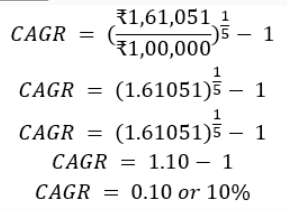
So, the CAGR is 10%, which means that although the mutual fund's returns may have varied from one year to another, the investment grew at an average annual rate of 10% over the five-year period (assuming all gains remained invested).
Looking to understand more investment concepts beyond CAGR? Read out educational articles on mutual fund types, investment returns, market trends, and other personal finance topics. |
CAGR vs Absolute/ Total Return: How Do They Differ?
Absolute return shows the total percentage by which your investment has increased or decreased from the time you invested until you redeemed it. It only compares the initial investment amount with the final value and does not consider how long the investment remained invested.
For example,
- Suppose you invest ₹1,00,000, and after 5 years, its value becomes ₹1,50,000.
- The investment has increased by ₹50,000, so the absolute return is 50%

In comparison, CAGR takes the investment period into account. It calculates the average annual growth rate required for the investment to grow from its initial value to its final value over a specified number of years.
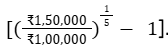
In the above example, although the total return is 50%, the CAGR is approximately 8.45% p.a.
For a better understanding, let’s study the detailed comparison below:
| Basis | Absolute Return | CAGR |
| What it Measures | Total gain or loss over the investment period | Average annual growth rate over the investment period |
| Considers Investment Duration | No | Yes |
| Assumes Compounding | No | Yes |
| Potential Use Cases | Short-term investments or when only total return is required | Long-term investments and comparing returns over different time periods |
Conclusion
So, now you know the CAGR full form, its meaning, and how it is calculated. If we were to revise, the CAGR full form in mutual funds is “Compound Annual Growth Rate”. It is a return metric that calculates the average annual growth rate of an investment over a specified period, assuming that all profits or gains are reinvested instead of being withdrawn.
To calculate CAGR, you may use the CAGR formula, where you need to input these three measures:
- The beginning value or original amount invested
- The ending value or the maturity amount
- The investment period (n)
Further, realise that the CAGR differs from absolute return, which shows the total percentage gain or loss over the investment period (ignoring the investment duration). In comparison, the CAGR factors in the time period and calculates the average yearly growth rate. Usually, it is the preferred metric for evaluating long-term investment performance.
For more information, you can visit www.tatamutualfund.com/deshkarenivesh . The Investor Service Centre of Tata Asset Management Pvt. Ltd. is located at Mulla House, Ground Floor, 51, M.G. Road, Near Flora Fountain, Mumbai – 400 001, Maharashtra. The office hours are Monday to Friday, 9:00 AM to 5:30 PM. For assistance, you can also call (022) 6282 7777 from Monday to Saturday, 9:00 AM to 5:30 PM, or email service@tataamc.com
CAGR FAQs
1. Is a higher CAGR always better when choosing a mutual fund?
As per general industry understanding, a higher CAGR may indicate that the mutual fund has delivered a better average annual growth rate over the selected period.
However, it should not be the only factor for making an investment decision. You may also consider the following:
- Fund's risk level
- Performance across different market conditions
- Portfolio quality
- Expense ratio
- CAGR generated by industry peers, and more
2. Can CAGR be negative in mutual funds?
Yes, if the value of your investment falls below the amount you originally invested, the CAGR could be negative. A negative CAGR indicates that the investment has lost value over the selected period and represents the average annual decline in your investment's value.
3. Should I use CAGR to calculate SIP returns?
As per general industry practice, CAGR is not suitable for calculating returns generated by SIP investments. That’s because each SIP installment is invested on a different date.
Since every investment remains invested for a different duration, CAGR may not accurately measure the returns. For SIPs, XIRR (Extended Internal Rate of Return) could be the more appropriate return metric.
Disclaimer:
An Investor Education and Awareness Initiative by Tata Mutual Fund .
To know more about KYC documentation requirements and procedure for change of address, phone number, bank details, etc., please visit: https://www.tatamutualfund.com/deshkarenivesh
Please deal only with registered Mutual Funds, details of which can be verified on the SEBI website under ‘Intermediaries / Market infrastructure institutions.’
All complaints regarding Tata Mutual Fund may be directed to service@tataamc.com and/or https://scores.sebi.gov.in/ (SEBI SCORES portal) and/or https://smartodr.in/login
Nomination is advisable for all folios opened by an individual, especially with sole holding, as it facilitates an easy transmission process.
This communication is a part of the investor education and awareness initiative of Tata Mutual Fund.
*Mutual Fund Investments are subject to market risks, please read all scheme related documents carefully.
Author Bio

Ashish Suryakant Pawar

What Are ETFs and Their Types
Written by Ashish Suryakant Pawar
21 Jul 2026 • 9 minutes read

Get closer to your financial goals
Start InvestingLoading Form...
Loading Similar Blogs...