

Tata CRISIL-IBX Financial Services 3-6 Months Debt Index Fund
NFOOther Schemes – Index Fund
- Minimum Amount
- NA
- Benchmark
- CRISIL-IBX Financial Services 3-6 Months Debt Index (TRI)
- Start Date
- 15 Sep 2026
- Closure Date
- 22 Sep 2026

Written by Tata Mutual Fund
18 Sep 2026 • 7 minutes read


You may have money that you don't need right away, but you may not want to lock it away for years either. So, where does that money fit?
One segment worth understanding is the 3–6 month debt market.
The Tata CRISIL-IBX Financial Services 3-6 Months Debt Index Fund gives investors a passive way to access this part of the debt market. It follows the CRISIL-IBX Financial Services 3-6 Months Debt Index, which focuses on eligible debt securities from the financial services sector with a 3–6 month maturity profile.
Sounds technical? It doesn't have to be.
Let's understand what 3–6 months actually means, how the strategy works and what you should know before considering the fund.
Table of Content

What Is a 3–6 Month Debt Index Fund?
A 3–6 month debt index fund is a passive mutual fund that follows a debt index with a defined 3–6 month maturity profile.
In this case, the underlying index focuses on eligible debt securities from the financial services sector. The fund aims to keep its portfolio aligned with this index rather than actively selecting securities with the aim of outperforming the benchmark.
Think of it as:
A defined maturity range + a defined universe + a rules-based approach.
How Does the Tata CRISIL-IBX Financial Services 3-6 Months Debt Index Fund Work?
So, where does the money actually go?
Under normal circumstances, 95% to 100% of the portfolio is invested in securities forming part of the CRISIL-IBX Financial Services 3-6 Months Debt Index. Up to 5% may be invested in permitted debt and money-market instruments, including Triparty Repo.
Not every financial services debt security makes the cut.
The underlying index looks at factors such as credit rating, maturity, outstanding amount and liquidity. Its eligible universe includes Certificates of Deposit (CDs), Commercial Papers (CPs) and Corporate Bonds from AAA-rated financial services issuers that meet the index criteria.
In other words, the fund follows a defined, rules-based index methodology.
Why Does the 3–6 Month Maturity Period Matter in Debt Investing?
Debt securities can mature in a few days, a few months or several years.
Why does that matter?
Because maturity can influence how sensitive a debt security's price is to changes in interest rates. Generally, longer-maturity securities may see greater price movements when interest rates change compared with shorter-maturity securities.
Here, the benchmark is designed to maintain a 3–6 month maturity profile, keeping it towards the shorter end of the debt market.
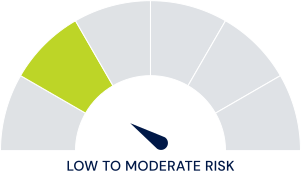
The scheme is classified under Potential Risk Class A-I – Relatively Low Interest Rate Risk and Relatively Low Credit Risk.
However, relatively low risk does not mean no risk.
There is also another interesting aspect of the 3–6 month maturity range: roll-down.
What Is a Roll-Down Strategy in a Debt Fund?
Roll-down may sound complicated, but the idea is quite simple.
Imagine a debt security with around six months left until maturity. As time passes, its remaining maturity keeps reducing:
6 months → 5 months → 4 months → 3 months
This movement towards maturity is commonly referred to as roll-down.
While the security is held, returns can be influenced by the income accrued on the security as well as changes in yields and market prices.
The underlying index is periodically reconstituted to maintain its defined 3–6 month maturity profile.
Under favourable yield-curve conditions, this movement may create potential roll-down benefits. However, such benefits depend on market conditions and are not assured.

Why Does the Index Focus on Financial Services Debt?
Banks, NBFCs and other financial institutions are participants in India's short-term debt market.
But the index doesn't simply include any security issued by a financial services company.
Eligible securities have to meet defined criteria around credit rating, maturity, outstanding amount and liquidity. The index universe includes eligible CDs, CPs and Corporate Bonds of AAA-rated financial services issuers.
The methodology also includes issuer and group-level limits to manage concentration, and the index is reconstituted quarterly.
So, instead of asking “Which security does the fund manager prefer today?”, the passive approach is built around a different question:
“Which securities meet the index rules?”
Liquid Fund vs 3–6 Month Debt Index Fund: What Is the Difference?
Both operate towards the shorter end of the debt market, but they are not the same.
Liquid Fund | 3–6 Month Debt Index Fund |
Invests in debt and money-market securities with maturity of up to 91 days | Underlying index maintains a 3–6 month maturity profile |
Operates at the very short end of the debt market | Goes somewhat further along the maturity curve |
Typically actively managed within category rules | Follows a passive, index-tracking approach |
Risk-return characteristics depend on the underlying portfolio | Risk-return characteristics depend on the underlying index, portfolio and tracking |
So, which one is better?
There isn't one answer for everyone.
A more useful question is: When might you need the money, and what level of risk are you comfortable with?
Your investment horizon, liquidity needs and risk appetite matter when evaluating different debt fund categories.
Who May Consider a 3–6 Month Debt Index Fund?
So, who might find this strategy relevant?
Investors looking at the shorter end of the debt market and comfortable with a passive, rules-based approach may consider a 3–6 month debt index fund.
It may also be relevant for investors looking at different maturity segments as part of their overall debt allocation.
One thing is important to understand:
The “3–6 months” refers to the maturity profile of the securities in the underlying index. It does not mean you have to remain invested for 3–6 months.
The Tata CRISIL-IBX Financial Services 3-6 Months Debt Index Fund is an open-ended scheme and has perpetual duration.
Whether the scheme is suitable for you will depend on factors such as your investment goal, intended holding period, liquidity needs and risk appetite.
To understand the scheme in more detail, explore the Tata CRISIL-IBX Financial Services 3-6 Months Debt Index Fund.
Explore the 3–6 Month Debt Segment
Disclaimers

What Are the Risks of Investing in a 3–6 Month Debt Index Fund?
Short maturity doesn't mean no risk. Neither does an AAA rating.
Like other debt mutual funds, the scheme can be exposed to interest-rate risk, credit risk, liquidity risk and market risk.
There is also concentration risk, since the underlying index focuses on the financial services sector.
And because this is an index fund, there can be tracking error. Simply put, the fund's performance may not exactly match the index it follows. Expenses, cash holdings, transaction timing, availability of securities and other operating factors can create a difference.
The scheme does not assure or guarantee returns, and there is no assurance that its investment objective will be achieved.
FAQs
The Tata CRISIL-IBX Financial Services 3-6 Months Debt Index Fund is an open-ended passive debt index fund. It follows the CRISIL-IBX Financial Services 3-6 Months Debt Index, which has a defined 3–6 month maturity profile and focuses on eligible debt securities from the financial services sector.
A 3–6 month debt index fund follows an underlying debt index designed around securities with a 3–6 month maturity profile. In this scheme, the underlying index focuses on eligible financial services debt securities that meet its rating, maturity, liquidity and other selection criteria.
No. The 3–6 months refers to the maturity profile of securities in the underlying index, not the life of the mutual fund scheme.
The scheme is open-ended and has perpetual duration.
As time passes, a debt security moves closer to maturity. For example, a security with around six months remaining maturity may gradually move towards five, four and three months.
This is commonly referred to as roll-down. Returns during this period can be influenced by accrual as well as changes in yields and market prices. Any potential roll-down benefit depends on market conditions and is not assured.
Liquid Funds invest in debt and money-market securities with maturity of up to 91 days. A 3–6 month debt index fund follows an index with a 3–6 month maturity profile.
This difference in maturity means their interest-rate sensitivity and risk-return characteristics can also differ.
No. AAA-rated does not mean risk-free.
The scheme may still be exposed to interest-rate risk, credit risk, liquidity risk, market risk, concentration risk and tracking error.
The scheme is classified under Potential Risk Class A-I – Relatively Low Credit Risk and Relatively Low Interest Rate Risk, but this classification should not be interpreted as a guarantee or absence of risk.
A Defined Approach to the Shorter End of Debt
Not all short-term debt strategies are the same.
The Tata CRISIL-IBX Financial Services 3-6 Months Debt Index Fund offers a passive way to access a defined 3–6 month maturity segment through a rules-based financial services debt index.
What matters is understanding where the fund invests, what the 3–6 month maturity profile means, how the strategy works and the risks involved.
If this part of the debt market fits your investment requirement and risk profile, explore the Tata CRISIL-IBX Financial Services 3-6 Months Debt Index Fund and review the scheme-related documents before making an investment decision.
Mutual Fund investments are subject to market risks, read all scheme-related documents carefully.
A Defined Approach to the Shorter End of Debt
Not all short-term debt strategies are the same.
The Tata CRISIL-IBX Financial Services 3-6 Months Debt Index Fund offers a passive way to access a defined 3–6 month maturity segment through a rules-based financial services debt index.
What matters is understanding where the fund invests, what the 3–6 month maturity profile means, how the strategy works and the risks involved.
If this part of the debt market fits your investment requirement and risk profile, explore the Tata CRISIL-IBX Financial Services 3-6 Months Debt Index Fund and review the scheme-related documents before making an investment decision.
*Mutual Fund Investments are subject to market risks, please read all scheme related documents carefully.
Author Bio

Tata Mutual Fund
Loading Form...
Loading Similar Blogs...
