


Small Cap Mutual Funds - Features, Benefits and How to Invest?
Written by Akshay Kumar Rao
15 Sep 2025 • 9 minutes read


A small-cap mutual fund is a category of equity-oriented schemes that invests in companies ranked 251st onwards in terms of full market capitalisation. As per SEBI Master Circular on Mutual Funds dated 27 June 2024, such funds must invest at least 65% of their total assets in such small-cap stocks.
These companies are usually younger businesses that are still growing. Now, because of their small size, they can deliver high growth; however, they are also more unstable and vulnerable during market downturns. Thus, these funds can be more suitable for very high-risk investors.
So, want to invest in small-cap MF schemes? In this article, let’s first learn about some key features and advantages of investing in small-cap mutual funds. Then, you will check out a small-cap MF scheme you can invest in 2025.
Table of Content

Key Features of Small-Cap Mutual Funds
Small-cap mutual funds can deliver potentially better returns, but they also carry higher risks compared to large-cap or mid-cap funds. As an investor, you should understand their unique features before committing money. Below are the main aspects you should know:
You May Earn Potential Returns (Alpha)
Small-cap companies are less studied by analysts and are not owned by many institutional investors. This gives fund managers a chance to find “undervalued stocks” that may grow into multi-bagger opportunities.
If these companies succeed, they can generate much potential higher returns than established large caps but comparatively with higher risk. However, these opportunities are not constant. Their success depends on the economic cycle and overall market conditions.
There Could Be Liquidity Risk
Small-cap stocks are not traded in very high volumes like large-cap stocks. Thus, when a fund manager wants to buy or sell large quantities, such low liquidity can negatively impact the stock price.
Your Portfolio Can Be Exposed to Higher Volatility
Small-cap MFs are highly volatile. Their NAVs can fluctuate more sharply than large-cap or multi-cap funds. During market downturns, it is common for them to lose a majority of their value. Sometimes, it becomes hard for investors to handle these losses emotionally.
Small-Cap Funds Can Be Sensitive to Market Cycles
Small-cap funds can deliver potential performance when:The economy is growing strongly
There is easy access to money (liquidity)
Investors are confident about the future
These are called “risk-on” phases, and during these periods, you can earn potential returns Alpha. However, in contrast, small-cap MFs can underperform when:Interest rates rise
Money supply becomes tight
International investors are reducing risk
In this way, small-cap mutual funds are exposed to “market cycle sensitivity”.
Small-Cap MF Schemes Require “Active Stock-Picking”
In some small-cap funds, performance can depend more on picking the right companies than following market trends. Small-cap schemes usually invest in businesses with:Strong growth potential
Competent management
Good financial metrics, such as high return on capital employed (RoCE)
Usually, fund managers of such schemes do not chase short-term stock price movements.
Disclaimer: The above features of small-cap funds are for educational purposes only. Investors must do their own research before investing.
4 Major Benefits of Investing in Small-Cap Mutual Funds

As mentioned before, small-cap MFs are risky. Thus, they should not dominate your portfolio.
With a long-term horizon, these schemes is suitable for investors seeking long term capital appreciation with a very high risk appetite. For your reference, below are some advantages you should know before investing:
Long Runway for Growth
Small companies start from a low base. They are businesses that can add products, expand capacity, and enter new regions without fighting giants everywhere. This helps small-caps in two major ways
A) Revenue Compounding
B) Increase in Profits > More Than Sales
Small companies often operate in industries where no single player dominates.
As they grow and capture more customers, their sales keep increasing year after year.
In some cases, it has been observed that even a modest increase in their market share led to a big jump in revenue due to a low base.
As a small company grows, some costs (like rent, machinery, or management expenses) remain the same.
When sales increase, these fixed costs are spread across more units sold.
As a result, the company keeps a larger share of each rupee earned as profit.
This makes profit grow faster than sales.
Such a growth runway is hard to find in mature large caps.
Possibility of Mergers and Acquisitions (M&A)
Small-caps are often attractive targets for larger companies. When a small company is acquired or merged with a bigger company, there may be a sudden price appreciation.
Why? This happens because investors expect the combined company to grow faster (realisation of “synergy ”) after the merger. The rise also comes from the belief that the merged business will create more profits.
Can Enjoy “Valuation Discovery” Growth
Many small caps receive limited analyst coverage. They are also not preferred by institutional investors. Due to such a lack of interest, their prices can lag behind business progress.
Now, as results improve and disclosures strengthen, more investors notice the story. This may increase the stock's valuation. At this time, a small-cap MF holding such stocks gains from:
Earnings growth
and
Multiple expansions
That’s why a good small-cap MF always searches for these “undiscovered but improving” businesses and enters before they become popular.
Potential Returns at the Time of Index Migration
Good businesses migrate from small-cap to mid-cap indexes as their market value increases. They move up from below the 250th rank into the mid-cap segment, which includes companies ranked 101st to 250th by market capitalisation.
Now, when this happens, it triggers buying from mid-cap passive funds. This leads to:
More demand for the small-cap stock due to “index inclusion buying”.
More analyst attention as brokerage houses and research firms start tracking the company (this improves visibility).
Higher trading volumes, which make it easier for investors to buy and sell
A shift in investor base from retail to institutional investors, such as mutual funds, insurance firms, and pension funds.
All of this can create strong stock price increases of mid-cap stocks. That’s why a skilled small-cap MF manager always tries to build positions before such upgrades.
Disclaimer: The above benefits of investing in small-cap funds are for educational purposes only. Investors must do their own research before investing.
Tata Small-Cap Mutual Fund Scheme You May Consider to Invest in 2025
If you are planning to invest in small-cap MF schemes, Tata Mutual Fund offers some good options. You can begin with as little as ₹100 through SIP or ₹5,000 as a lump sum. Investors can also choose between two options under the Direct and regular plan:
The “growth” option, where earnings are reinvested
or
The “IDCW (Income Distribution cum Capital Withdrawal)” option, where dividends are paid out to you.
Now, let’s have a look at a small-cap mutual fund scheme you can consider in 2025:
Tata Small Cap Mutual Fund
An open-ended equity scheme predominantly investing in small cap stocks
| Inception | Exit Load | Benchmark | Scheme Risk Level | Benchmark Risk Level |
| 12 November 2018 | NIL (0.50% when redeemed on or before 30 days from the date of allotment) | Nifty Smallcap 250 TRI | Very High Risk | Very High Risk |
Tata Small Cap Mutual Fund can invest in smaller companies expected to grow over the next 3 to 4 years. The fund compares its returns with the benchmark small-cap 250 index. It can look for businesses with:
- Low debt
- High free cash flow
- Fair valuations
This small-cap mutual fund scheme can also follow a “Growth at a Reasonable Price” philosophy. The fund managers of this plan can select companies following these two techniques:
| A) Low Churn | B) Bottom-up Approach |
| It can hold quality businesses for the medium to long term rather than frequent trading. | It can pick stocks based on individual business strength and valuations (not just market trends). |
Furthermore, this scheme can avoid “global commodity companies” as their earnings depend heavily on price cycles rather than business fundamentals.
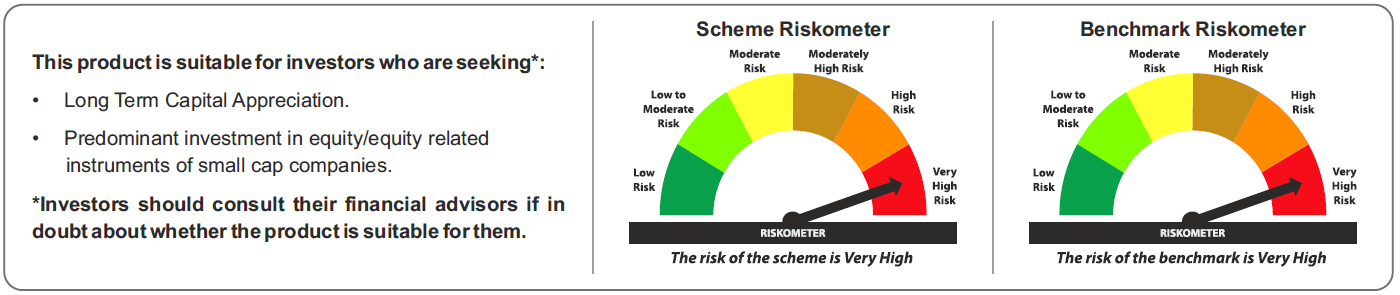
It may be noted that risk-o-meter specified above is based on internal assessment. The same shall be updated as per provision no. 17.4.1.i of SEBI Master Circular on Mutual Fund dated 27.06.2024, on Product labelling in mutual fund schemes on ongoing basis.
Conclusion
Small-cap mutual funds are equity schemes that invest at least 65% of their portfolio in companies ranked 251st onwards by full market capitalisation (as defined by SEBI). These funds carry higher risk compared to large-cap and mid-cap funds, but they also provide investors seeking to earn potential returns over the long term.
Be aware that mutual fund schemes can follow two approaches: active funds, where managers carefully pick stocks, and passive funds, which simply track an index.
For investors considering small-cap exposure, Tata Mutual Fund offers options. If you prefer an actively managed strategy, the Tata Small Cap Fund can be considered.
Disclaimers:
The views mentioned above are for information & educational purposes only and do not construe to be any investment, legal or taxation advice. Investors must do their own research before investing. The views expressed in this article are personal in nature and in is no way trying to predict the markets or to time them. Any action taken by you on the basis of the information contained herein is your responsibility alone and Tata Asset Management Pvt. Ltd. will not be liable in any manner for the consequences of such action taken by you. Please consult your Mutual Fund Distributor before investing. The views expressed in this article may not reflect in the scheme portfolios of Tata Mutual Fund. There are no guaranteed or assured returns under any of the scheme of Tata mutual Fund.
*Mutual Fund Investments are subject to market risks, please read all scheme related documents carefully.
Author Bio

Akshay Kumar Rao

Loading Form...
Loading Similar Blogs...