


Potential Long-Term Financial Growth with Large-Cap SIPs: A 10-Year Retrospective
Written by Akshay Kumar Rao
31 Dec 2025 • 7 minutes read


A mutual fund is an investment vehicle that collects money from several investors and uses it to buy a mix of assets, primarily equity shares and bonds. Now, if we talk about the latter, the equity portfolio of a mutual fund consists of companies of different sizes.
A company’s size is measured by its “market capitalisation”, which shows the total market value of that company. Now, based on this value, companies fall into three groups:
Large-cap companies, ranked 1st to 100th
Mid-cap companies, ranked 101st to 250th
Small-cap companies, ranked 251st and below
Okay, so where does a large-cap mutual fund invest? As per SEBI guidelines, it must invest at least 80% of its total assets in such large-cap companies. Since such businesses are established, mature, and usually profitable, several investors run large-cap SIPs for potential long-term financial growth.
Want to learn how? Read this article to learn everything about wealth building using large-cap funds.
Table of Content

Why SIPs are a Preferred Route for Long-Term Investors?
A Systematic Investment Plan (SIP) lets you invest a fixed amount in a mutual fund every month instead of making a large one-time investment. The amount can be as low as ₹500 (or ₹250 under Chhoti SIP). Once you set up a SIP, your bank account is debited automatically, which removes the need for manual payments.
Nowadays, SIPs have become highly popular among mutual fund investors. Let’s check out some official data (Source: AMFI India) that supports this popularity trend:
Nearly 9.9 crore SIP accounts were active in Oct 2025, showing strong long-term participation.
In October 2025, 60.25 lakh new SIP accounts were registered.
If we talk about the total SIP contribution for Oct 2025, it touched ₹29,529 crore. This marks a strong 11% increase from ₹26,632 crore collected in April 2025.
So, these statistics clearly show that several investors are now choosing the SIP route for potential capital appreciation. Okay, but why? That’s largely because of these two major reasons:
| Rupee Cost Averaging | Investment Discipline |
|
|
How do Large-Cap SIPs support Long-Term Financial Growth?
Large-cap funds invest 80% of their assets in the top 100 companies (in terms of full market capitalisation). Usually, these entities are market leaders and may have:
Strong business models
High profitability
A long track record of performance
When you invest in them through a large-cap SIP, you may combine two powerful advantages:
The stability of large-cap companies +
The discipline of monthly investing.
Let’s see how this combination supports long-term capital appreciation:
| Factor | Explanation |
| Stability In Uncertain Markets |
|
| Lower Risk Compared To Other Equity Categories |
|
| Natural Compounding Through SIPs |
|
| Rupee Cost Averaging |
|
| Strong Long-Term Performance Track Record |
|
Large-Cap Schemes Offered by Tata Mutual Fund™ in 2025
If you are looking to make investments, you may consider these two mutual fund schemes offered by Tata Mutual Fund™:
Both schemes are available in Direct and Regular plans, and each offers Growth and IDCW (Income Distribution cum Capital Withdrawal) options. For better understanding, let’s look at what these investment products are and how they work:
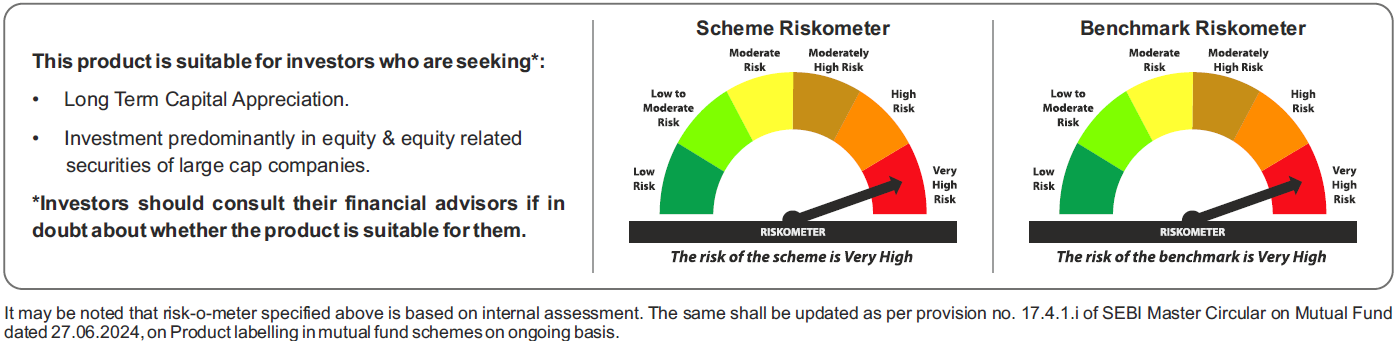
1. Tata Large Cap Fund
(An open-ended equity scheme predominantly investing in large-cap stocks)
| Inception | Exit Load | Benchmark | Scheme Riskometer | Benchmark Riskometer |
| 7th May 1998 |
| Nifty 100 TRI | Very High Risk | Very High Risk |
The investment objective of the scheme is to provide income distribution and/or medium to long-term capital gains while at all times emphasising the importance of capital appreciation. However, there is no assurance or guarantee that the investment objective of the scheme will be achieved.
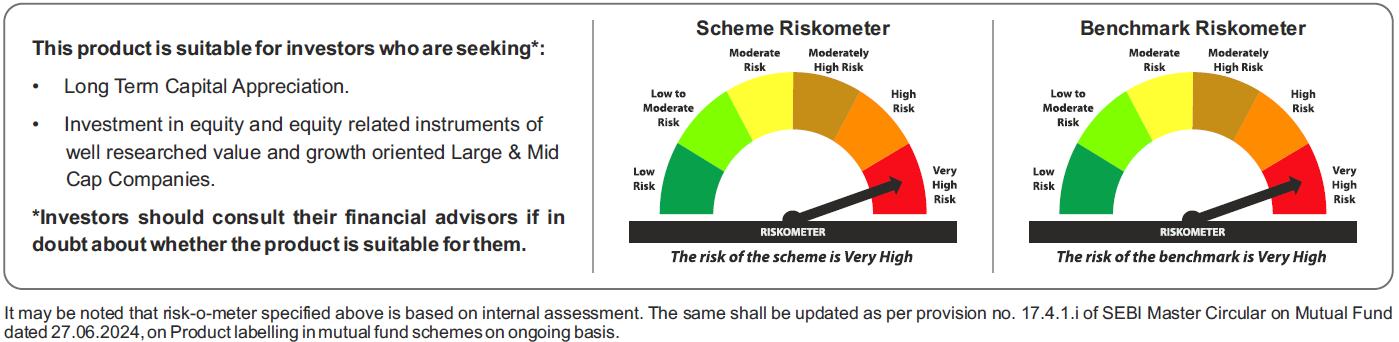
2. Tata Large and Midcap Fund
(An open-ended equity scheme investing in both large-cap and mid-cap stocks)
| Inception | Exit Load | Benchmark | Scheme Riskometer | Benchmark Riskometer |
| 25 February 1993 |
| Nifty Large Midcap 250 TRI | Very High Risk | Very High Risk |
The investment objective of the scheme is to provide income distribution and/or medium to long-term capital gains while at all times emphasizing the importance of capital appreciation. However, there is no assurance or guarantee that the investment objective of the scheme will be achieved.
Conclusion
So now you know why large-cap SIPs are a preferred way to build long-term wealth. They offer stability, reduce timing risk, and allow compounding to work without interruption. Let’s recap why several investors rely on them:
Large companies may stay stable during market volatility.
Risk of deep losses is lower compared to mid- and small-caps.
Monthly SIPs could strengthen the compounding process.
“Rupee Cost Averaging” may balance your long-term investment cost.
If you are looking for long-term investment plans, Tata Mutual Fund offers two options worth exploring: Tata Large Cap Fund and Tata Large and Midcap Fund. Both are open-ended schemes and offer equity exposure.
Disclaimers:
The views mentioned above are for information & educational purposes only and do not construe to be any investment, legal, or taxation advice. Investors must do their own research before investing. The views expressed in this article are personal in nature and in is no way trying to predict the markets or to time them. Any action taken by you on the basis of the information contained herein is your responsibility alone, and Tata Asset Management Pvt. Ltd. will not be liable in any manner for the consequences of such action taken by you. Please consult your Mutual Fund Distributor before investing. The views expressed in this article may not reflect in the scheme portfolios of Tata Mutual Fund. There are no guaranteed or assured returns under any of the schemes of Tata Mutual Fund.
*Mutual Fund Investments are subject to market risks, please read all scheme related documents carefully.
Author Bio

Akshay Kumar Rao

Loading Form...
Loading Similar Blogs...