


Navigating the Fine Print: What to Know Before Investing in Commodity ETFs
Written by Akshay Kumar Rao
24 Dec 2025 • 9 minutes read


A commodity ETF is a type of mutual fund that invests in physical commodities, such as gold, silver, oil, natural gas, or agricultural products. They allow investors to gain exposure to such commodities without needing to directly invest in physical commodities.
Okay, but how? Instead of buying gold / silver bars or storing oil, you buy units of a commodity exchange-traded fund listed on the stock market. Each unit represents your share in a “pool of money”.
This pool follows the price of a specific commodity or a basket of commodities. When the price of that commodity rises or falls, the value of your ETF units moves in the same direction.
So, are you looking to invest in a commodity ETF? Read this article to first learn about the five major factors you must analyse before committing funds. Also, check out some commodity exchange-traded funds offered by Tata Mutual Fund™.
Table of Content

5 Factors to Analyse Before Investing in Commodity ETFs
Before choosing a commodity ETF, you must be 100% clear about why you want it in your portfolio. Commodity ETFs can serve different roles, such as, they can be used to:
Hedge inflation
Add diversification
Exploit short-term opportunities
Each purpose demands a different mindset and holding period. Now, after deciding on your purpose, make an evaluation based on the following factors:
1. Understand What the ETF Actually Holds
When you buy a commodities ETF, you must first know what sits behind it. Some ETFs own the real commodity, for example, gold or silver bars stored in a vault. These are called “physical ETFs”.
Others do not hold the commodity itself. Instead, they use futures contracts, which are agreements to buy or sell the commodity at a later date. Let’s understand these two commodity ETF types in detail:
| Aspects | Physical Commodity ETF | Futures-Based Commodity ETF |
| What it holds | Actual commodity | Futures contracts |
| How price moves | May move almost the same as the real market price of the commodity (spot price) | Does not always move exactly like the real market price because “futures prices” change |
| Why does it move differently | Since it holds the real asset, so value changes only when the commodity price changes. | Futures expire, so the ETF must replace old contracts with new ones. This directly influences the performance of the ETF, and in turn, its price. |
| When a mismatch can happen | Rarely | Common, because new futures may be costlier or cheaper than old ones |
So, before you invest, check the “fund factsheet” to see whether the ETF is marked as:
Physical
Spot
Futures-based
This single detail influences your return pattern and risk level.
2. Check How Easily You Can Enter or Exit the ETF
Before investing in a commodity ETF, make sure you can buy or sell units without facing pricing issues. This depends on liquidity, which reflects how active the ETF is in the market. If an ETF has low trading activity, even a small order can lead to major fluctuations in its price.
The bid–ask spread is another signal. For those unaware, it represents the gap between:
The price buyers offer and
The price sellers want
A wide spread increases your trading cost because you pay more when buying and get less when selling. Thus, as an investor, you should review:
Average daily trading volume
Assets under management (AUM)
The usual bid–ask spread on the exchange
Commodity ETFs with higher liquidity + narrower spreads may be preferred.
3. Assess The Stability of ETF’s Counterparties
Some commodity ETFs do not buy the real commodity! Instead, they use swaps or other financial agreements with external parties. These parties are called “counterparties,” who may promise, “We will give your ETF the same return as the commodity price.”
Let’s understand better through an example:
Let’s say a precious metals exchange-traded fund does not hold gold or silver in its physical form.
Instead, it has an agreement with another company that says, “If gold goes up 5%, we will pay you that 5%.”
So the ETF depends on that company to honour the promise.
Now, if the counterparty company faces financial distress and cannot pay the ETF what it promised, the ETF may lose money even if the commodity price goes up. This is known as counterparty and credit risk.
To pick the right financial product, you should check as an investor
Who are the companies the ETF is depending on?
Are the agreements protected with collateral?
Does the ETF hold assets separately in case a counterparty fails?
4. Study How “Futures Prices” May Change
If the ETF uses futures, you must understand how the futures market behaves. Note that futures expire, so the fund keeps replacing old contracts with new ones. This process is called “rolling”.
Now, understand that the price of the new contract can be higher or lower than the old one. This leads to two unique market situations:
| Situation I: Contango | Situation II: Backwardation |
|
|
This gain or loss is known as “roll yield” and directly influences the returns of a commodity ETF. Okay, but how can I check it? You can study this by:
Reviewing the ETF’s long-term performance versus the spot price +
Reading the fund’s commentary on its roll strategy.
5. Check How Closely the ETF Follows the Commodity
“Tracking error” shows how accurately the ETF mirrors the price of the commodity it claims to follow. A perfect ETF (hypothetically) would rise and fall at the same rate as the commodity. However, in reality, ETFs lag or deviate due to:
Fees (say expense ratio)
Operational costs
Futures roll impact
Liquidity issues
Always remember that a high tracking error may signal that the ETF is not accurately capturing the movement of the underlying commodity. To judge this, you can look for “historical tracking error” from the ETF factsheet.
Next, compare this error across 1-year, 3-year, 5-year & since inception periods. A commodity ETF with consistently low tracking error may be preferred.
Commodity ETFs Offered By Tata Mutual Fund™ You May consider in 2025
If you are an investor specifically searching for precious metals exchange-traded funds, Tata Mutual Fund™ offers these gold and silver ETF schemes:
- Tata Silver Exchange Traded Fund and
- Tata Gold Exchange Traded Fund
Both financial products are physical ETFs, come as direct plans, and are backed by real commodities. Let’s understand both these products in detail:
1. Tata Silver Exchange Traded Fund
(An Open-Ended Exchange Traded Fund replicating/tracking the domestic price of Silver)
| Inception | Exit Load | Benchmark | Scheme Riskometer | Benchmark Riskometer |
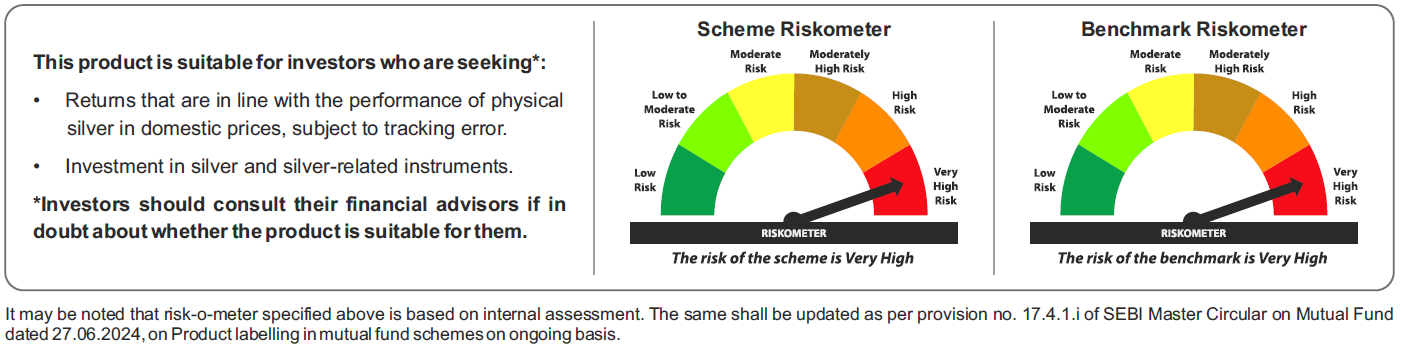
| 12 February 2024 | NIL | Domestic Price of | Very High Risk | Very High Risk |
The investment objective of the fund is to generate returns that are in line with the performance of physical silver in domestic prices, subject to tracking error. However, there is no assurance or guarantee that the investment objective of the Scheme will be achieved.
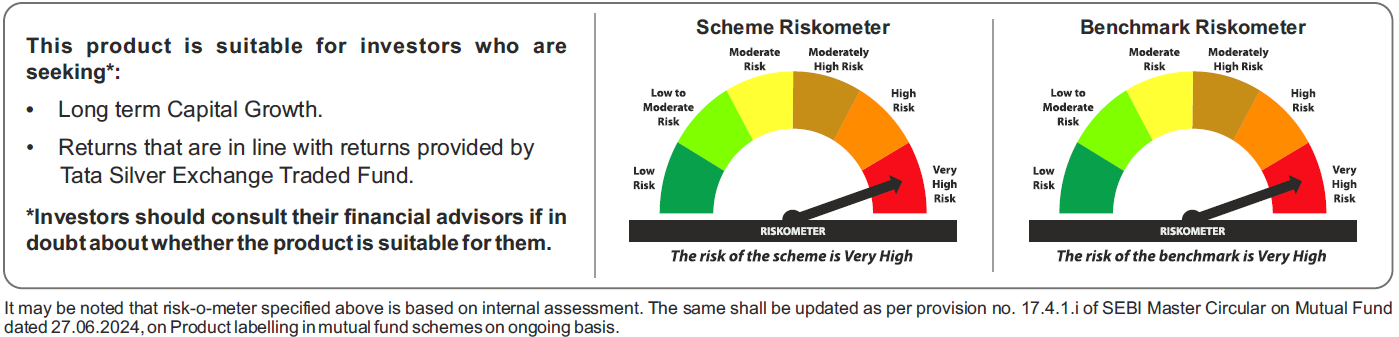
Besides, Tata Mutual Fund™ also offers Tata Silver ETF Fund of Fund (FoF), which is an open-ended fund of fund scheme investing in Tata Silver Exchange Traded Fund.
Tata Silver Exchange Traded Fund Riskometer
Tata Silver ETF Fund of Fund Riskometer
2. Tata Gold Exchange Traded Fund
(An Open-Ended Exchange Traded Fund replicating/tracking the domestic price of Gold)
| Inception | Exit Load | Benchmark | Scheme Riskometer | Benchmark Riskometer |
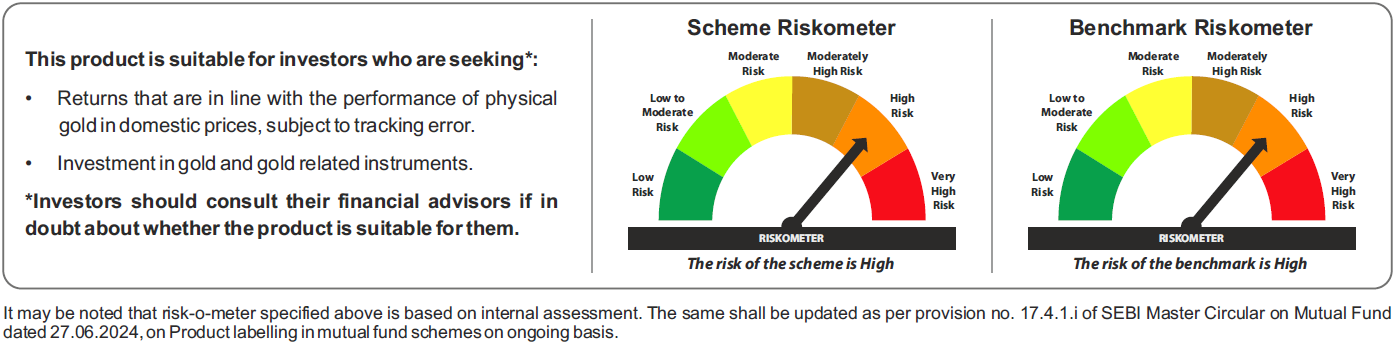
| 12 February 2024 | NIL | Domestic Price of | High Risk | High Risk |
The investment objective of the fund is to generate returns that are in line with the performance of physical gold in domestic prices, subject to tracking error. However, there is no assurance or guarantee that the investment objective of the Scheme will be achieved.
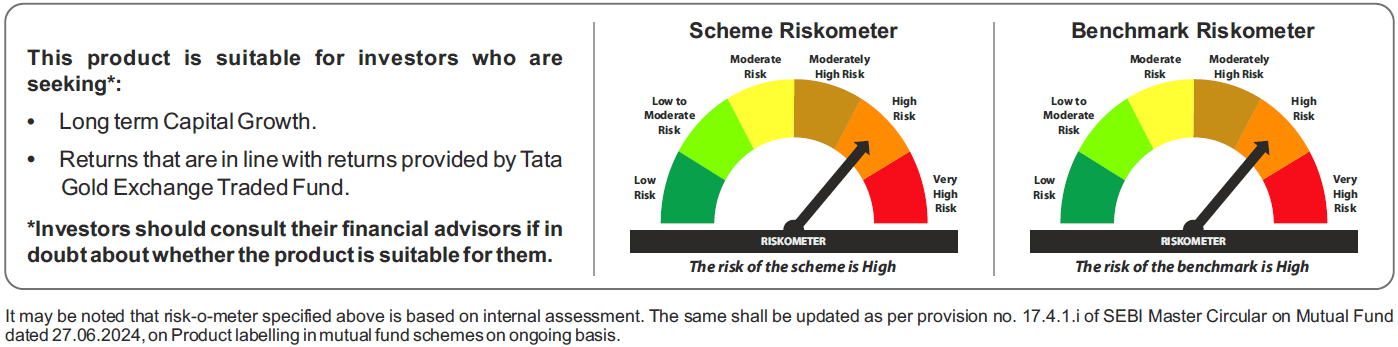
Besides, Tata Mutual Fund™ also offers Tata Gold ETF Fund of Fund (FoF), which is an open-ended fund of funds scheme investing in Tata Gold Exchange Traded Fund.
Tata Gold Exchange Traded Fund Riskometer
Tata Gold ETF Fund of Fund Riskometer
Conclusion
So now you know that commodity ETFs are investment products that let you participate in the price movement of various commodities (such as gold, silver, etc.) without owning or storing the commodity yourself.
They trade like normal stocks, and you can buy or sell them during market hours through your Demat and trading account. However, before investing in the commodity exchange-traded funds, you may check the following:
Type of ETF, whether they are physical or futures-based
Expense ratio and any additional costs
Tracking error over different time periods
Liquidity and bid–ask spread
Role in your portfolio and your comfort with volatility
*Mutual Fund Investments are subject to market risks, please read all scheme related documents carefully.
Author Bio

Akshay Kumar Rao

Loading Form...
Loading Similar Blogs...