


How to Choose the Right Small-Cap Fund: A Deep Dive into Fund Manager Expertise
Written by Akshay Kumar Rao
24 Dec 2025 • 9 minutes read


A small-cap fund is an equity scheme that must invest at least 65% of its total assets in small-cap stocks. As per SEBI, such companies are ranked 251st and below in terms of total market capitalisation. Since these companies are still in their “early growth stage”, their share prices are more volatile and risky as compared to large- and mid-cap stocks (particularly in the short or medium term).
However, small-cap fund returns could be comparatively higher. These businesses may have more room to expand their operations and enter new markets. When this growth happens, their share prices can rise sharply.
But much of this growth is dependent on the skill level of the fund manager. Why? That’s because:
Small-cap companies are harder to analyse
Their financial information is limited
Their business models may still be evolving
Here, a capable manager must identify which companies have genuine growth potential and avoid those with weak fundamentals. So, are you looking to invest in small-cap MF schemes? Read this article to first learn how to pick a small-cap fund after thoroughly analysing the fund manager's expertise.
Table of Content

What Does “Expertise of a Fund Manager” Mean?
Expertise refers to the knowledge, judgment, and skill a fund manager uses to choose the right stocks + build a strong portfolio. It covers the following aspects:
| Aspect of Expertise | Meaning |
| Research Ability |
|
| Stock-Picking Skill |
|
| Market Judgment |
|
| Portfolio Construction |
|
| Discipline And Process |
|
Together, this is called the manager’s expertise. Now, understand that most active small-cap mutual funds depend strongly on the fund manager’s skills. But why? That’s because small companies usually lack detailed information. This creates a higher risk of wrong selection.
Additionally, small-cap stocks are more volatile, and their market price can fluctuate sharply. This increases the importance of a small-cap fund manager as they must:
Identify small companies with genuine potential
Assess whether their growth is sustainable
Decide the right time to enter or exit a position.
How to Analyse Small-Cap Fund Managers’ Expertise Before Investing?
So far, you must have understood the importance of a fund manager’s skills and expertise in managing a small-cap mutual fund. Now, let’s see how you can evaluate it using different parameters:
1. Check the Fund Manager’s Past Track Record
A fund manager’s track record shows how they have performed across different market conditions. Always remember that small-cap MF investing could be “unpredictable”, so you need a manager who has handled this segment for a longer duration (say 5 to 7 years or more).
Also, you may compare their performance with the small-cap index (benchmark) over 3, 5, 10 years and since inception. If the manager’s returns swing too sharply or only look good in one year, it signals inconsistency.
2. Analyse Risk-Adjusted Returns
Risk-adjusted returns show whether the manager is delivering growth without taking unnecessary risks. Let’s see some metrics you may use to analyse a small-cap fund manager’s skills:
| Metric | What Does it Mean? | How to Use It to Judge Manager Skill? |
| Alpha |
|
|
| Sharpe Ratio |
|
|
| Maximum Drawdown |
|
|
| Downside Capture Ratio |
|
|
3. How the Manager Finds Quality Small Companies
“Research depth” shows how the manager studies companies before investing. Be aware that most small companies release limited information. Thus, the manager must build a strong research process, which may include a method for:
Checking company financials
Studying the business model
Deciding when to sell
For example, let’s say a manager only talks about “bottom-up investing” without showing a real process (how they find companies or value them), it is a warning sign.
4. Evaluate the “Team Strength”
Realise that small-cap MF investing requires continuous research, and one person cannot study everything alone! A skilled manager usually works with experienced analysts and co-managers who support:
Research
Valuation work
Company tracking
As an investor, you may evaluate the team strength by looking at the tenure of team members. That’s because:
Experience Matters: Longer-tenured members have handled different market conditions and know how to respond during market volatility.
Consistency in Strategy: An experienced team is more likely to stick to the fund’s investment approach rather than frequently changing styles, which can affect performance.
Reduced Risk: Frequent staff changes can create uncertainty and negatively impact returns.
5. Is the Fund Manager Capable of Controlling Portfolio Risk?
Strong risk management shows how the fund protects capital (not just how it grows it). As an investor, you may start checking whether the manager follows limits, such as:
How much can they invest in a single stock, sector, or illiquid asset?
These limits prevent oversized positions and could reduce the chance of large losses. Also, you may prefer fund houses, which usually have:
Compliance checks
Internal audits
A risk committee that monitors decisions without bias
6. How The Fund Manager Performs Under Pressure in Tough Markets
Past market stress reveals how disciplined a manager truly is! You may review:
How did they behave during corrections or crashes? and
Did they sell out of fear, or did they hold positions based on a clear thesis?
Okay, but how to check for it? You may look for commentary, case studies, or reports that explain their decisions during those periods. While analysing, specifically look for reasons why certain stocks or sectors were bought or sold. This shows a mutual fund team’s approach to risk management.
Searching Options? You May Consider the Tata Small Cap Fund in 2025!
Tata Small Cap Fund is an open-ended equity scheme predominantly investing in small-cap stocks. It has been in existence since 12 November 2018 and is available in both growth and IDCW (Income Distribution Cum Capital Withdrawal) options. For more clarity, let’s check out some of its primary features:
1. Investment Objective
The investment objective of the scheme is to generate long-term capital appreciation by predominantly investing in equity and equity-related instruments of small-cap companies. However, the scheme does not assure or guarantee any returns
2. Benchmark Index Used for Comparison
This fund measures its performance against the Nifty SmallCap 250 TRI index. It includes the 250 companies that fall in the 251st to 500th position by market size within the Nifty 500 universe .
The index uses the free-float market capitalization method, which means only the shares that are available for trading in the open market are counted (not promoter-held shares).
3. NAV Disclosure
Tata Small Cap Fund calculates and publishes its Net Asset Value (NAV) at the close of every business day. This ensures investors can track the value of their units regularly.
4. Exit Load (Redemption Charges)
If you redeem or switch out within 30 days of allotment, you pay a 0.50% exit load.
After 30 days, there is no exit load.
5. How the Scheme Invests (Asset Allocation)
Under normal market conditions, the fund may invest in the following manner:
| Asset Type | Minimum | Maximum |
| Equity and equity-related instruments of small-cap companies | 65% | 100% |
| Equity and equity-related instruments of other than small-cap companies | 0% | 35% |
| Debt and money-market instruments (including units of debt and liquid schemes of Tata Mutual Fund™) | 0% | 35% |
| Units of REITs and InvITs | 0% | 10% |
6. Risk Level
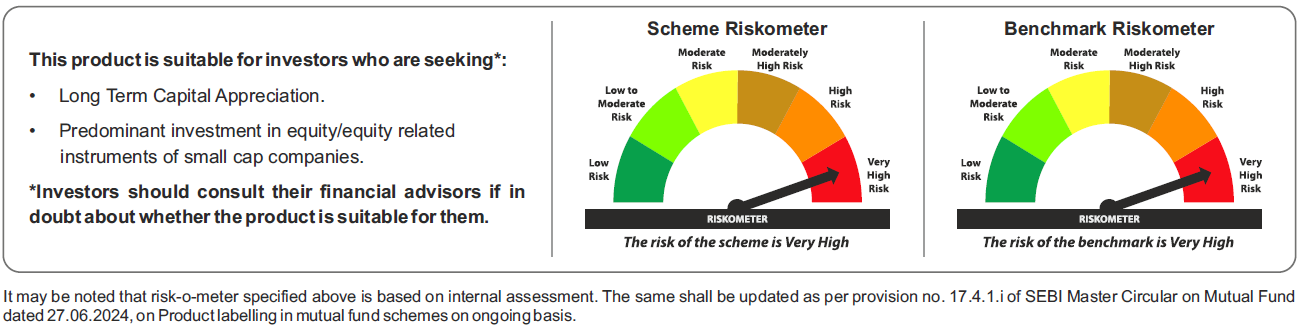
Investors must understand that their capital may be exposed to “very high risk.” Also, this scheme may suit investors with long-term horizons and a greater risk tolerance limit.
Conclusion
Till now, you must have understood that small-cap funds cannot be judged solely on their past performance. A fund manager’s expertise also plays a critical role in determining not only the potential returns a fund may deliver but also how it responds during market stress or volatility.
Be aware that small-cap stocks are inherently riskier and require deep research + careful stock selection. Therefore, assessing a manager’s skill is as important as evaluating the fund’s track record.
To make a thorough assessment, you may analyse the following parameters:
Research and stock-picking skills
Ability to identify growth opportunities.
Portfolio construction approach
Risk management techniques
Behaviour during stress
Disclaimers
The views mentioned above are for information & educational purposes only and do not construe to be any investment, legal, or taxation advice. Investors must do their own research before investing. The views expressed in this article are personal in nature and in is no way trying to predict the markets or to time them. Any action taken by you on the basis of the information contained herein is your responsibility alone, and Tata Asset Management Pvt. Ltd. will not be liable in any manner for the consequences of such action taken by you. Please consult your Mutual Fund Distributor before investing. The views expressed in this article may not reflect in the scheme portfolios of Tata Mutual Fund. There are no guaranteed or assured returns under any of the schemes of Tata Mutual Fund.
*Mutual Fund Investments are subject to market risks, please read all scheme related documents carefully.
Author Bio

Akshay Kumar Rao

Loading Form...
Loading Similar Blogs...