


Lumpsum vs. SIP: Timing the Long-Term Infrastructure Cycle and Infrastructure Mutual Fund
Written by Akshay Kumar Rao
25 Feb 2026 • 7 minutes read


Infrastructure mutual funds are a type of “sectoral” scheme. As per SEBI regulations, such funds invest at least 80% of their assets in equity and equity-related instruments of companies that operates in the infrastructure sector.
Usually, an infrastructure fund derives its “return potential” from capital expenditure (CAPEX) and policy support directed toward the infrastructure sector.
Recently, in the Union Budget 2026–2027, the Government of India allocated ₹12.2 lakh crore toward public CAPEX to improve national infrastructure. Moreover, infrastructure-related ministries have been directed to introduce a three-year pipeline of projects under the Public-Private Partnership (PPP) model. (Source: PIB)
So, are you looking to invest in 2026? And if yes, what’s the “right” way - SIP or lump sum? Read this article to first learn about the long-term “infrastructure cycle” and then see which investment mode might suit you. Lastly, we will know about the Tata Infrastructure Fund offered by Tata Mutual Fund™ and its primary features.
Table of Content

Why the Infrastructure Sector Has a Long-Term Cycle?
Realise that infrastructure is a “cyclical + policy-dependent” sector. Its performance depends on:
Government spending
Project approvals
Execution timelines
Funding availability
Economic growth
Most infrastructure projects (roads, railways, power plants, urban projects) take years to plan and complete. To understand better, let’s have a look at the 5-stage infrastructure investment cycle:
| Stage | What Happens | What It Means for Infrastructure Companies |
| 1. Policy Announcement/ Budget Allocation | The Government of India announces higher capital expenditure or sector reforms in the Union Budget. | Signals future project flow + funding support. |
| 2. Project Approvals and Tendering | Ministries and agencies invite bids and award contracts. | Companies secure new orders and expand their order books. |
| 3. Order Inflows | Infrastructure firms report confirmed contracts. | Revenue visibility improves based on order backlog. |
| 4. Execution Phase | Companies begin construction and implementation. | Costs are incurred, and revenues are recognised gradually. |
| 5. Revenue and Profit Growth | Projects reach advanced stages or completion. | “Earnings growth” may become visible in financial results. |
Now, at the same time, it is also important to talk about the “gestation period” in infrastructure.
Infrastructure Projects Have a “Long Gestation Period”
Gestation period refers to the time between project announcement and revenue generation. During this time:
Regulatory approvals and land acquisition may cause delays.
Revenue recognition happens gradually.
Profitability may not immediately reflect order inflows.
Now, due to this long gestation cycle, infrastructure stocks may remain volatile in the short term. This is why infrastructure mutual funds requires a longer investment horizon + very high risk tolerance.
What Could be the “Right Investment Approach - SIP or Lumpsum?
When investing in infrastructure mutual funds in 2026, the decision between SIP (Systematic Investment Plan) and lump sum should be based on the three realities of the sector:
Long economic cycles
Extended gestation periods
High short-term volatility
Now, let’s see how SIP vs. lump sum behaves when it comes to investing in an infrastructure fund:
A) How SIP May Behave
Infrastructure growth happens after several years as its economic cycles are long + uneven. An SIP spreads your investment through fixed periodic contributions and:
Reduce timing risk
Average purchase cost during volatility
Capture different phases of the infra cycle
Saves you from “timing the market entry”
But there is a limitation too! Let’s say the infrastructure sector enters a bull run or upward phase soon after you begin investing. Now, an SIP may capture gains gradually rather than capturing the full benefit from the outset.
B) How Lump Sum May Behave
In the lump sum mode, you invest a sum of money up front. Since infrastructure is a cyclical sector, a lump-sum investment can behave differently depending on the timing of entry. It might:
Capture the full upside if invested at the early stage of a capex cycle.
Aim to Benefit from “sector re-rating” and earnings expansion.
May Generate potentially returns if valuations are attractive at entry.
However, the risks are equally significant. You may be exposed to:
High timing risk
Sharp drawdowns (say the sector corrects after entry)
Long waiting periods (say, potential earnings growth is delayed due to execution or policy hurdles)
So, what can you learn? A lump-sum investment in infrastructure funds may deliver better gains if timed near the start of a growth cycle. But it also carries higher downside risk. If the sector corrects after your investment, short-term losses can be significant.
So, Which Mode Is Better for Infrastructure Mutual Funds?
There is no single answer! The choice between SIP vs. Lump sum depends on:
Your risk tolerance
Market valuations
Stage of the infrastructure cycle
Investment horizon
Still, if you need an option, SIP could be more suitable due to the sector’s short-term volatility + long execution timelines. In contrast, a lump-sum investment may be considered when you observe signals that a new infrastructure growth cycle is beginning, such as:
Rising CAPEX allocations or
Strong order inflows
As an investor, you can also follow a combined approach of “partial lump sum + ongoing SIP”.
Searching For Schemes? You May Consider the Tata Infrastructure Fund in 2026
The Tata Infrastructure Fund is an open-ended equity scheme investing in the infrastructure sector. The investment objective of the scheme is to provide income distribution cum capital withdrawal and/or medium to long-term capital gains by investing predominantly in equity and equity-related instruments of the companies in the infrastructure sector.
However, there is no assurance or guarantee that the investment objective of the scheme will be achieved. The scheme does not assure or guarantee any returns.
For more clarity, let’s have a look at some of its primary features:
| Feature | Details |
| Scheme Name | Tata Infrastructure Fund |
| Category | Equity Scheme – Sectoral |
| Inception Date | 31 December 2004 |
| Benchmark | BSE India Infrastructure TRI |
| Plan Types |
|
| Investment Options |
*IDCW sub-options are “payout” and “re-investment”. |
| Exit Load | 0.25% if redeemed/switched out within 30 days from allotment |
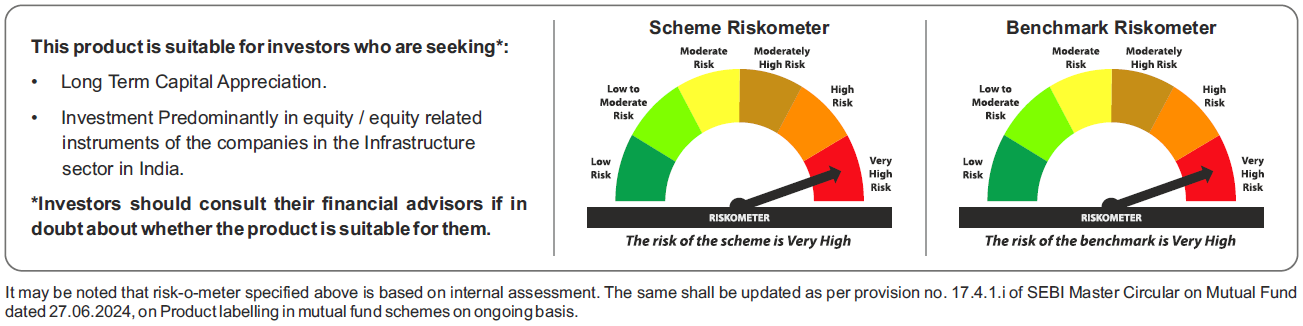
| Risk Level | Very High Risk |
Conclusion
So now you know about the long economic cycle + gestation period of the infrastructure sector. And you also understand what an infrastructure mutual fund is. It is a sectoral fund that invests at least 80% of its assets in companies operating within the infrastructure sector.
Usually, when public or private investment increases in areas such as transportation, power, or urban development, companies engaged in these activities may witness:
More order inflows
Improved revenue visibility
Better earnings growth potential
This may translate into a potential appreciation in their share prices, which in turn may raise the net asset value (NAV) of the mutual fund. However, at the same time, infrastructure mutual funds carry “high concentration risk” as their performance is closely tied to the health of the infrastructure sector.
Lastly, if we talk about the choice between SIP and lump sum, it depends on your risk tolerance and market conditions. An SIP may reduce timing risk, whereas a lump sum may allow you to capture the full upside if you enter at the early stage of an infrastructure growth cycle.
Disclaimers:
The views mentioned above are for information & educational purposes only and do not construe to be any investment, legal, or taxation advice. Investors must do their own research before investing. The views expressed in this article are personal in nature and in is no way trying to predict the markets or to time them. Any action taken by you on the basis of the information contained herein is your responsibility alone, and Tata Asset Management Pvt. Ltd. will not be liable in any manner for the consequences of such action taken by you. Please consult your Mutual Fund Distributor before investing. The views expressed in this article may not reflect in the scheme portfolios of Tata Mutual Fund. There are no guaranteed or assured returns under any of the schemes of Tata Mutual Fund.
*Mutual Fund Investments are subject to market risks, please read all scheme related documents carefully.
Author Bio

Akshay Kumar Rao

Loading Form...
Loading Similar Blogs...