


Looking to Invest in AAA-Rated PSU Bond Index Funds? But What Does "AAA" Actually Tell You!
Written by Akshay Kumar Rao
19 Oct 2026 • 6 minutes read
“Credit ratings” represent an independent assessment an issuer's ability to service its debt obligations on time. In India, credit ratings range from AAA (highest degree of safety) to D (default), with intermediate ratings indicating varying levels of credit risk.
A AAA-Rated PSU Bond Index Fund is a “passive” scheme that invests in securities tracked by its benchmark or underlying index and seeks to deliver returns similar to those of the index, subject to tracking error arising from factors, such as expenses, cash holdings, transaction costs, and portfolio rebalancing.
In India, bonds issued by Public Sector Undertakings (PSUs) may receive AAA ratings based on their financial strength, debt-servicing capacity, cash flow stability, repayment track record, and the credit rating agency’s assessment of its overall credit risk.
These bonds can form part of an index, which can then be tracked/ replicated by an index mutual fund. Such schemes are known as AAA-rated PSU bond index funds.
- But what does “AAA” indicate?
- Are such mutual funds less volatile?
Read this article to understand different credit ratings and the significance of an AAA rating. Learn what AAA-rated PSU bonds are and how AAA-rated PSU Bond Index Funds work. Lastly, you will know about the Tata Nifty SDL Plus AAA PSU Bond Dec 2027 60:40 Index Fund and its primary features.
Table of Content

What are Credit Ratings in India?
Credit ratings indicate a rating agency’s independent assessment of an issuer’s ability to repay its debt and meet interest payments on time. In India, credit ratings are assigned by SEBI-registered credit rating agencies, such as CRISIL, ICRA, CARE Ratings, and India Ratings & Research (IndRa).
Before assigning a rating, these agencies evaluate several factors, such as (illustrative list):
- The issuer’s financial position
- Repayment history
- Cash flows
- Outstanding debt, and
- Ability to meet future financial obligations
Additionally, they periodically review ratings and revise them when the issuer’s creditworthiness changes.
The General Range
Credit ratings for long-term debt securities generally range from AAA (highest degree of safety) to D (default). As per general market understanding:
- A “higher rating” indicates lower assessed credit risk
whereas,
- A “lower rating” indicates a greater risk of default
For your reference, below is a general long-term credit rating scale:
Credit Rating Scale | Potential Indications |
AAA |
|
AA |
|
A |
|
BBB |
|
BB |
|
B |
|
C |
|
D |
|
Note: Rating agencies also use '+' and '−' modifiers for ratings from AA to C to indicate the relative standing of a security within its rating category. Additionally, realise that credit ratings are only opinions about credit risk and are not guarantees of repayment or investment returns.
Want to explore more index funds? Check out our wide range of differentiated index funds, available under different categories, such as Thematic, Smart Beta, Commodities, and more. |
What are AAA-rated PSU bonds in India?
Now that you are aware of what an AAA credit rating indicates, it is worth noting that several Public Sector Undertakings (PSUs) in India issue bonds to raise funds for their business and financing requirements.
When bonds issued by such PSUs receive an AAA credit rating from a rating agency, they are referred to as “AAA-rated PSU bonds”. The “AAA rating indicate that the bonds have the highest degree of safety regarding timely servicing of financial obligations and carry the lowest credit risk within the rating scale.
Disclaimer: A AAA rating reflects the rating agency’s “current opinion” of the issuer’s creditworthiness and the likelihood of timely servicing of financial obligations. It does not guarantee repayment. The rating may be “downgraded” in the future if the issuer’s credit profile or other relevant factors change.
What is a AAA-Rated PSU Bond Index Fund?
Under the SEBI Circular, Rationalisation and Categorisation of Mutual Fund Schemes, dated February 26, 2026, a AAA-rated PSU Bond Index Fund falls in the “Other Schemes” category.
The fund invests a minimum of 95% of its total assets in the securities of its replicated/ tracked benchmark index. Such an underlying index may comprise AAA-rated bonds issued by Public Sector Undertakings (PSUs) and other eligible entities, as specified by the scheme’s stated mandate.
The objective is to replicate/track the performance of the underlying index, subject to tracking error and other factors.
Need an Option? You May Consider the Tata Nifty SDL Plus AAA PSU Bond Dec 2027 60: 40 Index Fund
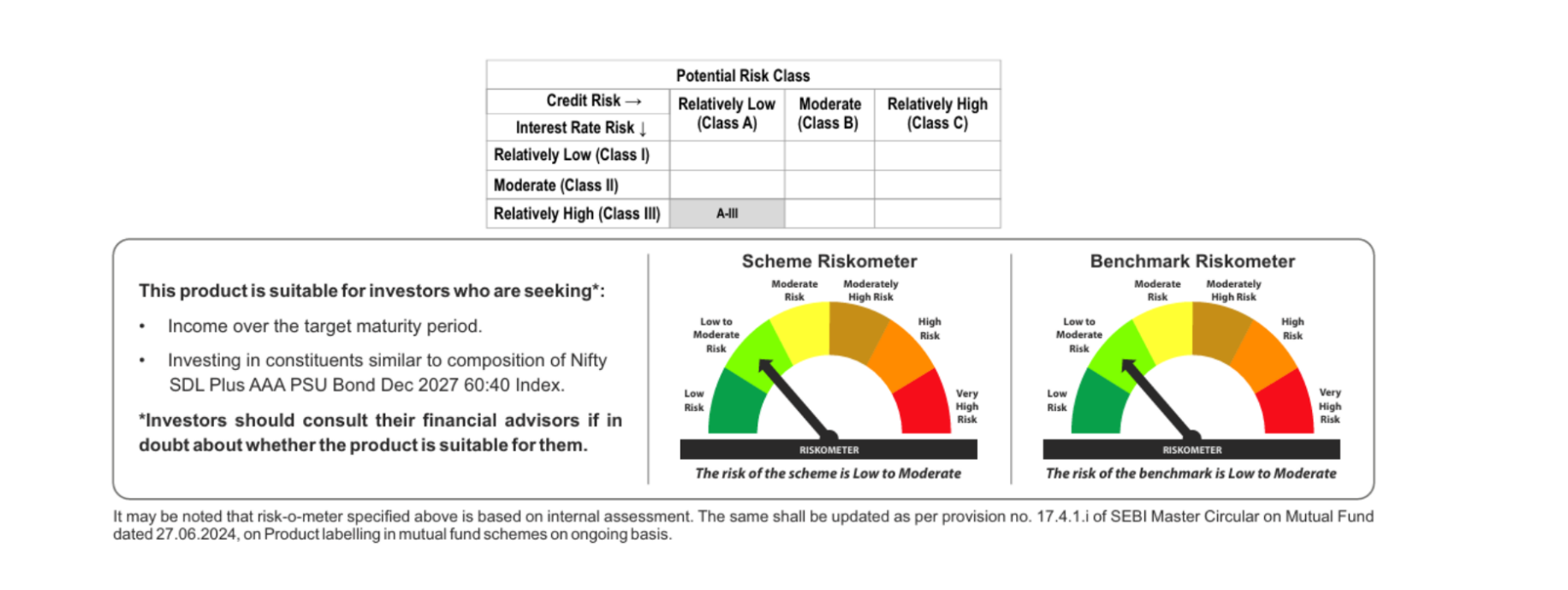
It is an open-ended Target Maturity Index Fund investing in constituents of Nifty SDL Plus AAA PSU Bond Dec 2027 60:40 Index. A scheme with relatively high interest rate risk and relatively low credit risk.
The investment objective of the scheme is to provide returns that correspond to the total returns of the securities as represented by the underlying index, subject to tracking error. There is no guarantee or assurance that the investment objective of the scheme will be achieved. The scheme doesn’t assure or guarantee any returns.
For more clarity, let’s check out some primary features of this PSU mutual fund:
Parameter | Details |
Category of the Scheme | Other Schemes – Debt Index Fund |
Benchmark (Total Return Index) | Nifty SDL Plus AAA PSU Bond Dec 2027 60:40 Index (TRI*) *TRI accounts for both changes in the market prices of the underlying securities and income earned from them. |
Plans | The scheme offers Regular and Direct Plans, each with Growth and Income Distribution cum Capital Withdrawal (IDCW) options. |
Exit Load | NIL |
Risk Level | Low to Moderate Risk |
Conclusion
So, now you know what credit ratings are, what an AAA rating indicates, and what a AAA-rated PSU Bond Index Fund is. To revise, credit ratings are assigned by credit rating agencies in India, such as CRISIL, ICRA, CARE Ratings, and India Ratings & Research. These ratings generally range from AAA (highest degree of safety) to D (default) and reflect the agency’s assessment of credit risk.
Several Public Sector Undertakings (PSUs), issue bonds to raise funds. Bonds that receive the highest credit rating of AAA from a credit rating agency are known as AAA-rated PSU bonds. An index may track a selected group of these bonds based on predefined eligibility criteria.
Next, such an index can be used for benchmarking purposes, by different mutual fund schemes. An index fund may replicate/track the composition and performance of such indices index by investing in its constituent securities. Such mutual fund schemes are known as AAA-rated PSU Bond Index Funds.
As per SEBI, these funds invest at least 95% of their total assets in securities covered by the underlying index they track/replicate, subject to the scheme’s stated investment mandate.
For more information, you can visit www.tatamutualfund.com. The Investor Service Centre of Tata Asset Management Pvt. Ltd. is located at Mulla House, Ground Floor, 51, M.G. Road, Near Flora Fountain, Mumbai – 400 001, Maharashtra. The office hours are Monday to Friday, 9:00 AM to 5:30 PM. For assistance, you can also call (022) 6282 7777 from Monday to Saturday, 9:00 AM to 5:30 PM, or email service@tataamc.com
AAA-Rated PSU Bond Index Fund FAQs
1. What are AAA-rated PSU bond index funds?
AAA-rated PSU bond index funds are passive schemes that invest at least 95% of their total assets in the constituents of their tracked/ replicated index. The underlying index comprise of AAA-rated bonds issued by Public Sector Undertakings (PSUs), based on the index’s eligibility criteria.
The fund aims to track/replicate the performance of this index, subject to tracking error and other factors.
2. What does an AAA credit rating indicate?
An AAA credit rating indicate the highest degree of safety regarding the timely servicing of financial obligations and the lowest credit risk within the rating scale.
However, it does not guarantee repayment or returns. Also, ratings only reflect the agency’s current assessment and may be downgraded if the issuer’s credit profile changes.
3. Who assigns credit ratings to PSU bonds in India?
Credit ratings are assigned by SEBI-registered credit rating agencies in India, such as CRISIL, ICRA, CARE Ratings, Acuite, and India Ratings & Research. Before assigning a rating, these agencies assess several factors, such as:
- An issuer’s financial position
- Debt obligations
- Cash flows, and
- Repayment capacity
Usually, credit rating agencies periodically review an issuer. If its creditworthiness improves or deteriorates due to changes in income, debt levels, cash flows, or other factors, the agency may “upgrade” or “downgrade” its rating accordingly.
Disclaimer:
The views mentioned above are for information & educational purposes only and do not construe to be any investment, legal, or taxation advice. Investors must do their own research before investing. The views expressed in this article are personal in nature and in is no way trying to predict the markets or to time them. Any action taken by you on the basis of the information contained herein is your responsibility alone, and Tata Asset Management Pvt. Ltd. will not be liable in any manner for the consequences of such action taken by you. Please consult your Mutual Fund Distributor before investing. The views expressed in this article may not reflect in the scheme portfolios of Tata Mutual Fund. There are no guaranteed or assured returns under any of the schemes of Tata Mutual Fund.
*Mutual Fund Investments are subject to market risks, please read all scheme related documents carefully.
Author Bio

Akshay Kumar Rao

How to Verify a Mutual Fund Distributor, Advisor or Platform Before You Invest
Written by Ashish Suryakant Pawar
19 Oct 2026 • 5 minutes read

Get closer to your financial goals
Start Investing
Loading Form...
Loading Similar Blogs...