


How Inflation May Affects Your ₹1 Crore Retirement Goal
Written by Ashish Suryakant Pawar
30 Sep 2026 • 5 minutes read


Inflation can gradually reduce the purchasing power of a ₹1 crore retirement corpus and make the amount worth less in real terms over time. For example (covered in the article below), if the corpus is received 20 years from now, ₹1 crore may be worth approximately ₹45 lakh in today’s money at 4% inflation and ₹30 lakh at 6% inflation.
Inflation refers to the “sustained increase” in the cost of goods and services that results in a loss of purchasing power over the years. In India, the official Consumer Price Index, or CPI, measures inflation for a representative consumption basket.
The RBI’s Monetary Policy guidelines define the medium-term headline CPI target at 4%, with a tolerance band of 2% to 6%. (Source: RBI Discussion Paper, dated August 21, 2025, Latest Available).
If you are planning for a retirement corpus in India, you must account for inflation as the amount needed to maintain the same lifestyle will potentially increase over time. A retirement plan based only on today’s expenses can underestimate the corpus required in the future.
Want to learn how? Read this article to learn how inflation influences your ₹1 crore retirement corpus under different scenarios. But firstly, let’s understand how this impact is calculated.
Table of Content

How Does Inflation Reduce the Purchasing Power of Your Retirement Corpus?
Inflation reduces the purchasing power of your retirement corpus by increasing the cost of goods and services over time. Consequently, a retirement corpus that seems sufficient today may not cover the same expenses years later.
But how to ascertain this fall in worth? To calculate what a future ₹1 crore retirement corpus would be worth in today’s money, ₹1 crore is treated as the “Future Amount”, and it is discounted for the assumed inflation rate and number of years.
Mathematically, we can represent this concept as follows:

Where,
- Current Worth = Today’s purchasing power of your retirement corpus.
- Future Amount = Expected corpus at retirement.
- Inflation Rate = Assumed annual rate of inflation.
- Number of Years = Years remaining until retirement.
For example, if ₹1 crore is the retirement corpus available 20 years from now, its approximate value in today’s money can be calculated as:

Want to learn more personal finance concepts? Continue building your financial knowledge by reading more educational blogs on inflation, retirement planning, portfolio diversification, SIPs, and other investment topics. |
What will be the Value of ₹1 Crore After Accounting for Inflation?
Your retirement corpus may look large on paper today! But realise that it may have less purchasing power by the time it is actually needed. The reason? ₹1 crore is a “nominal amount”, but the goods and services it can buy depend on their prices at that point in time.
Let’s check out the different cases where the worth of a ₹1 crore retirement corpus is calculated in today’s money:
A) Your Retirement is After 10 Years
Inflation Over 10 Years | Calculation | Approximate Future Purchasing Power of ₹1 crore |
4% |  | ₹65 lakhs |
6% |  | ₹55 lakhs |
B) Your Retirement is After 20 Years
Inflation Over 20 Years | Calculation | Approximate Future Purchasing Power of ₹1 crore |
4% | 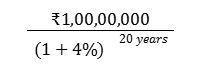 | ₹45 lakhs |
6% |  | ₹30 lakhs |
C) Your Retirement is After 30 Years
Inflation Over 30 Years | Calculation | Approximate Future Purchasing Power of ₹1 crore |
4% | 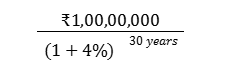 | ₹30 lakhs |
6% | 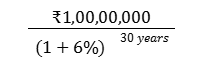 | ₹15 lakhs |
Disclaimer: These figures are based solely on mathematical calculations using the assumed inflation rates and time periods. Investors may consult a qualified financial advisor for retirement planning.
Conclusion
So, now you know what inflation is and how it impacts your retirement corpus. It is worth mentioning that an amount that looks sufficient today may potentially lose a substantial part of its purchasing power over time as the cost of living rises.
Thus, while planning or accumulating a retirement corpus, investors may need to account for inflation from the outset rather than treating today’s required amount as a fixed future target.
As the illustrations in this article show, even moderate inflation can significantly increase the amount required to maintain the same purchasing power over a long retirement horizon. However, investors may consult a qualified financial advisor for personalised retirement planning based on their circumstances and goals.
For more information, you can visit www.tatamutualfund.com/deshkarenivesh. The Investor Service Centre of Tata Asset Management Pvt. Ltd. is located at Mulla House, Ground Floor, 51, M.G. Road, Near Flora Fountain, Mumbai – 400 001, Maharashtra. The office hours are Monday to Friday, 9:00 AM to 5:30 PM. For assistance, you can also call (022) 6282 7777 from Monday to Saturday, 9:00 AM to 5:30 PM, or email service@tataamc.com
Retirement Corpus India FAQs
1. Why is ₹1 crore today not necessarily enough for retirement in the future?
₹1 crore today can buy more goods and services than the same ₹1 crore in several years from now. This is due to an increase in inflation rate over the years, the purchasing power of money falls.
Therefore, if retirement is years away, the ₹1 crore retirement corpus may need to be increased to enjoy a similar lifestyle in the future.
2. How much should I increase my ₹1 crore retirement corpus target for inflation?
There is no single amount that applies to every investor. Primarily, the required increase depends on the:
- Years remaining until retirement
and
- Inflation rate assumed for planning
Investors may use the “inflation-adjustment formula” (as given in this article) to estimate the future value of their current retirement requirement.
3. Should I use the same inflation rate for all my retirement expenses?
Realise that different expenses can increase at different rates. Healthcare, housing, education, and everyday consumption may experience different price changes.
A retirement plan may therefore consider the investor’s expected expense pattern rather than applying a single inflation assumption for every expense category.
4. How does the Repo Rate affect inflation?
Firstly, understand that the repo rate is the interest rate at which the Reserve Bank of India (RBI) lends short-term funds to commercial banks.
When the RBI raises the repo rate, borrowing generally becomes more expensive for banks, businesses, and consumers. Higher borrowing costs may discourage spending and investment, which reduces the demand for goods and services. When demand slows down, businesses may face less pressure to raise prices, which may potentially moderate inflationary pressures.
Conversely, when the RBI cuts the repo rate, borrowing can become cheaper. In this situation, lower interest rates may encourage businesses and consumers to borrow and spend more. This potentially increases both the economic activity and demand. If demand rises faster than the supply of goods and services, it can contribute to higher inflationary pressures.
Disclaimer:
An Investor Education and Awareness Initiative by Tata Mutual Fund.
To know more about KYC documentation requirements and procedure for change of address, phone number, bank details, etc., please visit: https://www.tatamutualfund.com/deshkarenivesh
Please deal only with registered Mutual Funds, details of which can be verified on the SEBI website under ‘Intermediaries / Market infrastructure institutions.’
All complaints regarding Tata Mutual Fund may be directed to service@tataamc.com and/or https://scores.sebi.gov.in/ (SEBI SCORES portal) and/or https://smartodr.in/login
Nomination is advisable for all folios opened by an individual, especially with sole holding, as it facilitates an easy transmission process.
This communication is a part of the investor education and awareness initiative of Tata Mutual Fund.
*Mutual Fund Investments are subject to market risks, please read all scheme related documents carefully.
Author Bio

Ashish Suryakant Pawar

Loading Form...
Loading Similar Blogs...