


How to create a Mutual Fund Portfolio Without Overlapping Funds?
Written by Ashish Suryakant Pawar
07 Sep 2026 • 8 minutes read
Mutual fund overlap refers to the extent to which multiple schemes share exposure to the same securities, industries, or investment approaches. Such an overlap creates similar portfolio behaviour and potential concentration.
A portfolio can hold five mutual funds and still behave like one! Yes, the number of schemes does not always determine the level of diversification.
Several funds may hold the same companies, sectors, or follow similar investment styles. This creates concentration risk and may leave investors exposed to a greater market decline than expected.
Don’t want that? This article explains mutual fund overlap, its types, how to measure it, and ways to build a more diversified portfolio.
Table of Content

What is Mutual Fund Portfolio Overlapping?
Mutual fund portfolio overlap happens when two or more mutual fund schemes hold the same stocks, offer exposure to similar sectors, or investment styles. For example:
- Two funds may both invest in Company A, Company B, and Company C.
- Similarly, they may both have a large allocation to sectors such as IT, pharmaceuticals, and banking.
- Funds can also overlap when they follow similar investment approaches, such as growth, value, or large-cap strategies.
Okay, so what’s the potential issue? In all such cases, a portfolio may appear diversified because it contains several mutual fund schemes, but the underlying investments may still be concentrated.
A “high mutual fund overlap” can increase dependence on the same companies, sectors, or investment styles. As a result, a decline in a particular stock, sector, or market segment may negatively influence several schemes at the same time, increasing the portfolio’s concentration risk.
What are the Different Types of Mutual Fund Portfolio Overlaps?
Mutual fund overlap is not limited to two schemes holding the same stocks. Similar exposure can arise at different levels of a portfolio, from individual companies and sectors to broader investment styles. For a better understanding, let’s check out the various mutual fund overlap styles:
Type of Mutual Fund Portfolio Overlap | Explanation | Importance |
Stock Overlap |
|
|
Sector Overlap |
|
|
Style or Mandate Overlap |
|
|
The more carefully a portfolio is assessed, the easier it becomes to spot “hidden concentration”. Further build your knowledge by reading more educational blogs about diversification, investing concepts, and portfolio management. |
How to Make a Mutual Fund Overlap Check?
A proper mutual fund overlap check requires both a “portfolio-level” view and a “fund-to-fund” comparison. For your reference, below are some steps you may follow to evaluate the mutual fund portfolio overlap:
Step I: Build an Inventory of All Mutual Funds in Your Portfolio
Start by making a list of every scheme held in the portfolio. For each fund, record the following details:
Information | Why is it Needed? |
Current Market Value | Shows the present value of the investment in each fund. |
Portfolio Allocation (%) | Shows what percentage of the total mutual fund portfolio's current value is invested in each fund. |
Fund Category | Helps in comparing schemes with similar or different mandates |
Benchmark | Indicates the market segment the fund is designed to track or outperform |
Fund Manager | Helps in identifying whether different schemes have the same or different portfolio management |
Amc | Useful when assessing schemes from the same fund house |
Equity/Debt/Gold Allocation | Shows the broad asset exposure |
Top Holdings | Provides an initial view of common stocks |
Sector Allocation | Helps identify concentration at the sector level |
Step II: Calculate Your Actual Exposure to Each Stock
Once the inventory is ready, download the latest monthly factsheet / portfolio statement for each scheme. Use the relevant figures to assess what percentage of your entire mutual fund portfolio is ultimately invested in a particular stock.
You may use the following formula:

Where,
- “Fund i as percentage of portfolio” shows how much of the investor's total mutual fund portfolio is in that scheme.
- “Fund i weight in stock s” shows how much of that particular scheme is invested in the stock.
Multiplying the two gives the stock's contribution to the investor's total portfolio.
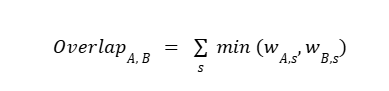
Step III: Measure the Pairwise Overlap Between Two Funds
How similar are Fund A and Fund B? To evaluate this, you can calculate the “pairwise overlap” using this formula:

Step IV: Check the Sector Overlap
Two funds may hold different companies but still have substantial exposure to the same sector. To calculate the sector overlap, you may use the following formula:

Where,
- Fund Allocationi represents the percentage of the total portfolio invested in the Fund "i".
- Fund's Sector Weighti represents the percentage of the Fund "i" invested in the sector being measured, such as banking or IT.
Step V: Check investment-style overlap
Lastly, there is another layer beyond stocks and sectors, and that is “investment style”. Two funds may have different names but follow similar approaches. For example:
- Both may favour large companies.
- Both may prefer growth stocks.
- Both may give high weight to quality companies.
- Both may have similar value-oriented strategies.
In such cases, the funds may respond in “similar ways” to certain market conditions even when their exact holdings are different.
How to Choose Mutual Funds and Construct a Portfolio with Minimal Overlap in 2026?
Avoiding mutual fund overlap does not mean that no two funds can own the same stock. Realise that some common holdings are natural, particularly among diversified equity funds.
As per general market understanding, your goal may be to build a portfolio where each scheme has a distinct role, while “unnecessary concentration” is kept under control. To do so, you may:
- Avoid collecting similar categories: Holding multiple large-cap or flexi-cap funds can add schemes without adding much diversification if their portfolios are highly similar.
- Compare portfolios, not fund names: Two funds from different categories can still hold many of the same stocks, so compare their underlying holdings and sector allocations.
- Check the top holdings: Before adding a fund, see whether it substantially increases exposure to stocks already prominent in the portfolio.
- Limit sector concentration: If several funds already have high exposure to banking, IT, or another sector, consider whether another fund would increase that concentration.
- Review overlap periodically: Fund portfolios change over time, so a portfolio with limited overlap today can develop significant common exposure later.
The key technique? DO NOT try to maintain a high number of mutual fund schemes in your portfolio. Instead, assess what the funds collectively own. Realise that a portfolio of four carefully selected schemes with distinct roles can offer better diversification than a portfolio of eight schemes with substantial common exposure.
Conclusion
So, now you know what mutual fund portfolio overlap is, and how to check and minimise it. To revise, “overlap” occurs when two or more schemes provide exposure to the same stocks, sectors, or investment styles. This can make a portfolio more concentrated than it appears.
Some overlap is “natural”, but excessive overlap may reduce the diversification gained from holding multiple schemes. To minimise unnecessary overlap, you may potentially:
- Compare holdings and sector allocations of funds from different categories.
- Avoid adding similar categories of schemes (say multiple large-cap or flexi-cap funds) if their portfolios are almost similar.
- Before adding a fund, see whether it increases exposure to stocks already prominent in the portfolio.
- Limit sector concentration and avoid adding funds that further increase exposure to sectors already heavily represented.
Lastly, you may review your mutual fund portfolio periodically to identify any increase in overlap, concentration, or similarity across schemes. Make the necessary changes to achieve the intended level of diversification.
For more information, you can visit www.tatamutualfund.com/deshkarenivesh . The Investor Service Centre of Tata Asset Management Pvt. Ltd. is located at Mulla House, Ground Floor, 51, M.G. Road, Near Flora Fountain, Mumbai – 400 001, Maharashtra. The office hours are Monday to Friday, 9:00 AM to 5:30 PM. For assistance, you can also call (022) 6282 7777 from Monday to Saturday, 9:00 AM to 5:30 PM, or email service@tataamc.com
Mutual Fund Portfolio FAQs
How much overlap between mutual funds is too much?
There is no single limit that applies to every portfolio. Generally, an overlap of around 60 to 70% between two funds can indicate possible concentration risk, however the exact overlap limit depends on investor’s risk appetite and investment objectives. (Source: Morningstar India)
However, some overlap is natural because strong companies are usually selected by multiple fund managers.
How can I check the overlap between my mutual funds?
You may compare the latest factsheets/portfolio statements of the schemes and check their complete holdings, sector allocations, and investment styles. For a deeper assessment, calculate the combined exposure to each stock and sector across all the funds in the portfolio.
Should I sell the units of a scheme that has a high overlap with another fund?
First, check whether both schemes have similar holdings, sectors, investment styles, and objectives. If one fund adds little diversification to the portfolio, redemption may be worth reconsidering.
Besides redeeming the units, you may also explore switching to a different scheme within the same fund house.
Disclaimer:
An Investor Education and Awareness Initiative by Tata Mutual Fund .
To know more about KYC documentation requirements and procedure for change of address, phone number, bank details, etc., please visit: https://www.tatamutualfund.com/deshkarenivesh
Please deal only with registered Mutual Funds, details of which can be verified on the SEBI website under ‘Intermediaries / Market infrastructure institutions.’
All complaints regarding Tata Mutual Fund may be directed to service@tataamc.com and/or https://scores.sebi.gov.in/ (SEBI SCORES portal) and/or https://smartodr.in/login
Nomination is advisable for all folios opened by an individual, especially with sole holding, as it facilitates an easy transmission process.
This communication is a part of the investor education and awareness initiative of Tata Mutual Fund.
*Mutual Fund Investments are subject to market risks, please read all scheme related documents carefully.
Author Bio

Ashish Suryakant Pawar

What Is an Innovation-Themed Mutual Fund and How Does It Work?
Written by Akshay Kumar Rao
07 Sep 2026 • 8 minutes read

Get closer to your financial goals
Start InvestingLoading Form...
Loading Similar Blogs...