


How to choose Large Cap, Mid Cap, Flexi Cap Mutual Funds to invest?
Written by Tata Mutual Fund
15 Sep 2025 • 11 minutes read


Large-cap mutual funds are equity schemes that invest most of their investor’s money in the 100 largest companies in India by market capitalisation. By rule, they must invest at least 80% of their investor’s money in large-cap stocks.
Usually, such companies have established businesses with the ability to generate profits. Most investors consider large-cap funds for long-term investing as they can offer potential stability to the portfolio.
But how do you choose the right large-cap mutual fund scheme? There are several parameters you can consider, such as the Sharpe Ratio, the expense ratio, the fund manager’s track record, and more.
Need help? In this article, let’s understand several parameters that can help you pick the right large-cap mutual fund. Also, we will learn about flexi-cap funds and check out several Tata Mutual Fund schemes you can consider in 2025.
Table of Content

How to Choose the Right Large-Cap Fund?
Large-cap mutual funds may look similar at first glance! However, the choice depends on several factors/ parameters. Each one tells you something about the:
Fund’s risk level
The return expectations
Annual charges
Expertise of fund managers, and more
Below are the five key parameters you can review before investing:
1. Performance Metrics
Looking at a large-cap fund’s past performance can give you a reference for how it handled different market conditions. However, it is not an indicative of future performance and not a guarantee or assurance of investment amount and returns.
Instead of focusing only on the highest return, you can check how the returns have been across different years. A fund that delivers close to its “benchmark return” can be comparatively considered as more reliable than one that has high returns some years and poor returns in others.
Such consistency can show that the fund could handle both bull and bear markets.
2. Sharpe Ratio (Risk-Adjusted Return)
The Sharpe Ratio tells you whether a fund’s return is worth the amount of risk you are taking. It compares “excess return” with the “volatility” of the fund. For those unaware, excess return represents what you can get over a risk-free return, such as government bonds or treasury bills (T-bills).
A higher Sharpe Ratio means the fund is rewarding you more for each unit of risk. As an investor, you can consider a large-cap mutual fund scheme with a higher Sharpe Ratio.
3. Expense Ratio
Every mutual fund charges an annual fee to cover management and administrative costs. This is called the expense ratio. Even a small difference in expense ratio can reduce your final wealth significantly in the long term.
For example,
Say there are two large-cap mutual funds.
Hypothetically, Both have the potential to earn the same return, but one charges expense ratio of 1.2% p.a. while another charges 0.8% p.a.
Now, the second fund can leave you with more money.
To pick a scheme, you can always compare expense ratios among funds in the same category. Lower expense ratios usually mean less expense outflow.
4. Fund Manager’s Track Record
The fund manager is the decision-maker who chooses which companies the large-cap fund will invest in & weightage / exposure for the same. A manager who has shown good results in different market cycles could be preferable.
As an investor, you can look at how long the manager has been handling the fund and whether they have delivered outcomes across different market scenarios. A strong manager can increase your confidence in the fund’s future.
5. Portfolio Composition
As mentioned above, large-cap funds must invest at least 80% in the top 100 companies. Now, the rest of the 20% can be invested in mid or small-cap stocks or any other asset classes as specified in Scheme Information Document. While this may potentially generate a bit extra returns, it also increases the scheme's risk.
Thus, you can review the portfolio of the large-cap fund to check whether the composition suits your risk appetite.
Disclaimer: The parameters mentioned above are for educational purposes only. Investors must do their own research before investing.
What are Flexi-cap Funds?
Don’t want to stick to just the top 100 companies? Flexi-cap funds is a different financial product that invests in companies of all sizes; large-cap, mid-cap, and small-cap. They must invest at least 65% in equity and equity-related instruments.
Usually, the fund manager of a flexi-cap fund can shift money between different company sizes and sectors depending on market conditions. This makes them highly flexible but also means the risk and potential returns can vary more compared to large-cap funds.
Tata Mutual Fund Schemes You Can Consider in 2025
Tata Asset Management Private Limited was established in 1994 and has over 30 years of experience in managing investments. As of August 31, 2025, it has earned the trust of more than 63 lakh investors across India.
Tata Mutual Funds offer a wide range of investment options that are available in both lump sum (e.g. ₹5,000) and SIP (e.g. ₹500) modes. For your reference, below are large-cap and flexi-cap funds you can invest in 2025:
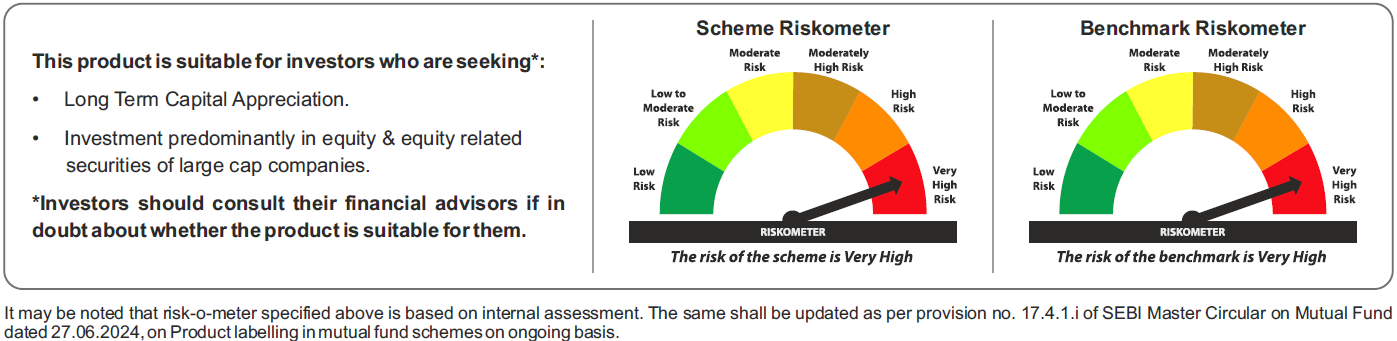
1. Tata Large-cap Fund - An Open-Ended Equity Scheme Predominantly Investing In Large Cap Stocks
| Inception | Exit Load | Benchmark | Risk Level |
| May 7, 1998 | NIL (0.50% if redeemed on or before 30 days from the date of allotment) | Nifty 100 TRI | Very High Risk |
The Tata Large Cap Fund can invest in mature companies that are financially strong but may be undervalued compared to their true worth. The fund managers of this scheme can make a detailed analysis of individual businesses rather than simply following the market index.
The selection of companies can be based on these factors:
- Financial health
- Growth potential
- Management quality
- Competitive strength
- Fair valuation
Additionally, the portfolio of this large-cap mutual fund scheme can include two types of stocks:
- Compounders: These are companies that grow steadily over time and
- Re-rating candidates: These are companies that may see their valuations rise if the market starts recognizing their potential.
Moreover, the fund does not limit itself to specific sectors. It can always stay invested in equities and does not deliberately hold cash.
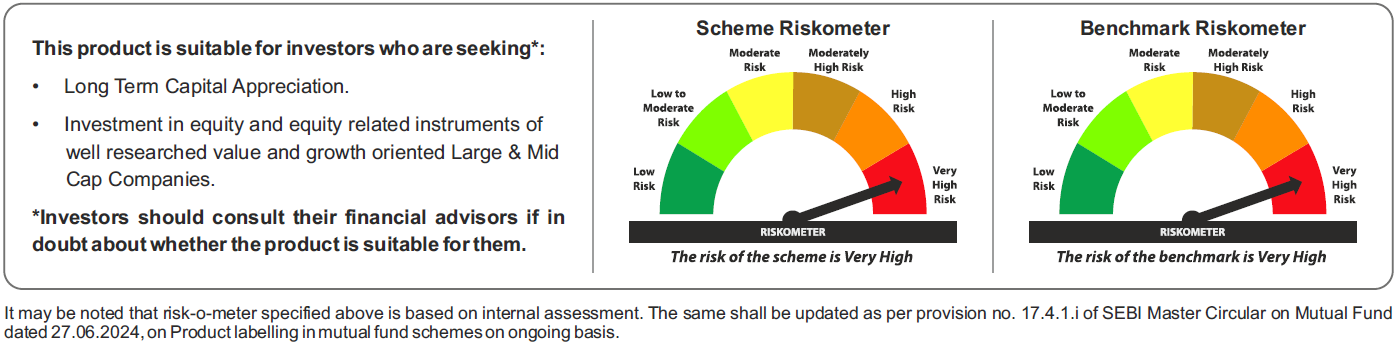
Tata Large and Mid Cap Fund (Direct Growth) - An Open-Ended Equity Scheme Investing In Both Large Cap and Mid Cap Stocks
| Inception | Exit Load | Benchmark | Risk Level |
| February 25, 1993 | NIL (0.50% if redeemed on or before 30 days from the date of allotment) | Nifty Large Midcap 250 TRI | Very High Risk |
Tata Large and Mid Cap Fund can invest in both large and mid-sized companies to aim to capture growth opportunities in these segments. The fund manager can look for companies that are:
- Financially strong
- Generate healthy cash flows
- Have a likelihood for re-rating or turnaround due to changing market conditions
This scheme can follow a “bottom-up” investment approach, where the stock selection is guided by four main factors:
- Company’s Performance
- Low debt with strong cash flows
- Earnings growth is higher than market expectations
- Availability at reasonable valuations
Furthermore, this large and mid-cap fund usually holds a concentrated portfolio of about 53 stocks (as on 31st August 2025). It can also adjust its mix of large and mid-cap companies as opportunities arise.
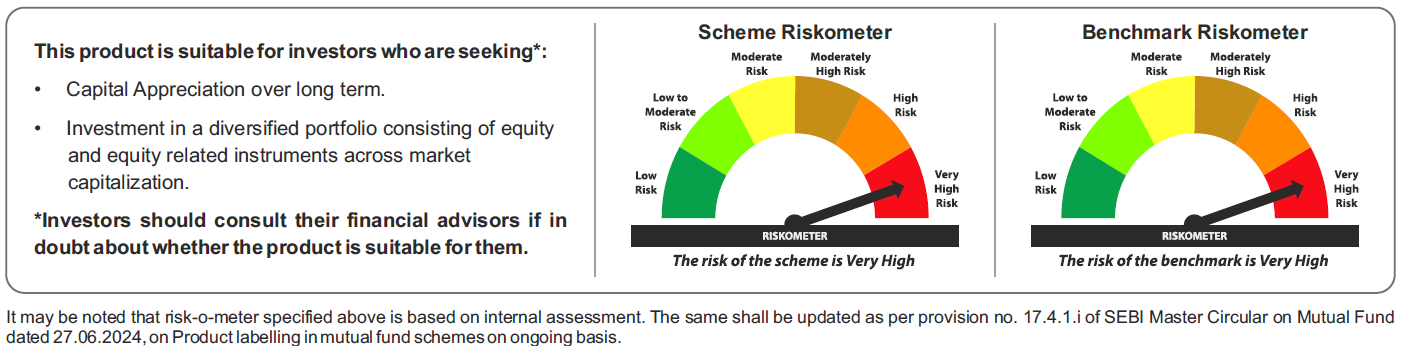
3. Tata Flexi Cap Fund - An Open-Ended Dynamic Equity Scheme Investing Across Large-Cap, Mid-Cap, and Small-Cap Stocks
| Inception | Exit Load | Benchmark | Risk Level |
| September 6, 2018 | NIL (0.50% if redeemed on or before 30 days from the date of allotment) | Nifty 500 TRI | Very High Risk |
Tata Flexi Cap Fund invests in companies of all sizes: large-cap, mid-cap, and small-cap. The investments are made without any market cap restrictions. This scheme have potential to create capital growth over the medium to long term by building a diversified portfolio.
The fund’s selection process can be based on the growth potential of a company and not its size. It can look for businesses with:
- Strong growth prospects
- Sustainable operations
- Low debt
- Leadership position in their sector
The fund managers of this scheme can also make “conviction BETS”, where they identify a few high-potential companies and hold overweight positions in them.
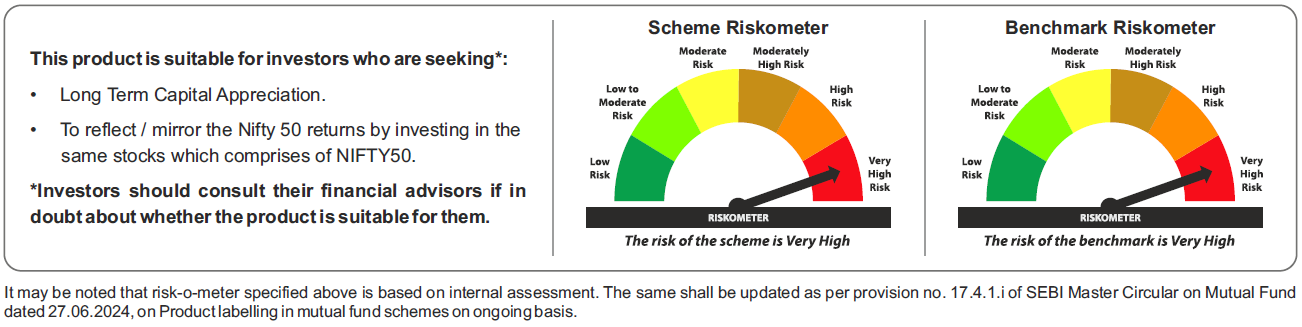
4. Tata NIFTY 50 Index Fund - An Open-Ended Equity Scheme Tracking Nifty 50 Index
| Inception | Exit Load | Benchmark | Risk Level |
| February 25, 2003 | 0.25% of the applicable NAV, if redeemed on or before 7 days from the date of allotment. | Nifty 50 TRI | Very High Risk |
This is an index fund that track NIFTY 50 Index. Nifty 50 companies are considered as the first 50 companies of the companies classified as large cap. The scheme invests at least 95% in the same 50 large companies that make up the index and in the same proportion. A small portion may be kept in money market instruments for liquidity needs.
Since it is a passive fund, the goal is not to beat/outperform the market, but instead to match the performance of the NIFTY 50. It can be suitable for investors who want exposure to India’s top companies through a single portfolio without active stock-picking.
Conclusion
Large-cap funds are equity schemes that invest at least 80% of the investor’s money in large-cap stocks. These funds allow you to participate in India’s top 100 companies. Usually, these are market leaders with strong balance sheets and established business models.
However, selecting a particular large-cap fund can be tricky! As an investor, you can evaluate multiple parameters, such as:
Scheme performance
Sharpe Ratio
Expense ratio
Fund manager’s track record
Portfolio composition
If you are looking for more diversification, Flexi-cap funds can be a good option. They invest across large-cap, mid-cap, and small-cap companies in different proportions.
So, are you searching for investment options? Tata Mutual Fund offers a range of equity schemes, such as the Tata NIFTY 50 Index Fund, Tata Flexi Cap Fund, Tata Large Cap Fund, and Tata Large and Mid Cap Fund and many other. You can pick the fund as per your investment objectives and risk appetite.
Disclaimers
The views mentioned above are for information & educational purposes only and do not construe to be any investment, legal or taxation advice. Investors must do their own research before investing. The views expressed in this article are personal in nature and in is no way trying to predict the markets or to time them. Any action taken by you on the basis of the information contained herein is your responsibility alone and Tata Asset Management Pvt. Ltd. will not be liable in any manner for the consequences of such action taken by you. Please consult your Mutual Fund Distributor before investing. The views expressed in this article may not reflect in the scheme portfolios of Tata Mutual Fund. There are no guaranteed or assured returns under any of the scheme of Tata mutual Fund.
*Mutual Fund Investments are subject to market risks, please read all scheme related documents carefully.
Author Bio

Tata Mutual Fund

Loading Form...
Loading Similar Blogs...