


Healthcare & Pharma - The 2026 "Defensive" Sector Choice along with Energy, Defence, and AI
Written by Akshay Kumar Rao
28 Jan 2026 • 7 minutes read


Pharma and healthcare mutual funds are sectoral/ thematic equity schemes that primarily invest in companies related to medicine and healthcare. When you invest in these funds, your money is used to buy shares of companies that (illustrative):
Make drugs
Develop vaccines
Produce medical equipment
Provide healthcare services (such as hospitals and diagnostics).
As per SEBI regulations, these funds must invest at least 80% of their total assets in pharmaceutical and healthcare companies. Since the investments are concentrated in one sector, the fund’s performance depends heavily on how the pharma and healthcare industry performs.
Okay, but isn’t it a “defensive sector”? Yes, pharma and healthcare are considered defensive sectors. That’s because people need medicines and medical care regardless of economic conditions. Thus, demand may remain relatively stable even during slowdowns. However, sector-specific risks still remain, such as regulation and pricing controls.
So, are you looking to invest? Before committing funds in 2026, read this article to first understand the various benefits of investing in pharma and healthcare funds. Next, we will learn about the Tata India Pharma & Healthcare Fund and its primary features.
Table of Content

4 Major Benefits of Investing in Healthcare and Pharma Mutual Funds
A study by IBEF.org (a trust established by the Ministry of Commerce) found that the government has significantly increased spending on the healthcare sector. In the Union Budget 2025-26, ₹99,858 crore has been allocated for healthcare development and maintenance. This amount is higher than last year’s allocation of ₹90,958 crore.
This increase of about 9.78% shows a strong government focus on improving healthcare facilities and infrastructure across the country. In 2026, investors can participate in this growth phase and potentially benefit as the unit valuation of pharma and healthcare mutual funds rises over the coming years.
Besides, there are also some other benefits you may realise:
1. Built for Long-Term Wealth Creation
As mentioned before, pharma and healthcare are considered defensive sectors. Usually, demand for these products and services grows as the:
- Population increases
- Lifestyles change
- Healthcare awareness rises
Over long periods, this growth can reflect in company profits and share prices. As a result, when you stay invested for many years, the market fluctuations may balance out.
2. Risk Spread Across Multiple Healthcare Companies
Instead of investing in one pharma or healthcare company, a mutual fund invests in many such companies at the same time. These may include large:
- Drug manufacturers
- Hospitals
- Diagnostic firms
- Medical equipment makers, and more.
Due to such diversification, if one company faces problems (such as regulatory issues or weak sales), the impact on your overall investment could be limited. Why? That’s because other companies in the fund may continue to perform. This reduces the risk of incurring heavy losses compared to investing in a single stock.
3. Expert Decision-Making Backed by Sector Research
Pharma and healthcare mutual funds are managed by professionals who track this sector closely. They may study:
- Company financials
- New drug approvals
- Government rules
- Patent timelines
- Future product launches
Additionally, they may also monitor risks such as pricing controls and policy changes. Based on this research, they decide which companies to buy, hold, or sell. As an individual investor, you may not have the time or technical knowledge to track such details.
4. A Chance to Earn Dividend Income
Some pharmaceutical and healthcare companies regularly declare dividends. When a mutual fund invests in such companies, the dividends it receives become part of the fund’s income. Now, what happens to this income depends on the investment option you have chosen in the mutual fund.
Investors generally have two options:
- Growth or
- IDCW (Income Distribution cum Capital Withdrawal)
Each option handles dividend income differently, which impacts how your returns are received over time. Let’s understand in detail:
| Investment Option | How Dividend Income Is Treated |
| Growth Option |
|
| IDCW Option |
|
What is the Tata India Pharma & Healthcare Fund?
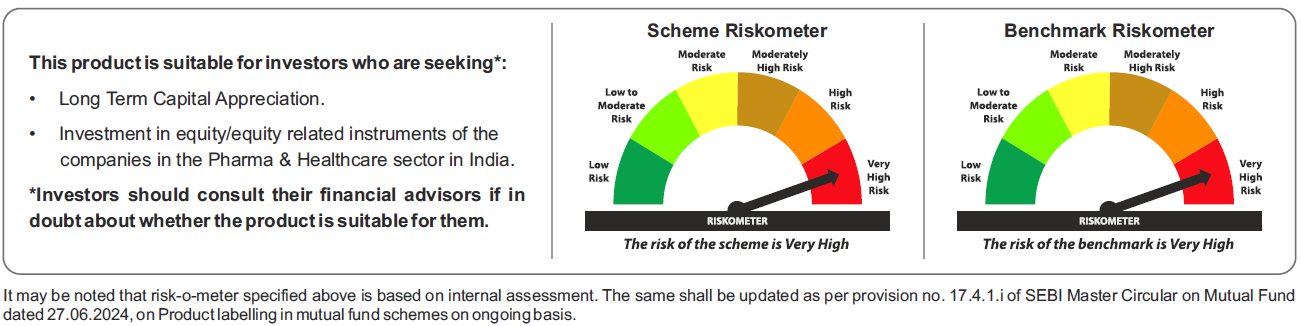
The Tata India Pharma & Healthcare Fund is an open-ended equity scheme investing in the Pharma and Healthcare Services Sector. The investment objective of the scheme is to seek long-term capital appreciation by investing at least 80% of its net assets in equity and equity-related instruments of the companies in the pharma and healthcare sectors in India. However, there is no assurance or guarantee that the investment objective of the scheme will be achieved.
For more clarity, let’s study some primary features of this scheme:
| Feature | Explanation |
| Scheme Name | Tata India Pharma & Healthcare Fund |
| Category | Equity Scheme - Sectoral Fund |
| Inception Date | 28 December 2015 |
| Benchmark | BSE Healthcare TRI, which tracks the performance of healthcare companies listed on the BSE. |
| Equity Allocation (Pharma and Healthcare) | Minimum 80% and up to 100% of total assets are invested in pharma and healthcare sector stocks |
| Other than Core Sector Equity Allocation | Up to 20% can be invested in equity shares of companies outside the pharma and healthcare sector |
| Debt and Money Market Allocation | Up to 20% can be invested in debt and money market instruments for liquidity and stability |
| Risk Level | Very High Risk |
| Exit Load | 0.25% of NAV if units are redeemed within 30 days from the date of allotment |
Conclusion
So now you know that pharma and healthcare mutual funds can be another investment option alongside energy mutual funds, defence mutual funds, and AI mutual funds within the defensive sector.
Due to the “evergreen demand” for medicines and healthcare services, these funds may offer relatively stable returns even during economic slowdowns. However, at the same time, investors must understand the risks involved. Factors such as price controls, regulatory changes, patent expiries, or weak demand in certain segments can lead to periods of volatility.
Due to this higher volatility, pharma and healthcare mutual funds may carry more risk than diversified equity mutual funds. Therefore, such schemes may be better suited for investors with a long-term horizon and the ability to handle higher risk.
Disclaimer:
The views mentioned above are for information & educational purposes only and do not construe to be any investment, legal, or taxation advice. Investors must do their own research before investing. The views expressed in this article are personal in nature and in is no way trying to predict the markets or to time them. Any action taken by you on the basis of the information contained herein is your responsibility alone, and Tata Asset Management Pvt. Ltd. will not be liable in any manner for the consequences of such action taken by you. Please consult your Mutual Fund Distributor before investing. The views expressed in this article may not reflect in the scheme portfolios of Tata Mutual Fund. There are no guaranteed or assured returns under any of the schemes of Tata Mutual Fund.
*Mutual Fund Investments are subject to market risks, please read all scheme related documents carefully.
Author Bio

Akshay Kumar Rao

Loading Form...
Loading Similar Blogs...