


Gold vs. Silver ETFs: Which Precious Metal Belongs in Your Portfolio?
Written by Akshay Kumar Rao
24 Dec 2025 • 7 minutes read


As per general market understanding, Gold ETFs provide exposure to domestic gold prices and may complement equity and debt investments (as gold can respond differently to factors such as inflation, currency movements, interest rates, and periods of market uncertainty).
On the other hand, Silver ETFs provide exposure to domestic silver prices and may complement traditional investments because silver is influenced not only by investment demand but also by industrial activity (including demand from electronics, solar energy, and manufacturing).
The choice between Gold and Silver ETFs depend on factors such as investment objective, risk appetite, time horizon, and prevailing economic conditions.
Gold and Silver ETFs are investment products that allow investors to gain exposure to the prices of gold and silver without owning the physical metals. Both funds track the domestic prices of gold and silver (respectively), and are usually structured as ‘physical ETFs.’
This means the fund actually holds physical gold or silver (stored in vaults), in quantities that match the size of the investor pool. So when you buy units of these ETFs, you’re owning a proportionate share of the underlying metal without having to store it yourself.
Want to understand in detail? Read this article to first learn what gold and silver mutual funds are and then see which product may suit you. Lastly, you will check some precious metals ETFs offered by Tata Mutual Fund™.
Table of Content

What is a Gold ETF?
A Gold ETF is a exchange traded funds that buys and holds physical gold on behalf of investors. It trades on the stock exchange, so you can buy or sell it in the same way you trade shares.
Always remember that you do not receive gold in hand. Instead, you own “units”, the price of which moves with the market price of gold. You can trade these ETF units on stock exchanges i.e., NSE or BSE using your demat and trading account.
How do Gold ETFs Work?
When you buy a unit of a Gold ETF, the fund purchases the same amount of physical gold and keeps it with an authorised custodian. The fund does not try to beat the market. It only follows the price of gold.
As a result, the Gold ETF returns may change based on these two primary factors:
International gold prices and
The rupee-dollar (USD/INR) exchange rate (because gold prices are set globally in USD)
Benefits of Gold ETFs
Mostly reputed Gold ETF schemes hold gold of 99.5% purity. Thus, buyers do not need to worry about adulteration, mixing, or quality checks. Additionally,
Gold ETFs are Easy to Buy and Sell:
You can sell your units anytime during market hours.
Physical gold often involves making charges or discounts on resale, which do not apply to ETFs.
Comparatively Lower Costs
You do not pay for storage, insurance, or making charges.
The only cost is the expense ratio, brokerage fees STT/ Exchange fees or other similar charges.
No GST on Purchase
Buying physical gold attracts 3% GST, while gold jewellery may also attract 5% GST on making charges. (Source: Economic Times, February 18, 2026)
However, buying Gold ETFs does not attract such taxes.
What is a Silver ETF?
Just like gold ETFs, silver ETFs are also exchange traded funds that buy and hold physical silver on behalf of investors. They are traded on stock exchanges just like company shares.
Again, when you buy a silver ETF, you do not receive physical silver. Instead, you own units whose value moves with the domestic price of silver.
How do Silver ETFs Work?
Note that in a silver ETFs, silver is the underlying asset. The fund collects money from investors and uses that pool of funds to buy physical silver bars of high purity (usually at least 99.99% purity). This silver is stored in secure vaults managed by authorised custodian banks.
The price of each unit of a silver ETF is linked to the current market price of silver. This allows the ETF to mirror silver’s performance.
Benefits of Silver ETFs
Since investors do not hold physical silver, there is no risk of loss, damage, or theft. Additionally:
Silver ETFs Could Be Highly Liquid & Flexible:
Investors can buy or sell the ETF units from anywhere through stock exchanges (during market hours).
They can also invest any amount based on their budget.
Comparatively Lower Costs:
There are no storage, making, or insurance charges that usually apply to physical silver.
The only ongoing cost is the fund’s expense ratio, brokerage fees, STT/ Exchange fees and other similar charges
Transparency:
Investors can see the real-time value of their units anytime.
The silver ETF price reflects the domestic market price of silver, subject to tracking errors.
Which Precious Metals ETF Should You Invest In 2025?
Before choosing between gold and silver ETFs, be 100% clear about why you want the metal in your portfolio. Note that gold may be suited for investors who want relative stability + protection during uncertain market periods. Why? That’s because gold usually holds value when:
Currencies weaken or
When equity markets are under pressure.
In contrast, silver is influenced not only by investor demand but also by industrial needs such as electronics, solar panels, and manufacturing. This dual nature makes its price more volatile.
Hence, if your purpose is long-term stability and capital protection, gold may be more appropriate. Whereas, if your purpose is to exploit short-term opportunities or trade based on economic trends, silver may be considered.
Additionally, to pick the right precious metals ETF, you may also read the market environment and check what the economy is signalling.
Okay, but how to do it? Realise that the price of gold and silver does not move randomly! Instead, each metal reacts to very specific “economic signals”. As an investor, when you understand these signals, you can better decide which metal deserves more weight at a given time. Let’s check them out:
| Economic Signal | What This Signal Means | Impact on Gold | Impact on Silver | Which Metal You May Prefer |
| High or Rising Inflation | Prices of goods increase, and the currency loses purchasing power | Gold often strengthens as more investors put their money in gold to maintain their purchasing power | Silver may also increase, but gold could outperform it | Gold |
| Falling “Real” Interest Rates (Interest rates after adjusting for inflation) | Returns on bonds become less attractive | Gold becomes more appealing as an alternative store of value | Silver may benefit, but not as strongly as gold | Gold |
| Central Banks Buying More Gold | Official institutions increase their reserves | Directly supports gold demand and adds long-term strength | Minimal impact since central banks do not buy silver | Gold |
| Currency Weakness (Particularly the domestic currency losing value) | Investors fear loss of purchasing power. | Gold usually gains because it is seen as a currency hedge. | Silver may follow, but it could be with a weaker correlation. | Gold |
| Industrial Expansion | Higher use of metal in production lines. There could be growth in Manufacturing, Electronics, Auto, and Solar Sectors. | Gold has limited industrial demand, so the impact is mild. | Silver demand increases due to heavy industrial use. | Silver |
| Supply Disruptions in Silver Mining | Mining output falls due to strikes, closures, or lower ore grades. | No major impact on gold. | Reduced supply can lead to an increase in silver prices. | Silver |
| Periods of Global Uncertainty | Investors look for safety during geopolitical tensions and recessionary periods. | Gold is often looked upon as a “defensive asset.” | Silver may rise, but it could happen with more volatility. | Gold |
Precious Metals ETF Offered by Tata Mutual Fund™
To let investors gain exposure to domestic prices of gold and silver, Tata Mutual Fund™ offers two types of precious metals ETFs:
- Tata Gold Exchange Traded Fund and
- Tata Silver Exchange Traded Fund
Both schemes are available in the “Direct-Growth” variant. This means you can invest directly with Tata Mutual Fund™ and are not required to pay commission to distributors. Also, these gold and silver ETFs do not pay dividends. All profits are reinvested back into the scheme, and the value of your investment potentially increases through NAV (Net Asset Value) appreciation.
In addition to precious metals ETFs, Tata Mutual Fund™ also offers Tata Gold ETF Fund of Funds and Tata Silver ETF Fund of Funds. These are open-ended schemes, respectively investing in the Tata Gold Exchange Traded Fund and the Tata Silver Exchange Traded Fund.
Let’s gain more clarity about all these investment options below:
| Mutual Fund Scheme | Product Label | Benchmark | Scheme Riskometer | Benchmark Riskometer | Exit Load |
| Tata Gold ETF | An open-ended exchange-traded fund replicating/ tracking the domestic price of Gold. | Domestic Price of Gold | High Risk | High Risk | NIL |
| Tata Silver ETF | An open-ended exchange-traded fund replicating/ tracking the domestic price of Silver. | Domestic Price of Silver | Very High Risk | Very High Risk | NIL |
| Tata Gold ETF Fund of Funds | An open-ended fund of funds scheme investing in the Tata Gold Exchange Traded Fund. | Domestic Price of Gold | High Risk | High Risk | 0.5% when redeemed or switched out on or before expiry of 7 days from the date of allotment. |
| Tata Silver ETF Fund of Funds | An open-ended fund of fund scheme investing in the Tata Silver Exchange Traded Fund. | Domestic Price of Silver | Very High Risk | Very High Risk | 0.5% when redeemed or switched out on or before expiry of 7 days from the date of allotment. |
Risk Level of the Above Precious Metals ETFs
1. Tata Gold Exchange Traded Fund
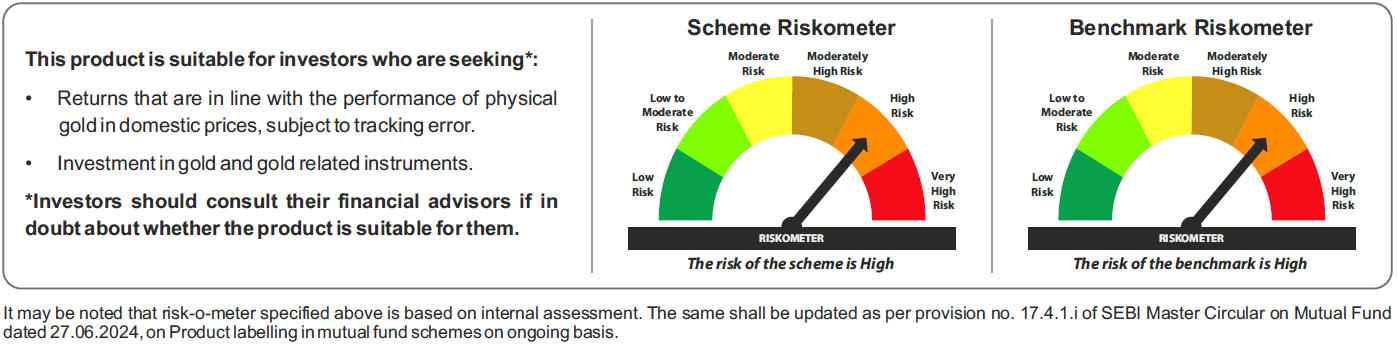
Disclaimer: It may be noted that the risk-o-meter specified above is based on an internal assessment. The same shall be updated as per provision no. 6.16.1.j of SEBI Master Circular on Mutual Fund dated 20.03.2026, on Product labelling in mutual fund schemes on an ongoing basis.
2. Tata Silver Exchange Traded Fund
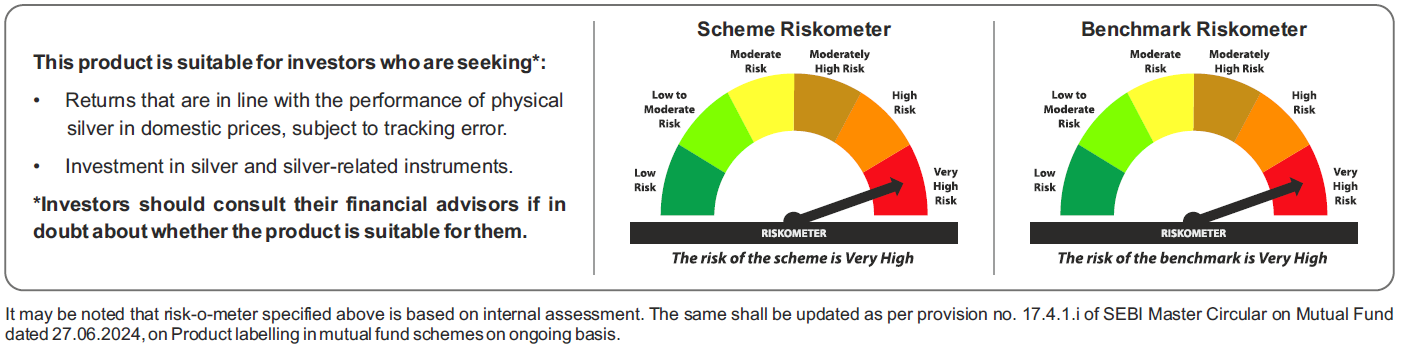
Disclaimer: It may be noted that the risk-o-meter specified above is based on an internal assessment. The same shall be updated as per provision no. 6.16.1.j of SEBI Master Circular on Mutual Fund dated 20.03.2026, on Product labelling in mutual fund schemes on an ongoing basis.
3. Tata Gold ETF Fund of Funds
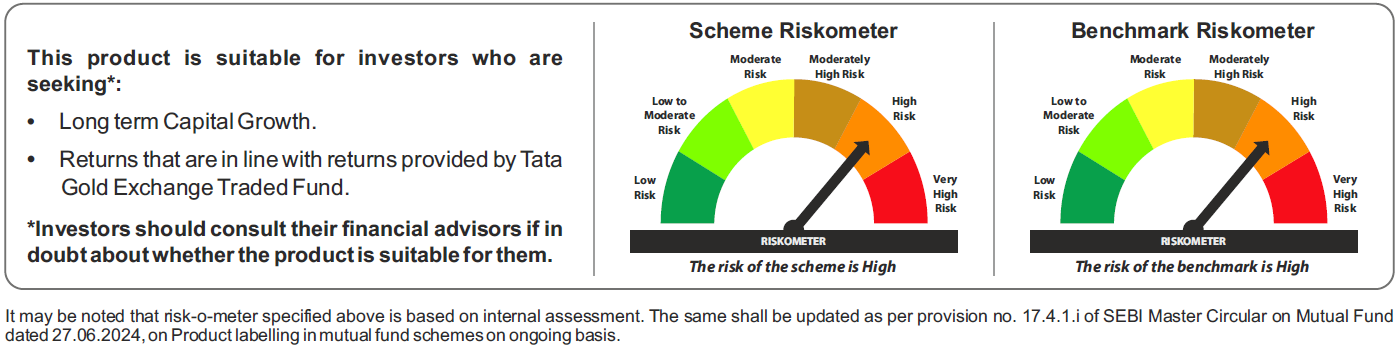
Disclaimer: It may be noted that the risk-o-meter specified above is based on an internal assessment. The same shall be updated as per provision no. 6.16.1.j of SEBI Master Circular on Mutual Fund dated 20.03.2026, on Product labelling in mutual fund schemes on an ongoing basis.
Investors are requested to note that they will be bearing the recurring expenses of the fund of funds scheme, in addition to the expenses of the underlying scheme in which the fund of funds scheme makes investments.
4. Tata Silver ETF Fund of Funds
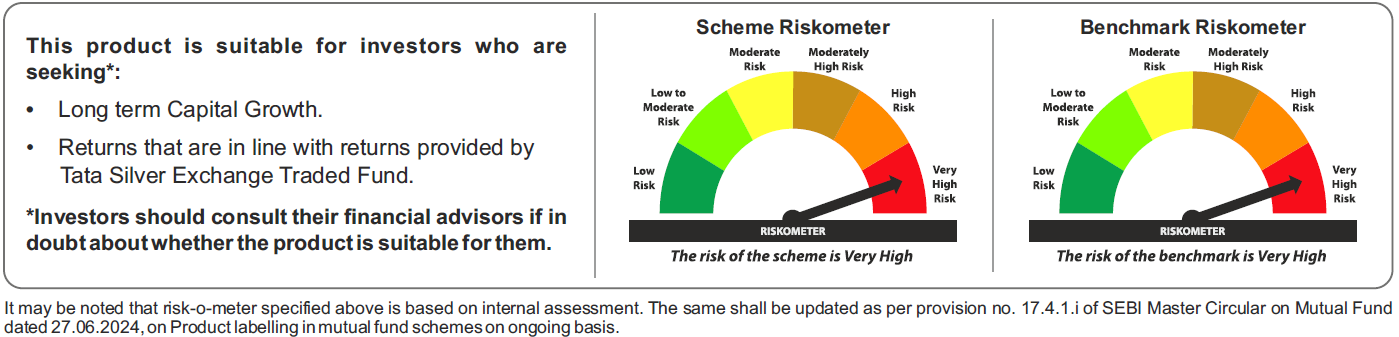
Disclaimer: It may be noted that the risk-o-meter specified above is based on an internal assessment. The same shall be updated as per provision no. 6.16.1.j of SEBI Master Circular on Mutual Fund dated 20.03.2026, on Product labelling in mutual fund schemes on an ongoing basis.
Investors are requested to note that they will be bearing the recurring expenses of the fund of funds scheme, in addition to the expenses of the underlying scheme in which the fund of funds scheme makes investments.
Conclusion
So now you know gold and silver ETFs are two distinct financial products that are influenced by different economic signals. The choice between the two entirely depends on your investment purpose and your risk appetite.
Still, to make a better selection, you may consider the following factors:
- Your core objective: Decide whether you want long-term stability or short-term opportunity.
- Your investment horizon: How long do you plan to stay invested?
Current economic signals: Check whether conditions favour the demand for defensive assets or industrial growth.
For more information, you can visit www.tatamutualfund.com. The Investor Service Centre of Tata Asset Management Pvt. Ltd. is located at Mulla House, Ground Floor, 51, M.G. Road, Near Flora Fountain, Mumbai – 400 001, Maharashtra. The office hours are Monday to Friday, 9:00 AM to 5:30 PM. For assistance, you can also call (022) 6282 7777 from Monday to Saturday, 9:00 AM to 5:30 PM, or email service@tataamc.com.
FAQs
1. How to invest in gold and silver ETFs in 2026?
Gold and Silver ETFs can be purchased online through a Demat and trading account using a stock exchange (similar to shares). Investors can select an ETF based on factors such as expense ratio, tracking accuracy, and risk profile of the scheme.
2. Is it good to invest in a silver ETF?
A Silver ETF may potentially be considered by investors looking to gain exposure to domestic silver prices without physically owning the metal. Besides, silver may offer diversification to a portfolio as its demand is influenced by both investment activity and industrial use.
However, silver prices can be “volatile”, so suitability depends on the investor’s objectives, risk tolerance, and investment horizon.
3. Is Tata Silver ETF a good investment?
The Tata Silver ETF is an open-ended exchange-traded fund replicating/ tracking the domestic price of Silver. The investment objective of the fund is to generate returns that are in line with the performance of physical silver in domestic prices, subject to tracking error. However, there is no assurance or guarantee that the investment objective of the scheme will be achieved.
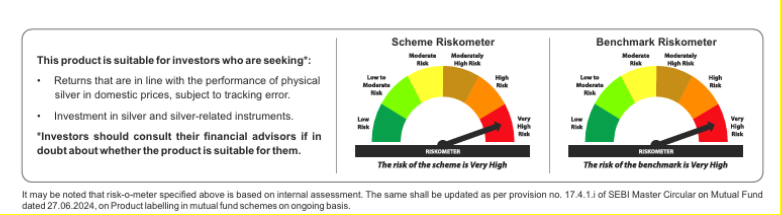
Disclaimer: It may be noted that the risk-o-meter specified above is based on an internal assessment. The same shall be updated as per provision no. 6.16.1.j of SEBI Master Circular on Mutual Fund dated 20.03.2026, on Product labelling in mutual fund schemes on an ongoing basis.
Potentially, the Tata Silver ETF may suit investors seeking exchange-traded exposure to domestic silver prices without holding physical silver. Note that it is classified as a “very high risk” scheme, so investors should assess whether this level of volatility matches their risk appetite.
4. How do gold and silver ETFs work?
As per general market understanding, Gold and Silver ETFs pool investors’ money and invest primarily in their respective physical metals (which are usually held with authorised custodians).
Units of both Gold and Silver ETFs are traded on stock exchanges (during regular business hours), and their values are based on the domestic gold or silver prices, respectively, subject to tracking errors.
5. Is Tata Gold ETF backed by physical gold?
The Tata Gold ETF is an open-ended exchange-traded fund replicating/tracking the domestic price of gold. As per the latest available SID (as on August 13, 2026), the Tata Gold ETF invests about 95 to 100% of its total assets in gold, including “physical gold” and permitted gold-related instruments. The remaining 0 to 5% may be invested in debt and money market instruments for liquidity.
6. Is there a gold and silver ETF?
Yes, Gold ETFs and Silver ETFs are available in India as separate investment products. A Gold ETF seeks to track domestic gold prices, while a Silver ETF seeks to track domestic silver prices.
Note that they are not a single combined product. Investors can choose between them based on their objectives, risk appetite, and investment horizon.
7. Is the Tata Silver ETF backed by physical silver?
As per the latest SID (available as of August 13, 2026), Tata Silver ETF invests 95 to 100% of its total assets in silver, including “physical silver” and other SEBI-permitted silver-related instruments. Up to 5% may be invested in debt and money market instruments to meet liquidity requirements.
Disclaimer:
The views mentioned above are for information & educational purposes only and do not construe to be any investment, legal, or taxation advice. Investors must do their own research before investing. The views expressed in this article are personal in nature and in is no way trying to predict the markets or to time them. Any action taken by you on the basis of the information contained herein is your responsibility alone, and Tata Asset Management Pvt. Ltd. will not be liable in any manner for the consequences of such action taken by you. Please consult your Mutual Fund Distributor before investing. The views expressed in this article may not reflect in the scheme portfolios of Tata Mutual Fund. There are no guaranteed or assured returns under any of the schemes of Tata Mutual Fund.
*Mutual Fund Investments are subject to market risks, please read all scheme related documents carefully.
Author Bio

Akshay Kumar Rao

Loading Form...
Loading Similar Blogs...