


Consumption Fund: Tier 2 & 3 Cities Growth Fueling the fund
Written by Akshay Kumar Rao
03 Feb 2026 • 9 minutes read


A consumption fund is a type of thematic mutual fund that invests at least 80% of its net assets in equity or equity-related instruments of companies operating in the “consumption-oriented theme”. Some common examples of such sectors are FMCG (Fast Moving Consumer Goods), Automobiles, Retail, Electronics, Healthcare, and more.
Do you know what’s fueling these sectors? A big part of the demand is coming from Tier-2 and Tier-3 cities. Rising incomes, easy access to digital payments, and the influence of social-media are changing how people shop. These smaller cities are now fueling consumer spending and have become a growth engine for D2C brands.
So, do you expect the consumption funds to grow in the coming years? Before investing funds, read this article to first check how they work and understand some benefits & risks of investing in them. Next, you will learn about the Tata Consumer Fund and its primary features.
Table of Content

How do Consumption Mutual Funds work?
These are “consumption theme mutual funds” that invest in shares of companies whose products and services are used by people in their daily lives. When people spend more, these companies usually earn more. As a result, their share prices may rise, which could benefit the consumption mutual funds.
For more clarity, let’s understand how different economic phases and corresponding consumer spending behaviour could impact a consumption mutual fund:
| Economic Phase | Consumer Spending Pattern | Impact on Companies | Impact on the Consumption Fund |
| Strong Economic Period | Higher spending on non-essential items such as cars, electronics, travel, and lifestyle products. | Higher sales and profits for “discretionary consumption companies”. | Rising share prices may lead to an increase in the fund’s NAV. |
| Weak Economic Period | Continued spending on essential items such as food, healthcare, and basic services. | Stable revenues for “essential consumption companies”. | There may be a decrease in the fund’s NAV.. |
5 Major Benefits of Investing in Consumption Mutual Funds in 2026
A study by Bain & Co. indicates that online shopping (a major driver of consumption) is no longer limited to only big cities. Since 2020, 3 out of every 5 new online shoppers have come from Tier-3 or smaller towns. People in remote areas, who earlier had limited access to brands, can now shop online.
Additionally, online selling is also spreading, with 60% of new sellers since 2021 coming from Tier-2 or smaller cities. So, what do these trends indicate? They support the long-term growth potential of consumption-based mutual funds in India.
If you are looking to invest, let’s see how they may benefit you:
1. Driven by Everyday Spending
As India’s economy grows and average income levels rise, people may spend more on both essentials + lifestyle products. This increase in spending could support business growth for consumption-focused companies.
Gradually, higher sales and stable demand can lead to better earnings, which could reflect positively on the NAV of consumption mutual funds. This makes consumption funds suitable for investors who are looking for exposure to “long-term domestic demand”.
2. Track Record of Wealth Creation
Many large consumption-oriented companies (say, FMCG and healthcare businesses) try to manage their operations more efficiently across different market cycles. These companies have a long operating history and continuously try to:
Grow earnings
Maintain strong brands
Adapt to changing consumer needs
Manage risks during uncertain phases
When these companies are part of a consumption fund’s portfolio, investors get exposure to businesses with strong long-term wealth creation potential.
3. Balance Within an Equity Portfolio
Consumption theme mutual funds focus on companies that directly benefit from rising consumer demand, such as FMCG, retail, banking, and telecom. These businesses depend on local spending (or domestic demand) rather than:
Exports
Global commodity prices
Foreign markets
When you add a consumption fund to a portfolio that already has exposure to sectors like IT, metals, or infrastructure, your returns are no longer driven by one single theme. If one sector underperforms, regular spending by Indian consumers may reduce the impact on your overall portfolio.
4. Professional Fund Management
Selecting the right stocks of consumption-oriented companies requires a strong understanding of:
Financial statements
Market trends
Economic conditions
Company history, and more
As an individual investor, you may not have the time or expertise to track multiple consumer sectors. The solution could be consumption funds! They are managed by professional fund managers who:
Research companies
Assess risks
Adjust portfolios based on changing consumer behaviour
This allows investors to participate in the consumption theme without needing to make individual stock selection decisions on their own.
3 Major Risks of Investing in Consumption Mutual Funds
One of the major risks associated with the consumption mutual funds is the “concentration risk” (or limited diversification). As mentioned before, these schemes must invest at least 80% of their assets in consumer-oriented sectors.
As a result, the fund is not widely diversified across multiple sectors such as IT, metals, energy, or infrastructure. Thus, if consumer-related sectors “underperform”, the fund may struggle to deliver returns even when other parts of the market are doing well.
Additionally, you may be exposed to the following risks:
1. Economic Sensitivity
Consumption funds are highly dependent on “consumer spending cycles” and are closely linked to how much people spend. Usually, during periods of weak economic growth or slowdowns, there are:
Job losses
High interest rates
Weak income growth
All of these factors reduce consumer spending. This directly affects sales + profits of consumption-focused companies. As a result, the performance of a consumption fund may weaken during economic stress.
Also, realise that such thematic schemes are more exposed to changes in household spending patterns as compared to defensive or diversified funds.
2. Behavioral Shifts and Technology Disruption
Consumer preferences change over time due to:
Lifestyle changes
Technology adoption
Evolving tastes
As a result, products or brands that are popular today may lose relevance tomorrow. Okay, but how could this impact your investment? Consumption funds holding traditional market leaders may face pressure if those companies fail to adapt.
Since these funds focus on a “specific consumer theme”, they are more exposed to such behavioral and technological changes compared to broad-market funds.
3. The Impact of Inflation and Government Policies
It is a fact that high inflation reduces purchasing power. Usually, it forces consumers to cut back on “discretionary spending”. Generally, this impacts sectors like:
Automobiles
Electronics
Retail
In addition, government policies such as changes in GST rates, fuel prices, or imposing new food regulations can influence consumer demand. All these factors can impact a consumer-oriented company’s profitability and stock prices. In turn, this could negatively impact the NAV of consumption mutual funds.
Looking for Options? You May Consider the Tata India Consumer Fund in 2026!
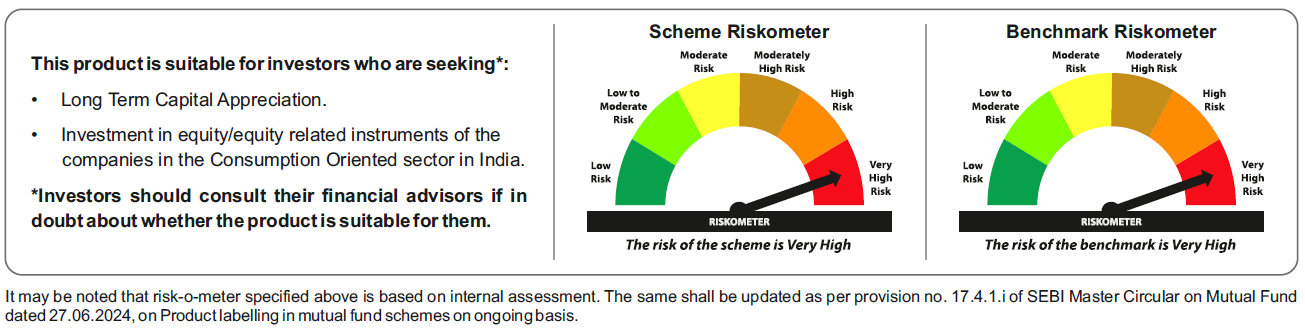
The Tata India Consumer Fund is an open-ended equity scheme investing in the consumption-oriented sector. The investment objective of the scheme is to seek long-term capital appreciation by investing at least 80% of its net assets in equity and equity-related instruments of the companies in the consumption-oriented sectors in India.
However, there is no assurance or guarantee that the investment objective of the scheme will be achieved. The Scheme does not assure or guarantee any returns.
For more clarity, let’s check out its several features:
| Feature | Details |
| Scheme Name | Tata India Consumer Fund |
| Category | Equity Scheme – Sectoral |
| Inception | December 28, 2015 |
| Exit Load | 0.25% if redeemed/switched out within 30 days from allotment |
| Core Equity Allocation | 80% to 100% in equity and equity-related instruments of companies in the Consumer Macro Economic Sector |
| Other Equity Exposure | 0% to 20% |
| Debt and Money Market Allocation | 0% to 20% |
| Risk Level | Very High Risk |
Conclusion
So now you know what consumption funds are and how they are benefiting from rising domestic demand, particularly from Tier-2 and Tier-3 Indian cities. These funds are designed to capture India’s long-term consumption story, which is being influenced by higher incomes + wider digital access.
If we were to recap, consumption mutual funds are thematic equity schemes that invest at least 80% of their net assets in consumer-oriented themes (as required by SEBI). Generally, these themes include FMCG, retail, banking, automobiles, healthcare, and related services among other sectors.
As disposable incomes rise and more consumers enter the formal and digital economy, demand for these products and services may grow. Over time, this rising demand may support company earnings and may have a positive impact on the consumption theme mutual funds. However, they may also go through phases of slowdown depending on the economic factors.
Disclaimer
The views mentioned above are for information & educational purposes only and do not construe to be any investment, legal, or taxation advice. Investors must do their own research before investing. The views expressed in this article are personal in nature and in is no way trying to predict the markets or to time them. Any action taken by you on the basis of the information contained herein is your responsibility alone, and Tata Asset Management Pvt. Ltd. will not be liable in any manner for the consequences of such action taken by you. Please consult your Mutual Fund Distributor before investing. The views expressed in this article may not reflect in the scheme portfolios of Tata Mutual Fund. There are no guaranteed or assured returns under any of the schemes of Tata Mutual Fund.
*Mutual Fund Investments are subject to market risks, please read all scheme related documents carefully.
Author Bio

Akshay Kumar Rao

Loading Form...
Loading Similar Blogs...