


Beyond Roads and Ports: Understand the Diverse Sub-sectors within Infrastructure Sectoral Funds
Written by Tata Mutual Fund
21 Nov 2025 • 9 minutes read


Infrastructure sectoral mutual funds are a type of equity schemes that primarily invest in companies related to the infrastructure sector. These organisations may operate in several areas, such as construction or maintenance of roads, bridges, railways, airports, ports, power plants, and telecom networks.
According to SEBI (Securities and Exchange Board of India) rules, infrastructure sectoral funds must invest at least 80% of their total assets in equity and equity-related instruments of infrastructure-related companies. Some well-known examples of such companies are Larsen & Toubro and Rail Vikas Nigam.
Need more information? Read this article to first check out the primary sub-sectors that make up the infrastructure industry (as per general understanding). Next, check out key features of infrastructure sectoral funds and then explore some options offered by Tata Mutual Fund™.
Table of Content

What are the Various Sub-Sectors of Infrastructure Sectoral Funds?
The infrastructure sector in India includes several industries that build the foundation for the country’s growth. Each sub-sector plays a specific role, such as:
Some create the physical framework, like roads and power plants and
Others supply materials or manage projects
Together, they generate employment, improve connectivity, and lead to industrial expansion. If you’re planning to invest in a mutual fund for infrastructure sector, firstly, check out these sub-sectors to know where your money is likely to be invested (illustrative list):
Energy
Power & Power Equipment
Petroleum & related industries
Coal
Mining
Aluminium & other Metal Industries
Steel & Steel Utilities
Engineering
Construction & Construction Related Industries
Cement
Transportation
Ports
Telecommunications
Housing
Banking & Financial Services & Healthcare & Related Industries.
Disclaimer: The sub-sectors may differ on a fund-by-fund basis. Investors may refer to the Scheme Information Document (SID) or other offer documents before investing.
4 Primary Features of Infrastructure Sectoral Mutual Funds
Infrastructure funds are a type of sectoral mutual fund and focus only on companies from the infrastructure space. This sector plays a major role in a country’s economic growth, so the performance of these funds depends largely on:
The state of the Indian economy and
The progress/ level of infrastructure spending
Usually, when the government or private sector increases spending (say on roads, power, transport, or housing), infrastructure companies may see higher demand and profits. Now, as these companies grow, the NAV (Net Asset Value) of an infrastructure sectoral fund may also rise.
For investors, this concentration offers a chance to benefit directly from India’s long-term development cycle. However, since the focus is narrow, performance depends largely on how the sector performs rather than the overall market.
For more clarity, also check out these other features of an infrastructure sector investment fund:
1. Influenced by Government Support
The infrastructure sector in India may receive consistent government attention through:
Policies
Incentives
Large-scale public projects
For example, according to IBEF.org (a trust established by the Ministry of Commerce),
In March 2024, connectivity projects worth US$1.8 billion were launched in Kolkata to boost regional connectivity.
As per the Union Budget 2025-26, the government plans to develop 120 new airports to handle about 4 crore more passengers (Source: IBEF)
Now, such a focus may create a supportive environment for infrastructure companies and, in turn, for sectoral funds that invest in them.
2. Potential for Strong Returns
Infrastructure projects often involve large investments + long timelines. However, once operational, they may generate regular revenue, say through:
Tolls
Power sales
Service charges, etc.
This may make the sector capable of delivering high returns over time (potentially). As a result, infrastructure mutual funds may particularly offer high-growth potential during “economic upcycles”.
This might happen when rising demand for transport, energy, and urban facilities translates into higher profitability for the companies involved. However, returns are not guaranteed and depend on timely project completion and overall economic stability.
3. Exposure to Higher Risk and Volatility
Infrastructure mutual funds may be exposed to several risks, such as:
Project delays
Policy changes
Funding issues
Fluctuations in commodity prices
All these factors can directly affect company performance. Now, because of these uncertainties, infrastructure sectoral funds may show greater volatility compared to diversified equity funds.
4. May Suit Long-Term Investors
Most infrastructure projects take time to build, operate, and generate profits. For this reason, infrastructure sectoral mutual funds may be better suited for investors with a long-term horizon.
As infrastructure projects are completed and begin generating regular income, the companies involved may become more profitable. This can increase the value of their stocks, which in turn may raise the NAV (Net Asset Value) of the sectoral fund that invests in them.
What Infrastructure Sectoral Mutual Fund Schemes are Offered by Tata Mutual Fund™?
If you are planning to invest in sectoral funds that invest in the infrastructure sector, Tata Mutual Fund™ offers two different options:
Nifty 500 MultiCap Infrastructure 50:30:20 Index Fund and
Tata Infrastructure Fund (an equity sectoral fund)
Both schemes are available in Growth and IDCW (Income Distribution cum Withdrawal Plan) options and come in Direct or Regular plans. Also, you can invest either a lump sum or start a monthly SIP.
To further your understanding, check out both these investment options in detail:
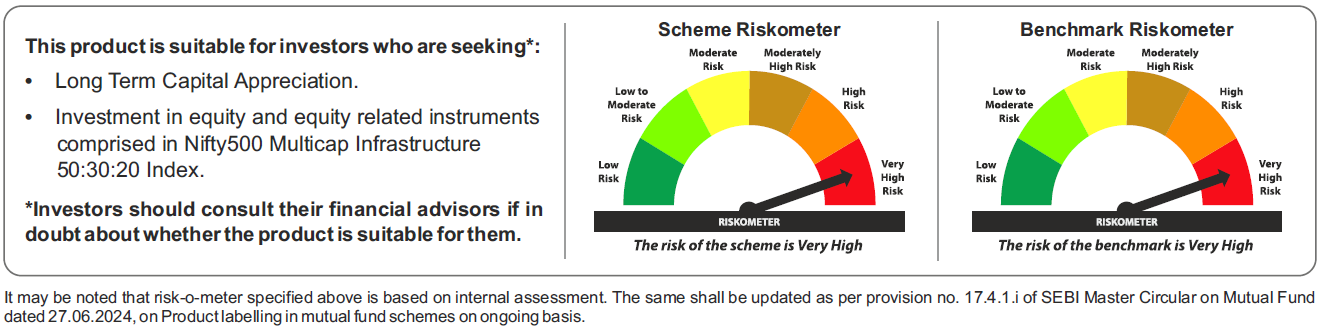
1. Tata Nifty 500 MultiCap Infrastructure 50:30:20 Index Fund
(An open-ended scheme replicating/ tracking Nifty500 Multi-cap Infrastructure 50:30:20 Index)
| Inception | Exit Load | Benchmark | Scheme Riskometer | Benchmark Riskometer |
| 26 April 2024 | 0.25 % of the applicable NAV, if redeemed on or before 15 days from the date of allotment. | Nifty500 Multicap Infrastructure 50:30:20 Index (TRI) | Very High Risk | Very High Risk |
This scheme is an infrastructure index fund, which may invest in companies connected to India’s infrastructure sector. The investment objective of the scheme is to provide returns, before expenses, that are in line with the performance of Nifty500 Multicap Infrastructure 50:30:20 Index (TRI), subject to tracking error. However, there is no assurance or guarantee that the investment objective of the scheme will be achieved. The scheme does not assure or guarantee any returns.
For those unaware, this index tracks large-cap, mid-cap, and small-cap stocks from the Nifty 500 universe that represent the “infrastructure theme”. If we talk about weightage, the index gives:
50% weight to large-cap stocks
30% to mid-cap
20% to small-cap companies
Additionally, no single stock can have more than 10% weight. This index fund may try to mirror the index’s performance, but it does not guarantee returns.
2. Tata Infrastructure Fund
(An open-ended equity sectoral scheme investing in the Infrastructure sector)
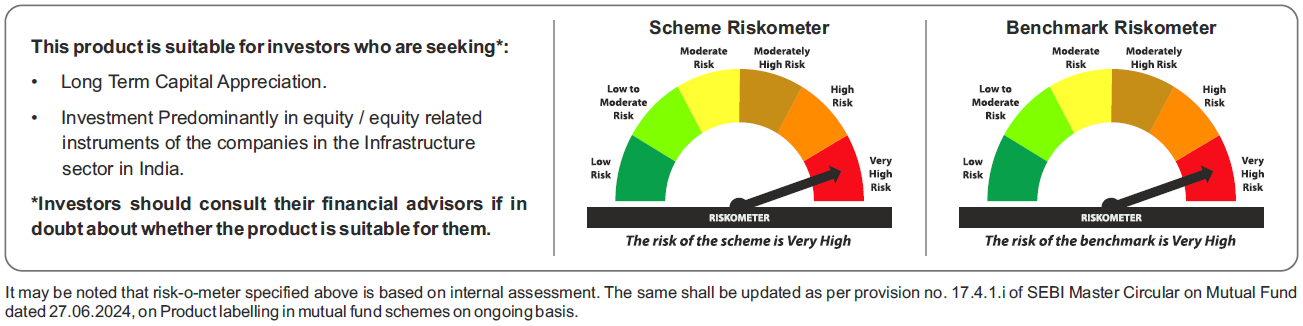
| Inception | Exit Load | Benchmark | Scheme Riskometer | Benchmark Riskometer |
| 31 December 2004 | 0.25% of the NAV if redeemed/switched out before 30 days from the date of allotment. | BSE India Infrastructure TRI | Very High Risk | Very High Risk |
The Tata Infrastructure Fund is an equity sectoral fund that could invest in shares of companies from India’s infrastructure sector. The fund’s performance is compared with the BSE India Infrastructure Index, which includes 30 leading infrastructure companies across five key areas:
Energy
Transportation
NBFCs
Telecommunications
Utilities
The index may use a modified market capitalisation weighted scheme to keep exposure balanced across these sectors.
Conclusion
So now you know that infrastructure mutual funds are sectoral funds that invest at least 80% of their assets in equity and equity-related instruments of infrastructure companies. These businesses operate across several sub-sectors such as:
Engineering
Real estate
Energy
Construction
Power
Metals
Such schemes are usually considered riskier than diversified mutual funds because of their narrow focus on a single sector. This concentration may lead to higher gains when the sector performs well, but it can also cause larger losses during weak phases.
If you are planning to invest in such sectoral funds, Tata Mutual Fund™ offers multiple options, such as infrastructure index funds and actively managed equity schemes.
*Mutual Fund Investments are subject to market risks, please read all scheme related documents carefully.
Author Bio

Tata Mutual Fund

Loading Form...
Loading Similar Blogs...