


Beyond the Best Performer: How to Choose the Right Large-Cap Fund for Your Portfolio?
Written by Akshay Kumar Rao
31 Dec 2025 • 7 minutes read


Large-cap mutual funds are equity schemes that invest at least 80% of their total assets in large-cap companies. As per SEBI, these are the top 100 companies in terms of full market capitalisation.
The potential advantage? These companies are established and could have a mature clientele. Also, most of them may have:
Stable revenues
Strong leadership
Proven business models
Their brand recognition + long track record potentially reduces the chances of sudden business shocks. Due to this stability, large-cap companies may handle market fluctuations better than smaller firms.
So, are you looking to invest in large-cap funds? Read this article to learn how you can go beyond merely the best performers and pick the right scheme in 2025.
Table of Content

How to Go Beyond Mere Past Performance? 5 Factors To Consider in 2025!
Before selecting any large-cap MF, firstly, be 100% clear about:
Why are you investing? and
When will you need the money?
Ideally, your financial goals with shorter timelines (say under 5 years) should not rely on equity funds because the market can fluctuate. In contrast, for longer timelines (say 5 years or more), large-cap funds may be considered.
This pre-screening prevents you from choosing a scheme that does not match your future needs. As an investor, you may list your goals in these categories:
Short-term goals (say up to 5 years)
Medium-term goals (say between 5-7 years)
Long-term goals (say 7 years or more)
Once you have made this segregation, you can select the right large-cap mutual fund after considering the following factors:
1. Active vs Index Large-Cap Fund
For your long-term goals, decide whether you want an index fund or an active fund. Let’s see how they differ:
| Aspects | Index Funds | Active Funds |
| How they invest | Follow a market index (such as Nifty 50). They may copy the index. | A fund manager chooses stocks to try to outperform the market. |
| Objective | Match benchmark returns. | Beat benchmark/ market returns. |
| Cost (Expense Ratio) | Lower fees. | Higher fees due to active research and management. |
| Role of Fund Manager | “Limited role” as tracking the index is the main task. | “Major role” as the performance depends on the manager’s skill and decisions. |
| Suitable For | Investors who want market-like returns at low cost. | Investors who want extra returns and accept higher risk. |
As an investor, you may choose an active large-cap fund only if:
The fund has shown long periods of better performance than its benchmark
The additional fee charged is justified by long-term results
You accept the risk that performance may vary
2) Verify the Category and Benchmark
Every mutual fund promises a specific investment style. For example,
Large-cap funds must primarily invest in large companies.
Other categories, like flexi-cap or large-and-mid-cap, invest in a broader mix.
Now, you must confirm that the fund stays true to the category it claims. Also, check the benchmark index the fund compares itself to, such as Nifty 100 or Sensex. This benchmark tells you what type of companies the fund tracks.
Some key checks you may make are:
Has the fund stayed within its defined investment category for years?
Does the benchmark match the type of companies the fund holds?
Does the fund comply with SEBI rules for large-cap definitions?
3) “Quantitative” Screening
You may not pick a large-cap MF because it had one great year! Instead, use the following tests:
| Metric | Interpretation |
| Rolling Returns (1, 3, 5, 7 years) |
|
| Sharpe and Sortino Ratio |
|
| Maximum Drawdown and Downside Capture |
|
| Alpha, Beta, and Tracking Error |
|
| Expense Ratio |
|
4) Read the Portfolio
A large-cap fund’s portfolio gives you visibility into the actual risk you are taking. Begin by studying the top 10 holdings to see if the fund is heavily dependent on a few companies. Then look at sector allocation; if one sector dominates, the fund may carry “concentrated risk”.
5) “Qualitative” Screening
Past performance is not enough! You must assess the people + processes behind the fund. As an investor, you may start by reviewing:
The fund manager’s experience
How long have they handled the scheme
Their performance during different market phases
Next, check if the fund has a clear investment approach (such as value, growth, or blended) and whether this approach has stayed consistent. Also, examine how decisions are made:
Is there a proper research team, or is everything dependent on one person?
Finally, review the fund house’s overall track record, governance culture, and compliance standards.
Some Tata Mutual Fund Schemes™ You May Consider in 2025
Tata Mutual Fund™ (operating as Tata Asset Management Private Limited) was established in 1994 and has been offering innovative financial products for more than 30 years.
We offer multiple large-cap mutual fund schemes for our investors, available in both Growth and IDCW (Income Distribution cum Capital Withdrawal) variants. Investors can also choose to invest through a lump sum or start a systematic investment plan (SIP) in the large-cap MF category.
Below are some schemes you may consider:
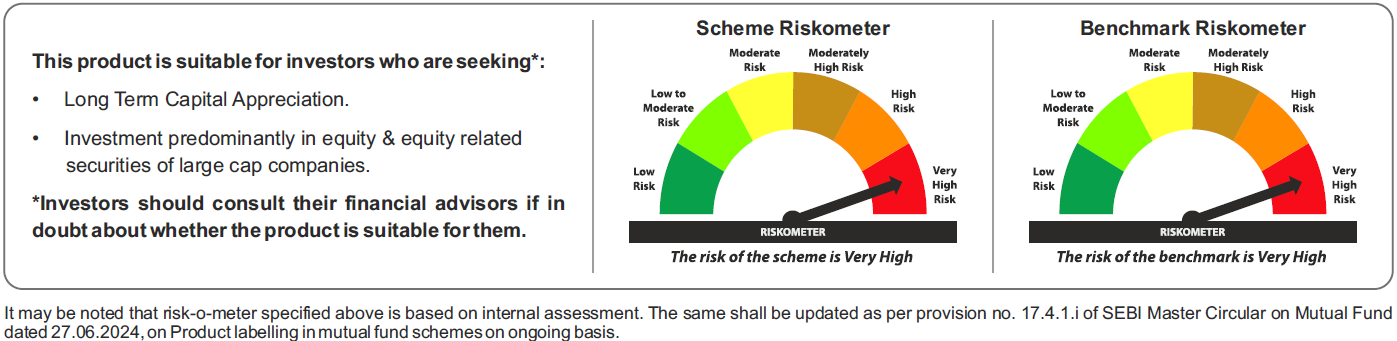
1. Tata Large Cap Fund
(An open-ended equity scheme predominantly investing in large-cap stocks)
| Inception | Exit Load | Benchmark | Scheme Riskometer | Benchmark Riskometer |
| 07 May 1998 |
| Nifty 100 TRI | Very High Risk | Very High Risk |
The investment objective of this large-cap MF scheme is to provide income distribution and/or medium to long-term capital gains while at all times emphasising the importance of “capital appreciation”.
However, the scheme does not assure or guarantee any returns. The benchmark of this financial product is the “Nifty 100 TRI”, which includes the top 100 companies in India based on their market size.
These companies are taken from the larger Nifty 500 universe and cover major sectors of the economy. It combines the companies in the “Nifty 50” + “the Nifty Next 50”.
2. Tata Large and Midcap Fund
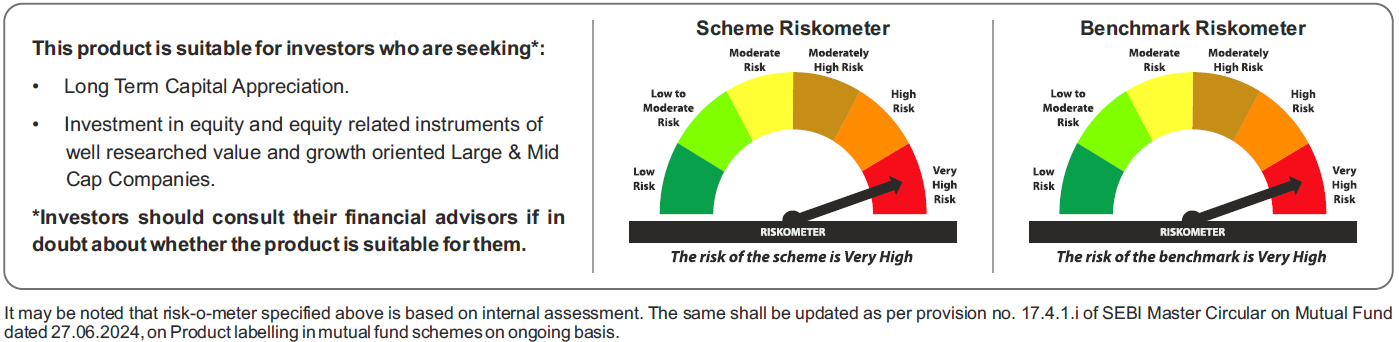
(An open-ended equity scheme investing in both large-cap and mid-cap stocks)
| Inception | Exit Load | Benchmark | Scheme Riskometer | Benchmark Riskometer |
| 25 February 1993 |
| Nifty Large Midcap 250 TRI | Very High Risk | Very High Risk |
The investment objective of this large-cap mutual fund is to provide income distribution and/or medium to long-term capital gains while at all times emphasising the importance of capital appreciation.
However, there is no assurance or guarantee that the investment objective of the scheme will be achieved. This financial product follows the Nifty LargeMidcap 250 index. It is an index that mixes large-cap + mid-cap companies in one place by tracking:
100 large-cap companies from the Nifty 100 and
150 mid-cap companies from the Nifty Midcap 150
Both groups get equal importance as the index is composed of 50% of the large caps and 50% of mid-cap companies. This balance is checked and reset every quarter.
Conclusion
So now you know that as an investor, you cannot rely solely on the past performance of a large-cap mutual fund. Why? That’s because past returns are not solely indicative of future results.
Thus, to choose the right scheme, you may look deeper and check the following:
Rolling returns (1, 3, 5, 7 years) across different time periods.
Risk measures like drawdowns, Sharpe, and Sortino ratios.
Portfolio quality to see sector balance and stock concentration.
Fund manager and fund house strength
Expense ratio to ensure the cost you pay is justified by the value you receive.
*Mutual Fund Investments are subject to market risks, please read all scheme related documents carefully.
Author Bio

Akshay Kumar Rao

Loading Form...
Loading Similar Blogs...