


Are Power & Resources Mutual Funds One of the Emerging Theme to Watch in India?
Written by Akshay Kumar Rao
01 Jun 2026 • 7 minutes read


The power and resource theme is focused on companies involved in power, energy, and natural resources.
Energy mutual funds, power mutual funds, renewable energy mutual funds, and oil & gas mutual funds are some of the common types of schemes under this theme.
Supportive government policies, India’s growing energy demand, and the shift to cleaner power are strong tailwinds for this theme.
But risks exist from cyclical performance, portfolio concentration, and global geopolitical factors.
The power and resource theme is an overarching theme with schemes under it investing in natural resources, power, and energy. These are typically sectoral mutual fund schemes that invest at least 80% of their total assets into equity and equity-related instruments of companies operating in India’s power, resource, and energy sector (depending on the scheme).
These companies can be involved in energy production, renewable energy, oil and gas, metals, mining, solar energy, and other resource-based businesses. ‘Energy mutual funds’ is often used as a broad term for such schemes.
Within this broad category, investors may come across:
Clean energy mutual funds
Mutual funds that invest in the oil & gas sector
Green energy mutual funds
Resource and energy mutual funds
Solar mutual funds
These funds may be focused on specific energy-related themes or sub-sectors to capture specific opportunities rather than the overall power and resources sector.
Table of Content

Why Can Resource and Power Emerge as a One of the Emerging Theme?
Mutual funds that invest in the power sector and resources for the long term may be in a favourable position, primarily due to:
- India’s growing energy and power demand
- Shift to cleaner power sources
- Favourable government policies
Let’s understand how these factors can impact energy mutual funds as a whole:
India’s Growing Energy and Power Demand
India’s energy demand is projected to grow faster than any other major world economy through 2035, with the country expected to account for over 23% of the global incremental energy demand by 2050 (Source: PIB).
At the same time, with the growth of India’s economy and rising living standards, electricity demand is also expected to rise across households, industry, agriculture, and services. To meet this demand at scale, two things are needed:
- More power generation
A system capable of delivering this power across the country
This may increase opportunities for companies involved in power generation, transmission, equipment manufacturing, and renewable infrastructure, which may positively impact energy mutual funds and mutual funds in the power sector over the long term.
Shift to Cleaner Power Sources
While India is already generating 50% of its electricity from renewable non-fossil fuel sources, it aims to achieve 500 GW of non-fossil fuel capacity by 2030 and become a net-zero country by 2070 (Source: PIB).
- Expanding renewable energy capacity will require more solar, wind, battery, and transmission infrastructure across India
- This may support companies involved in clean power generation and equipment manufacturing held by renewable energy mutual funds
- Growing investments in solar, EV, and energy storage ecosystems may benefit clean energy mutual funds and green energy mutual funds
- Long-term policy support for non-fossil fuel energy may create favourable conditions for energy mutual funds focused on renewable themes
Favourable Government Policies & Programmes
Over the last few years, the Indian government has also announced and executed several policies to support the resources and power sectors. Some of them are listed below:
- Government programmes like the National Green Hydrogen Mission may support companies involved in clean fuel production, renewable infrastructure, and energy equipment manufacturing
- Projects such as Green Energy Corridors may create opportunities for power transmission, grid infrastructure, and renewable energy companies held by energy mutual funds
- Increased spending on Carbon Capture Utilisation and Storage (CCUS) technologies may support businesses working on cleaner industrial and energy solutions
These policy-driven investments may create favourable long-term conditions for clean energy mutual funds, green energy mutual funds, and renewable energy mutual funds.
Looking to Invest in Such Funds? You May Consider the Tata Resources and Energy Fund
The Tata Resources and Energy Fund is an open-ended equity scheme investing in the Resources & Energy Sector.
The investment objective of the scheme is to seek long-term capital appreciation by investing at least 80% of its net assets in equity/equity-related instruments of the companies in the Resources & Energy sectors in India. However, there is no assurance or guarantee that the investment objective of the scheme will be achieved. The scheme does not assure or guarantee any returns.
The fund is offered in both growth and IDCW (Income Distribution Cum Capital Withdrawal) options:
- Tata Resources & Energy Fund direct growth plan
- Tata Resources & Energy Fund regular growth plan
- Tata Resources & Energy Fund direct IDCW
- Tata Resources & Energy Fund regular IDCW
Note: IDCW has two options: Payout (income distribution is paid to the investor) and Reinvestment (income distribution is reinvested).
Here are some more key details about the scheme:
| Feature | Details |
| Benchmark Index | Nifty Commodities Index |
| Exit Load | 0.25% of NAV: If units are redeemed or switched out before 30 days from the date of allotment. |
| Asset Allocation | Under normal circumstances, the scheme may invest in the following pattern:
*As classified by AMFI and in keeping with changes made from time to time. |
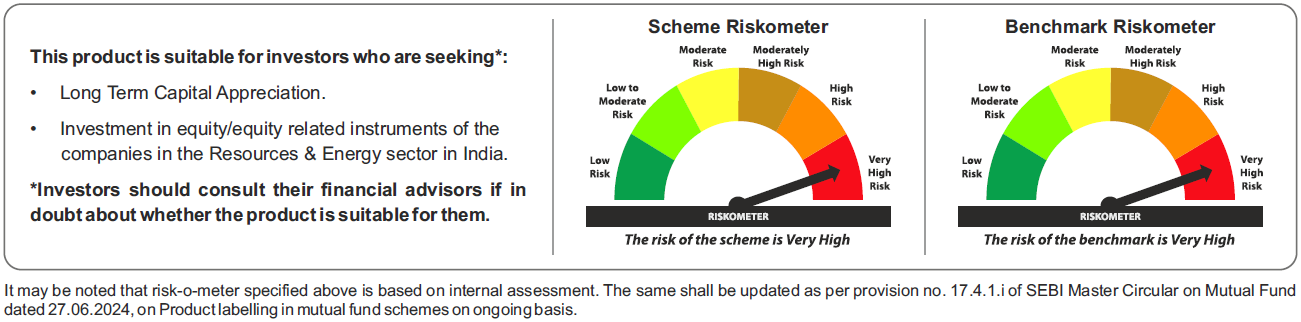
| Scheme Riskometer | Very High Risk |
| Benchmark Riskometer | Very High Risk |
Risks Associated with the Resource and Power Theme
Here are some risks you should understand before opting in for energy sector mutual funds or any other scheme with the resource and power theme:
Concentration Problems
Power and energy funds invest mainly in a single sector or theme. This means their performance depends heavily on how the energy and resources sector performs overall.
If the sector faces weak demand, regulatory issues, or lower investments, these funds may see higher volatility than diversified equity funds.
Supply Chain Disruptions
The energy and renewable sector depends on equipment, raw materials, and global supply chains for manufacturing and project execution. Delays in imports, rising raw material costs, or shortages of components may impact project timelines and company profitability.
For instance, geopolitical tensions like the West Asia conflict may disrupt crude oil supply chains and cause sharp fluctuations in oil prices, which can increase volatility in mutual funds that invest in the oil & gas sector.
Cyclical Performance
Power and energy sectors often move through cycles based on economic growth, commodity prices, policy changes, and investment activity. This means energy mutual funds may perform during favourable phases but may also experience periods of slower growth or corrections.
Conclusion
Mutual funds in the power sector and resource theme have some tailwinds supporting them in India. These include favourable support factors like:
- Rising electricity and energy demand
- Supportive government policies
- Shift to green energy
However, there is no guarantee since the energy sector also faces supply chain disruptions and rising costs from the West Asia conflict, concentration risks, and other headwinds. If you are considering these funds, you should make sure they align with your goals and risk appetite completely.
FAQs
1. Who may invest in energy mutual funds?
Energy mutual funds may be suitable for investors with a very high risk appetite who are looking for long-term capital appreciation. These funds are also suitable for those investors who understand the energy sector properly.
2. What are green energy mutual funds?
Green energy mutual funds are mutual fund schemes that invest in companies that work in the renewable energy sector or engage in clean energy activities like solar, hydro, or wind energy. These may also be called renewable energy mutual funds.
3. Are power sector mutual funds good for beginners?
Generally, no. Mutual funds that invest in the power sector are typically not suitable for beginners, as they may have higher concentrated risks and face higher volatility. Investing in these funds requires knowledge about the power sector and its performance, which beginners may not possess.
Disclaimers:
The views mentioned above are for information & educational purposes only and do not construe to be any investment, legal, or taxation advice. Investors must do their own research before investing. The views expressed in this article are personal in nature and in is no way trying to predict the markets or to time them. Any action taken by you on the basis of the information contained herein is your responsibility alone, and Tata Asset Management Pvt. Ltd. will not be liable in any manner for the consequences of such action taken by you. Please consult your Mutual Fund Distributor before investing. The views expressed in this article may not reflect in the scheme portfolios of Tata Mutual Fund. There are no guaranteed or assured returns under any of the schemes of Tata Mutual Fund.
*Mutual Fund Investments are subject to market risks, please read all scheme related documents carefully.
Author Bio

Akshay Kumar Rao

Loading Form...
Loading Similar Blogs...