


Why Should You Include Tata Multicap Fund in Your Investment Strategy?
Written by Akshay Kumar Rao
14 Aug 2025 • 11 minutes read


Tata Multicap Fund is an open ended equity scheme investing across large cap, mid cap, and small cap stocks. The investment objective of the scheme is to generate long-term capital appreciation from a portfolio of equity and equity related securities across market capitalization. However, there is no assurance or guarantee that the investment objective of the Scheme will be achieved. The scheme does not assure or guarantee any returns.
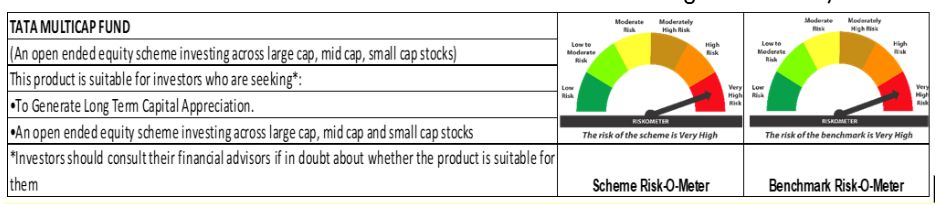
Disclaimer: It may be noted that the risk-o-meter specified above is based on an internal assessment. The same shall be updated as per provision no. 6.16.1.j of SEBI Master Circular on Mutual Fund dated 20.03.2026, on Product labelling in mutual fund schemes on an ongoing basis.
When it comes to potential long-term wealth creation, diversification is often touted as the key to minimising risks and optimising returns. This principle is at the heart of multicap funds, which invest across large-cap, mid-cap, and small-cap stocks having minimum 25% allocation in each category as per SEBI Classification. Among the many options available to Indian investors, the Tata Multicap Fund stands out for its disciplined approach, expert fund management, and potential growth.
If you are exploring multicap mutual funds for your investment option, this article will walk you through everything you need to know - what makes a multicap fund unique, why Tata Mutual Fund’s offering merits a place in your portfolio, and how it may align with various investor goals.
Table of Content

What Are Multicap Funds?
As per SEBI regulations, a Multi-Cap Fund is an equity scheme that invests a minimum of 75% of its total assets in equity and equity-related instruments. This investment is divided equally across market-cap categories:
- Large Cap: Minimum 25% of total assets in equity and equity-related instruments of large cap companies.
- Mid Cap: Minimum 25% of total assets in equity and equity-related instruments of mid cap companies.
- Small Cap: Minimum 25% of total assets in equity and equity-related instruments of small cap companies.
The remaining 25% of total assets may be allocated to other permitted investments, subject to the scheme's investment strategy.
Key Features:
- Minimum 25% allocation to each of large, mid, and small-cap stocks (as per SEBI’s mandate)
- Allows fund managers the flexibility to invest in growth opportunities across sectors
- Offers a risk-reward proposition
By spreading investments across a broad spectrum, multicap mutual funds aim to reduce volatility while still participating in potential growth.
Why Choose a Multicap Fund Over Other Equity Funds?
Investors often struggle to pick the “right” market cap for a given year. Markets can be cyclical - mid and small caps may outperform in one year, while large caps dominate the next. Instead of trying to time the market, multicap funds offer a structure that adapts according to market shifts.
Benefits of Multicap Funds:
- Diversification: Reduces dependency on any one segment/market-cap
- Flexibility: Fund managers can rebalance the portfolio based on market cycles
- Volatility: Aim to absorb sector- or cap-specific shocks
- Growth Potential: Access to potential well-performing mid and small-cap stocks
This combination makes them suitable for long-term investors who want to stay invested across market cycles.
Introducing Tata Multicap Fund
Among the options in this category, the Tata Multicap Fund is designed to offer investors a well-rounded exposure to Indian equities. It combines the Tata Mutual Fund’s investment philosophy with the structural benefits of a multicap approach.
Fund Snapshot:
- Scheme Type: An Open-ended equity scheme investing across large cap, mid cap, small cap stocks.
- Investment Strategy: The Scheme aims to generate capital appreciation by investing in a diversified portfolio of equity & equity related instruments across market capitalization. The scheme will predominantly invest in equity and equity related instruments of well researched and growth-oriented companies. The fund would follow a mix of Top Down and Bottom-up approach towards construction of the diversified equity portfolio
- Benchmark: Nifty 500 Multicap 50:25:25 TRI
Risk Level: Very High (as per Scheme Riskometer)
The fund maintains a minimum 25% allocation to each market cap segment and uses bottom-up stock selection to build a portfolio that reflects India’s evolving economy.
Why Should You Include Tata Multicap Fund in Your Portfolio?
1. Balanced Market Exposure
By maintaining exposure to all three market segments, the fund can diversify. If large caps underperform, mid or small caps can drive potential returns, and vice versa.
2. Professional Fund Management
With Tata Mutual Fund’s experienced fund managers at the helm, the Tata Multicap Fund benefits from in-depth research, sectoral analysis, and strong governance. Their ability to spot under-researched, aiming for high-potential companies, can give investors a competitive edge.
3. SIP-Friendly Option
You can start investing in the funds through a Systematic Investment Plan (SIP) with as little as Rs. 150 per month. SIPs help average out the cost of units over time, making it suitable for retail investors seeking discipline and affordability.
4. Smart Rebalancing Strategy
The fund rebalances its allocation periodically to align with market conditions. This dynamic approach helps capture potential uptrends in specific cap segments while reducing exposure to overvalued ones.
5. Tailored for Long-Term Goals
Whether you're saving for retirement, a child’s education, or building wealth for future expenses, this fund’s diversified exposure and potential for compounding make it a long-term choice.
Who Should Consider Investing?
The Tata Multicap Fund is suitable for:
- Investors with a medium to long-term horizon (5 years or more)
- Individuals seeking diversification across market caps
- Those looking to avoid the risk of being overexposed to one market segment
- Investors wanting a one-stop equity solution
However, since this is an equity-oriented scheme with a very high-risk profile, it is not ideal for those with low risk tolerance or short-term liquidity needs.
Performance Overview
(As per SEBI guidelines, past performance is not indicative of future results. Data here is for illustration only.)

Benchmark: Nifty 500 Multicap 50:25:25 TRI
Riskometer: Very High
How to Invest in Tata Multicap Fund?
Step-by-Step:
- Visit www.tatamutualfund.com
- Select the fund
- Choose between SIP or Lumpsum
- Track your investments via the Tata Mutual Fund Investor app or website
Make sure to read the Scheme Information Document (SID) and Key Information Memorandum (KIM) before investing.
Tax Implications
Since a Multi Cap Fund invests at least 75% of its total assets in equity and equity-related instruments, it may qualify as an equity-oriented mutual fund.
- Short-Term Capital Gains (STCG) may arise on units sold within 12 months. These gains are taxed at 20%.
- Long-Term Capital Gains (LTCG) may arise on units held for more than 12 months. These gains are taxed at 12.5%, with gains up to ₹1.25 lakh in a financial year being exempt.
Investors should also consider applicable surcharge, and health and education cess while calculating their final tax liability. Furthermore, dividends received from a Multi Cap Fund are taxable in the hands of the investor at the applicable slab rate.
Note: Investors may consult a qualified tax advisor to understand the tax implications based on their individual circumstances.
Conclusion
In an unpredictable market, choosing a fund that offers built-in diversification, active fund management, and long-term potential is a smart move. The Tata Multicap Fund brings all of this together with the credibility and research-driven approach.
Whether you are a new investor or looking to add breadth to your existing portfolio, a multicap fund like this can help you ride market waves with greater resilience while capturing growth opportunities across India’s corporate landscape.
 |  |


For more information, you can visit www.tatamutualfund.com. The Investor Service Centre of Tata Asset Management Pvt. Ltd. is located at Mulla House, Ground Floor, 51, M.G. Road, Near Flora Fountain, Mumbai – 400 001, Maharashtra. The office hours are Monday to Friday, 9:00 AM to 5:30 PM. For assistance, you can also call (022) 6282 7777 from Monday to Saturday, 9:00 AM to 5:30 PM, or email service@tataamc.com.
FAQs on Tata Multicap Fund
1. Is Tata Multicap Fund good for SIPs?
Yes. It offers exposure to all market caps, helping to average out returns and reduce risk over time.
2. How is it different from a flexicap fund?
Flexicap funds have no minimum cap-wise allocation requirement. Multicap funds must maintain 25% each in large, mid, and small-cap stocks.
3. Is it suitable for conservative investors?
While more diversified than small- or mid-cap funds, it still carries very high equity risk. Suitable for investors with very high-risk tolerance.
4. How to invest in Tata Multi Cap Fund?
You may invest directly via the Tata Mutual Fund website. Before investing, complete the Know Your Customer (KYC) process by providing information, such as your PAN, full name, mobile number, bank account, and more.
Next, you may choose a fund based on your risk appetite and investment objectives. Decide the installment mode (SIP* or lump sum) and complete the payment online.
*For SIP (Systematic Investment Plan) investments, you may also be required to set up a mandate for automatic transfers from the registered bank account.
5. What is the difference between Flexi Cap and Multi Cap Funds?
The primary difference lies in their mandatory equity allocation and market-cap requirements. As pr SEBI regulations,
- A Multi Cap Fund invests at least 75% of total assets in equity and equity-related instruments, with at least 25% each in large cap, mid cap and small cap companies.
- In contrast, a Flexi Cap Fund invests at least 65% in equity and equity-related instruments and can dynamically invest across large, mid and small cap stocks without a prescribed minimum allocation to each category.
Disclaimer:
The views mentioned above are for information & educational purposes only and do not construe to be any investment, legal, or taxation advice. Investors must do their own research before investing. The views expressed in this article are personal in nature and in is no way trying to predict the markets or to time them. Any action taken by you on the basis of the information contained herein is your responsibility alone, and Tata Asset Management Pvt. Ltd. will not be liable in any manner for the consequences of such action taken by you. Please consult your Mutual Fund Distributor before investing. The views expressed in this article may not reflect in the scheme portfolios of Tata Mutual Fund. There are no guaranteed or assured returns under any of the schemes of Tata Mutual Fund.
*Mutual Fund Investments are subject to market risks, please read all scheme related documents carefully.
Author Bio

Akshay Kumar Rao

Loading Form...
Loading Similar Blogs...