


Want to Invest According to Your "Values"? Learn Everything About Ethical Mutual Funds 2026
Written by Akshay Kumar Rao
14 Oct 2026 • 8 minutes read


Ethical mutual funds invest according to a set of values or principles, such as Shariah rules, ESG factors, or sector exclusions. They may avoid certain industries and invest only in companies that meet their chosen criteria. Like other mutual funds, they are market-linked, so investors should still look at risk, diversification, costs, and suitability before investing.
If you’re choosing a mutual fund, returns and risk are usually the first things you look at. But you may also care about where your money is being invested. For example, you may want to avoid certain industries, follow Shariah principles, or prefer companies with stronger environmental or social practices. In short, you may want your investment to reflect your values.
That is the main idea behind ethical funds. In this guide, we’ll look at how ethical funds work, the main types, their risks, and where the Tata Ethical Fund fits in.
Table of Content

What Exactly Are Ethical Funds?
Ethical funds are simply those mutual fund schemes that have a set of values guiding them on where to invest. Based on the type of ethical fund in question, this can mean investing in only those companies that meet certain religious, environmental, or social standards.
Some common types of ethical funds include:
Type | What it does | What does this mean |
Shariah-compliant funds | Invest only in businesses and securities that meet Shariah rules. | May avoid prohibited sectors and practices like alcohol/tobacco/gambling and leverage. |
ESG funds | Invest in companies based on how they impact the environment, how they treat their employees, and how they are managed. | May invest in companies that have low-carbon emissions, pay parity, transparency, or display proper business ethics. |
Sustainability-focused funds | Focus on businesses linked to areas such as clean energy or sustainable practices. | May invest in companies that focus on upholding sustainability. |
Main Features of Ethical Funds in India
While ethical funds can be categorised into different types, they may share the following core features:
- They follow a set of values: Each ethical fund has a clear set of rules and values that offer guidance on where it can and cannot invest.
- Generally thematic: Most ethical funds are classified as thematic funds that select investment options based on their guiding values and theme (religious principles/ESG, etc.).
- Some sectors are avoided: Certain ethical funds may avoid investing in sectors prohibited by the fund's main guiding values. For instance, Shariah funds may avoid alcohol, tobacco, and weapons sectors, while ESG funds may avoid companies engaged in non-sustainable practices.
- Inclusion screening: Ethical funds screen compliant industries to find companies that meet their predefined ethical guidelines. They may also use financial ratios to avoid heavily debt-laden companies if that’s against their core values.
- They still work like regular mutual funds: You invest in units, the NAV changes over time, and returns depend on how the underlying investments perform.
Among the various types of ethical funds in India, Shariah-compliant schemes remain the most common ones.
Understanding Tata Ethical Fund: An Example of a Shariah-Compliant Ethical Fund
Many investors in India look for mutual funds that align with their religious values to participate in the capital market. That’s why Shariah-compliant funds are one of the most popular types of ethical funds in India.
The Tata Ethical Fund scheme is among the most well-known and oldest funds in this category. Launched in 1996, this open-ended thematic equity fund scheme invests in Shariah-compliant companies.
Key Highlights of the Scheme
If you want to align your investments with your religious values with the Tata Ethical Mutual Fund, here’s what you should understand first:
- The fund follows Shariah principles while selecting investments.
- It invests only in securities that are part of the Shariah-compliant universe.
- A Shariah Advisor may be appointed to identify securities that meet these rules.
- The fund does not use leverage or short selling.
- If a company later becomes non-compliant with Shariah principles, the fund manager will exit the investment within the time allowed by the Shariah Advisor.
Scheme Type | An open-ended equity scheme following Shariah principles. |
Investment Objective | The investment objective of the scheme is to provide medium- to long-term capital gains by investing in Shariah-compliant equity and equity-related instruments of well-researched value- and growth-oriented companies. However, there is no guarantee that this investment objective will be achieved. The scheme does not guarantee/assure returns. |
Exit Load | 0.50% if redeemed/switched out on/before 90 days from the date of allotment. |
Benchmark | Nifty 500 Shariah TRI |
Asset Allocation (Indicative as per SID) |
|
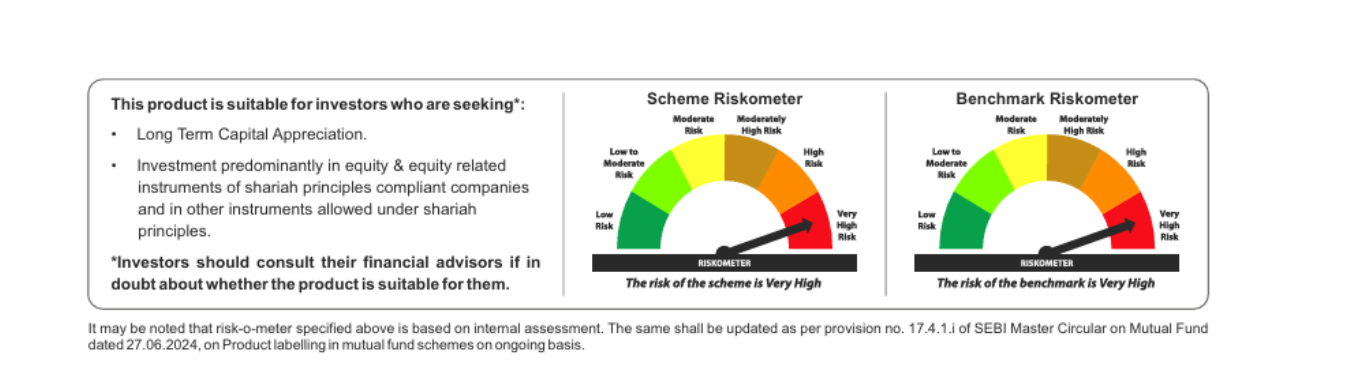
Scheme Riskometer | Very high risk |
Benchmark Riskometer | Very high risk |
What’s Allowed & What Isn’t
Where the Fund May Invest | Where the Fund Will Not Invest |
Can invest in listed or to-be-listed securities of companies that are incorporated in/operating mainly from India/making significant revenue from India. Such securities may include:
| Cannot invest in instruments that are not Shariah-compliant, including:
Plus, the fund cannot engage in short-selling and using its assets as leverage for borrowing. |
Tata Ethical Fund Plan Options & NAV
The Tata Ethical Fund NAV shows the current per-unit value of the scheme and is updated on business days. Investors can check it on the Tata Mutual Fund website or other registered investment platforms.
As for plan options, investors can choose from:
- Regular Plan: Where investments are routed through distributors
- Growth Option
- Income Distribution cum capital withdrawal option (IDCW Option)
- Direct Plan: Where investments are not routed through distributors
- Growth Option
- Income Distribution cum capital withdrawal option (IDCW Option)
Who May Find the Tata Ethical Fund Suitable?
The Tata Ethical Fund option may be suitable for those who want to invest in mutual funds while staying aligned with their religious values. This scheme may be suitable for:
- Investors who want to invest in Shariah-compliant companies.
- Investors who want to invest on the basis of faith-based guidelines, like avoiding sectors prohibited under Shariah Law.
- Those who are looking for potential long-term growth*.
- Investors who are aware of and accept the risks related to equity investing.
*Disclaimer: Returns are market-linked and not guaranteed.
Risks of Ethical Funds
- Limited investment choices: Ethical filters can reduce the number of companies the fund can invest in.
- Higher concentration risk: The portfolio may be more exposed to certain sectors or themes.
- Performance can differ from the broader market: If excluded sectors perform well, the fund may miss out on those gains.
- Different funds follow different rules: Ethical, ESG, and Shariah-based funds may use very different screening methods.
- Market risk still applies: Ethical funds are still mutual funds, so their value can rise or fall with the market.
Conclusion
Ethical funds are useful for investors who want their investments to reflect certain personal, social, or religious values. The main thing to remember is that the “ethical” label does not remove investment risk.
These funds can have a narrower investment universe because some sectors or companies are excluded. So, before investing, check what rules the fund follows, where it can invest, how diversified the portfolio is and whether the risk level matches your goals and time horizon.
Ethical Funds FAQs
1. What are ethical mutual funds and how do they work?
Ethical mutual funds invest according to a defined set of values or principles. A fund may avoid certain industries, prefer companies with stronger ESG practices, or follow religious guidelines such as Shariah rules. The fund manager selects investments only from the companies or securities that meet these stated criteria.
2. What criteria do ethical mutual funds use to select stocks?
The criteria depend on the type of ethical fund. Some may exclude sectors such as tobacco, alcohol, gambling or weapons. ESG-focused funds may look at environmental, social, and governance factors. Shariah-compliant funds, such as the Tata Ethical Fund, follow separate financial and business-activity screens based on Shariah principles.
3. How do ethical mutual funds differ from regular mutual funds?
The main difference is the investment filter. A regular mutual fund generally selects investments based on its stated financial strategy and scheme mandate. Ethical funds add another layer of screening based on environmental, social, religious, or other values. This can reduce the number of companies available for the fund to invest in.
4. Who should consider investing in ethical mutual funds?
Ethical funds may suit investors who want their investments to reflect certain personal or religious values. They may also appeal to investors specifically looking for ESG- or Shariah-based portfolios. However, investors should still consider the fund’s risk level, investment objective, time horizon, and portfolio before investing.
5. Do ethical mutual funds deliver competitive returns compared to traditional funds?
We cannot directly compare returns of ethical and regular funds. Ethical funds invest in a smaller or differently screened set of companies, so their performance may be better or worse than broader mutual funds at different times. Returns ultimately depend on the fund’s portfolio, market conditions, and investment strategy, not simply on its ethical label.
6. What are ESG factors in ethical mutual fund investing?
ESG stands for Environmental, Social and Governance. These factors look at areas such as a company’s environmental impact, treatment of employees and customers, and quality of corporate governance. Some ethical funds use ESG factors to decide which companies to include or avoid, although not all ethical funds follow an ESG approach.
Disclaimer:
The views mentioned above are for information & educational purposes only and do not construe to be any investment, legal, or taxation advice. Investors must do their own research before investing. The views expressed in this article are personal in nature and in is no way trying to predict the markets or to time them. Any action taken by you on the basis of the information contained herein is your responsibility alone, and Tata Asset Management Pvt. Ltd. will not be liable in any manner for the consequences of such action taken by you. Please consult your Mutual Fund Distributor before investing. The views expressed in this article may not reflect in the scheme portfolios of Tata Mutual Fund. There are no guaranteed or assured returns under any of the schemes of Tata Mutual Fund.
*Mutual Fund Investments are subject to market risks, please read all scheme related documents carefully.
Author Bio

Akshay Kumar Rao

Loading Form...
Loading Similar Blogs...