


How to Pick a Suitable Large and Mid-Cap Fund? - 5 Key Factors to Consider
Written by Akshay Kumar Rao
24 Nov 2025 • 9 minutes read


As per SEBI regulations, Large and Mid Cap funds are open-ended equity schemes investing at least 35% of their total assets in equity and equity-related instruments of large-cap companies and 35% of their total assets in equity and equity-related instruments of mid-cap companies.
For those unfamiliar with the classification, large-cap companies rank among the top 100 companies by full market capitalisation, while mid-cap companies rank from 101st to 250th.
Large cap funds and mid cap funds are two of the most popular mutual fund categories in the equity funds segment. At present, large cap funds invest in large cap companies ranked 1-100 in terms of market capitalisation, while mid-cap funds invest in mid-cap companies ranked 101-250 as per market capitalisation.
A large and mid cap fund combines both segments by investing in a mix of both large and mid-cap stocks. SEBI introduced the large and mid cap fund category in October 2017 as part of its mutual fund categorisation and rationalisation framework. The goal was to improve transparency, standardise definitions, and help investors better understand where their money is being invested.
In this article, we take a closer look at what they are, how they function, and the key factors to keep in mind before investing.
Table of Content

What are Large-Cap and Mid Cap Funds?
A large and mid cap fund is an open-ended equity mutual fund that invests in both large-cap and mid-cap companies. As per SEBI classification, these funds must invest at least 35% in large-cap and 35% in mid-cap stocks. This ensures that investors get exposure to both relative stability through large caps and possibly better growth through mid caps in a single investment.
Key aspects of large and mid cap funds include:
Diversified allocation: The fund invests in both established and emerging companies, reducing dependence on a single segment.
Defined structure: The 35:35 rule ensures discipline in portfolio construction, keeping exposure spread between large and mid caps.
Dual benefit: Investors can participate in potential of steady performance from large-cap stocks while aiming o capture the long-term growth opportunities of mid caps.
This mix allows a large and mid cap fund to offer diversified exposure across company sizes, aiming for consistent growth over the long term.
How do Large and Mid Cap Funds work?
A large and mid cap fund combines the stability of large companies with the growth potential of mid-sized ones. While SEBI requires a minimum 35% investment in each segment, fund managers have the flexibility to allocate the remaining portion based on changing market conditions.
If large-cap stocks look more attractive, they can increase exposure there for potentially greater stability. When mid-cap opportunities arise, they can tilt the portfolio toward mid cap stocks, aiming for a higher growth potential. This flexible approach helps the fund adapt to market cycles while maintaining a diversified structure.
As a result, a large and mid cap fund offers a dynamic way to participate in different phases of the equity market through a single investment.
Features of Large and Mid Cap Funds
Let’s have a look at the key features of large & mid-cap funds:
Investment Strategy: Aims to combine large-cap stability with mid-cap growth for a potentially balanced performance.
Growth Potential: Aims to offer long-term appreciation through exposure to expanding mid-sized companies.
Diversification: Spreads investments across sectors to potentially reduce concentration and volatility risk.
Risk and Returns: Carries high risk but rewards patience over a longer horizon.
Market Exposure and Liquidity: Provides access to both established leaders and emerging businesses.
Suitability: Ideal for investors with long-term goals and higher risk tolerance.
5 Key Factors to Consider Before Picking a Large and Mid Cap Fund
Choosing the right large and midcap fund depends on your goals, risk profile, and investment approach. Here are five key factors to evaluate before making a decision:
Investment Goal and Time Horizon
Before you choose a large and mid cap fund, make sure it matches your financial goals and how long you plan to stay invested. These are equity-oriented funds, so they tend to work better for long-term financial planning rather than short-term needs.
You may consider:
Aligning your investment with goals that have a minimum 5–10 year horizon.
Using these funds for long-term objectives like wealth creation or retirement planning.
Avoiding them for short-term goals, as market fluctuations can impact performance in the near term.
Risk Profile
Evaluating the risk profile of a fund is an important step before investing. You should understand the following aspects about the risk profile of large and mid cap funds:
These funds carry a high risk level because they invest in equities both large and mid-sized companies.
The large-cap portion may add stability and help cushion market downturns.
The mid-cap exposure may introduce higher growth potential but also greater short-term volatility.
The overall risk may vary depending on how the remaining 30% of the portfolio is allocated across market segments.
Expense Ratio and Costs
Every large and mid cap fund comes with an expense ratio, which covers the cost of managing and operating the fund. Since this charge is deducted from the fund’s returns, a lower ratio means more of your money stays invested.
You should consider:
Funds with lower expense ratios to ensure less money goes towards administrative costs.
Direct plans over regular plans because there is no distributor/agent commission involved.
How the expense ratio aligns with the fund’s performance and management quality.
Portfolio Composition and Fund Manager’s Track Record
The composition of a large and mid cap fund and the experience of its fund manager can significantly influence performance. Reviewing how your fund is built helps you understand where and how your money is invested.
You should check:
The balance between large-cap and mid-cap stocks to ensure alignment with your goals.
Sector allocation and diversification, which show how risks are managed across industries.
The track record of the fund manager, including years of experience, past fund performance, and ability to navigate varying market cycles.
Past Performance
Evaluating past performance helps you understand how consistently a large and mid cap fund has performed across market cycles. While it doesn’t predict future results, it offers perspective on how well the fund has managed different phases of the market.
You should review:
Rolling returns over 3, 5, and 7 years compared with its category and benchmark, such as the Nifty LargeMidcap 250 TRI.
Performance across bull and bear markets to gauge stability.
Volatility indicators like standard deviation and Sharpe ratio to assess risk-adjusted returns.
Consistency of returns relative to peers over long-term horizons.
Benefits and Risks of Large and Mid Cap Funds
Benefits
Balanced exposure to both stable large-cap and growth-oriented mid-cap companies.
Built-in diversification across sectors and market sizes helps manage volatility.
Potential to capture market upswings while maintaining relative portfolio stability.
Professionally managed and easily accessible through mutual fund platforms.
Potential for long-term wealth creation and goal-based financial planning.
Risks
Equity market movements can cause short-term fluctuations in value.
Mid-cap exposure may lead to higher volatility during uncertain phases.
Performance can vary across market cycles, requiring a longer holding period.
Broader economic changes can affect both large and mid-cap segments.
Differences in fund strategy and cost structures can impact returns.
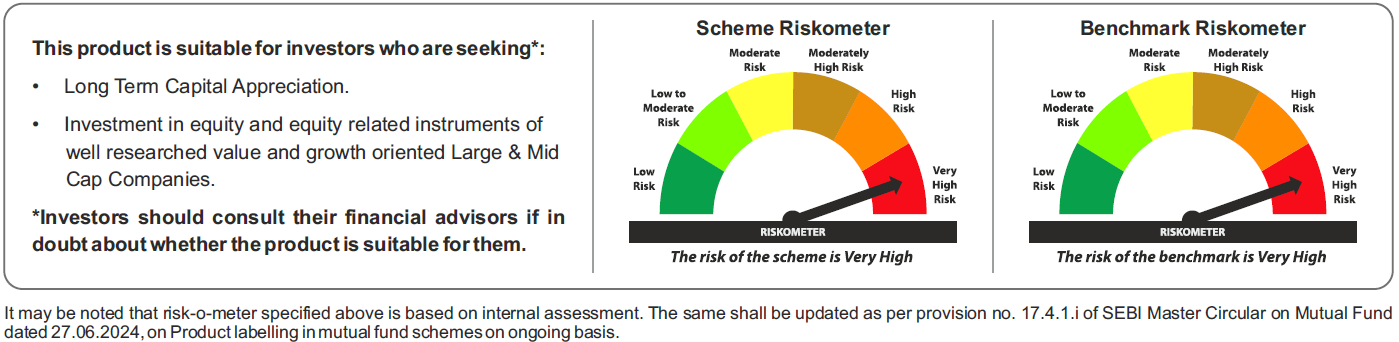
Exploring the Tata Large & Mid Cap Fund
| Exit Load | Benchmark | Scheme Riskometer | Benchmark Riskometer |
| Nifty Large Mid Cap 250 TRI | Very High Risk | Very High Risk |
Scheme Type: The Tata Large & Mid Cap Fund is an open-ended equity scheme investing in both large cap and mid cap stocks.
Investment Objective: To provide income distribution and/or medium to long term capital gains while at all times emphasising the importance of capital appreciation. Please note that the scheme does not offer a guarantee or assurance of returns or achievement of its objectives.
In other words, the Tata Large & Mid Cap Fund aims to generate medium- to long-term capital growth by investing in equity and equity-related instruments of well-researched, value- and growth-oriented large-cap and mid-cap companies. The scheme is available in multiple plan types to suit different investor preferences:
Tata Large and Midcap Fund Direct Growth
Tata Large and Midcap Fund Regular Growth
Tata Large and Midcap Fund Direct IDCW
Tata Large and Midcap Fund Regular IDCW
The fund is benchmarked against the Nifty Large Midcap 250 Total Return Index, which reflects the combined performance of 250 large-cap and mid-cap companies—offering investors exposure to potential for both stability and growth within a single category.
Are Large and Midcap Funds a Good Investment?
Large & mid cap funds can be suitable if you are looking for equity-led growth with moderate volatility and have a medium to long investment horizon. These schemes aim to balance the stability of large-cap companies with the growth potential of mid-cap firms.
They may not be ideal if your goals are short-term or if you prefer to avoid market-linked fluctuations. Typically, a holding period of five years or more helps smooth out short-term volatility and allows the fund’s growth potential to play out.
A practical approach could be:
Make it part of your core equity allocation if you have a moderate risk profile.
Start a Systematic Investment Plan (SIP) and increase contributions as your income grows.
Stay invested during market corrections and review performance annually, rather than reacting to short-term news.
Maintain a balanced asset allocation by pairing it with suitable hybrid or debt funds for relative stability.
Conclusion
A large and mid cap fund brings together the stability of large companies and the growth potential of mid-sized ones, offering a balanced way to participate in equity markets. It can help you build long-term wealth while keeping your portfolio diversified.
Before you invest, take time to understand your risk appetite, investment goals, and time horizon. Making thoughtful decisions based on these factors can help you stay aligned with your financial planning journey.
For more information, you can visit www.tatamutualfund.com. The Investor Service Centre of Tata Asset Management Pvt. Ltd. is located at Mulla House, Ground Floor, 51, M.G. Road, Near Flora Fountain, Mumbai – 400 001, Maharashtra. The office hours are Monday to Friday, 9:00 AM to 5:30 PM. For assistance, you can also call (022) 6282 7777 from Monday to Saturday, 9:00 AM to 5:30 PM, or email service@tataamc.com.
FAQs
1. What is the difference between mid-cap and large-cap stocks?
The primary difference lies in their ranking by full market capitalisation. As per SEBI’s regulations, large-cap stocks are companies ranked 1st to 100th, while mid-cap stocks are ranked 101st to 250th.
As per general market understanding, large-cap companies are established businesses with strong market presence, developed customer bases, and relatively mature operations.
In comparison, mid-cap companies are smaller in scale but may have greater room for business expansion and earnings growth. However, this higher growth potential is generally accompanied by greater business and market risk.
2. What are large and mid-cap funds?
Large and Mid Cap Funds are equity schemes that invest in both large-cap and mid-cap companies. As per SEBI regulations, these funds invest at least 35% of their total assets each in large-cap and mid-cap stocks.
3. How to invest in the Tata Large and Mid Cap Fund?
Investors can invest in the Tata Large and Mid Cap Fund online through the official Tata Mutual Fund™ website or the Tata Mutual Fund App. The process generally involves the following steps:
Register on the platform and complete the applicable KYC requirements.
Search for the Tata Large and Mid Cap Fund.
Choose the investment mode [decide whether to invest through a Systematic Investment Plan (SIP)* or make a lump-sum investment].
Enter the investment amount.
Complete the payment using the available payment options.
For an SIP, an NACH mandate may be required to enable automatic periodic investments from the registered bank account.
The investment is processed after the applicable requirements and payment instructions are successfully completed.
Disclaimer:
The views mentioned above are for information & educational purposes only and do not construe to be any investment, legal, or taxation advice. Investors must do their own research before investing. The views expressed in this article are personal in nature and in is no way trying to predict the markets or to time them. Any action taken by you on the basis of the information contained herein is your responsibility alone, and Tata Asset Management Pvt. Ltd. will not be liable in any manner for the consequences of such action taken by you. Please consult your Mutual Fund Distributor before investing. The views expressed in this article may not reflect in the scheme portfolios of Tata Mutual Fund. There are no guaranteed or assured returns under any of the schemes of Tata Mutual Fund.
*Mutual Fund Investments are subject to market risks, please read all scheme related documents carefully.
Author Bio

Akshay Kumar Rao

Loading Form...
Loading Similar Blogs...