


Banking & Financial Services Funds: Risks, Returns, and Market Cycles
Written by Akshay Kumar Rao
20 Feb 2026 • 7 minutes read


According to IBEF (a trust set up by the Ministry of Commerce), India’s BFSI sector has grown 50 times in the last 20 years. The market capitalisation has increased from Rs. 1,80,000 crore (US$20.28 billion) in 2005 to Rs. 91,00,000 crore (US$1 trillion) in 2025. (Source: IBEF)
Want to be a part of this growth story? A Banking and Financial Services Fund is a thematic/ sectoral equity mutual fund that primarily invests in companies from the BFSI sector. As per industry understanding, this includes banks, non-banking finance companies (NBFCs), insurance firms, and other financial institutions.
As per SEBI, at least 80% of the fund’s total assets must be invested in equity and equity-related instruments of this single sector. As a result, the performance of a banking mutual fund depends heavily on how the BFSI industry performs. Due to this concentration, they also carry a higher risk than diversified equity funds, which invest across many sectors.
Looking to invest in BFSI mutual funds in 2026? Before committing funds, read this article to first understand the various associated risks and how these schemes offer returns. Lastly, we will learn about the Tata Banking and Financial Services Fund offered by Tata Mutual Fund™.
Table of Content

3 Major Risks of Investing in a Banking and Financial Services Mutual Fund in 2026!
One of the biggest risks is “sector concentration”. As mentioned before, Banking and Financial Services mutual funds invest 80% of their assets in the BFSI sector. Now, due to this “narrow focus”, the fund’s performance depends only on the health of one industry.
As an investor, realise that the BFSI sector can face several issues, such as:
Weak economic growth
Rising loan defaults
Credit slowdowns
Regulatory changes
When this happens, the NAV of a financial sector mutual fund can significantly reduce. Always remember that, unlike diversified equity funds, these schemes do not have exposure to other sectors that could offset losses.
This makes sector-focused BFSI mutual funds more volatile + riskier than funds that spread investments across multiple industries. Additionally, you must be aware of these risks:
1. Interest Rate Risk
Interest rate changes have a direct impact on banking and financial services companies. And, BFSI mutual funds are highly sensitive to them. First, let’s see how the rate increase or decrease impacts the banking and financial services sector:
| Aspect | When Interest Rates Increase | When Interest Rates Decrease |
| Cost of Borrowing | Loans become more expensive for individuals and businesses. | Loans become cheaper and more affordable. |
| Loan Demand | Demand for loans decreases. | Demand for loans increases. |
| Credit Growth | Loan growth slows across the banking system. | Credit growth picks up. |
| Borrower Repayments | EMIs rise, which increases financial pressure on borrowers. | EMIs fall, which eases the repayment pressure. |
| Risk of Defaults | A higher repayment burden leads to more loan defaults. | A lower burden reduces default risk. |
| Bank/ NBFC “Funding Cost” | Banks pay more to raise deposits and other funds. | Banks raise funds at a lower cost. |
| Bank/ NBFC “Profit Margins” | Margins may shrink if higher costs cannot be passed to borrowers. | Margins may improve due to lower funding costs. |
Now, if we talk about the impact on the banking and finance mutual fund, its performance may potentially improve during rate cuts due to better bank/NBFC earnings. In contrast, during periods of interest rate increases, the NAV of a BFSI mutual fund may drop.
2. Credit and NPA (Non-Performing Asset) Risk
A “credit risk” arises when borrowers fail to repay their loans on time. When this happens, such loans turn into non-performing assets (NPAs). Usually, higher NPAs reduce a bank’s income because:
Interest payments stop and
Provisions must be set aside to cover potential losses.
Now, this negatively influences profitability and weakens the balance sheets of the lending bank/NBFC. If such companies are held by a financial services fund, its NAV can drop.
However, recently, India’s banking sector has shown improvement in both asset quality and profitability. As per a press release from PIB (dated December 10, 2025):
The Gross NPA declined sharply from a peak of 11.46% in 2018 to 2.31% in 2025. This indicates lower loan defaults.
At the same time, public sector banks have reported higher profits, with net earnings rising from ₹1.05 lakh crore in FY 2022–23 to ₹1.78 lakh crore in FY 2024–25 (Source: PIB)
3. Regulatory and Policy Risk
Realise that banking and financial services companies operate under strict regulatory oversight. Any change in rules issued by authorities such as the Reserve Bank of India (RBI) or SEBI can directly influence their earnings and capital structure. For example,
Let’s say the RBI makes “capital adequacy norms” stricter.
Now, banks will be required to hold more capital against their loans.
This reduces the amount available for lending.
These changes again directly influence BFSI mutual funds, which invest heavily in such closely regulated financial companies.
What is the Return Potential of Banking and Financial Services Mutual Funds?
Since it is a thematic/sectoral fund, the returns primarily depend on how banks, NBFCs, insurers, and other financial companies perform in the stock market.
A BFSI fund’s performance may improve when:
Credit growth is strong
Loan defaults are low
Interest rates support lending margins
In such cases, the financial companies usually report higher profits, which can raise their share prices and improve fund returns. However, during economic slowdowns or rising NPAs, the stock prices of the companies operating in the financial sector could fall. In turn, this also reduces the NAV of a financial services mutual fund.
What is the Tata Banking and Financial Services Fund?
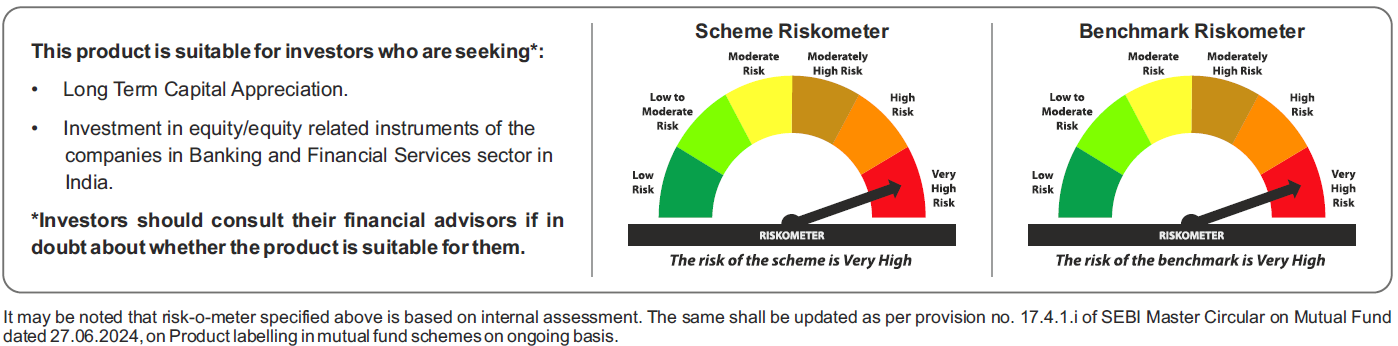
The Tata Banking and Financial Services Fund is an open-ended equity scheme investing in the Banking & Financial Services Sector. The investment objective of the scheme is to seek long-term capital appreciation by investing at least 80% of its net assets in equity and equity-related instruments of the companies in the Banking and Financial Services sector in India.
However, there is no assurance or guarantee that the investment objective of the scheme will be achieved. The scheme does not assure or guarantee any returns.
For more clarity, let’s have a look at some primary features of the Tata Banking and Financial Services Fund:
| Category | Details |
| Type of Scheme | An open ended equity scheme investing in Banking and Financial Services Sector |
| Scheme Category | Equity Scheme – Sectoral |
| Sector Focus | Banking and Financial Services sector |
| Risk Level | Very High Risk |
| Liquidity | Units can be bought or sold on every business day |
| Plans and Options Available |
*IDCW sub-options are Payout and Reinvestment. |
| Exit Load | 0.25% of NAV, if redeemed within 30 days from the date of allotment |
Conclusion
So now you know what a banking and financial services fund is, its return profile, and the various associated risks. If we were to revise, such thematic schemes invest at least 80% of their assets in the BFSI sector.
As per IBEF, by the end of 2025, banks had led the sector with a 57% share. However, this has declined from 85% in 2005, as NBFCs, fintech firms, AMCs, and insurance companies have expanded their presence. (Source: IBEF)
When investing in BFSI mutual funds, realise that these schemes are highly exposed to a single sector and may experience volatility. Usually, the performance of these funds improves when credit growth is strong, and loan defaults remain under control.
However, during economic slowdowns and periods of rising NPAs, the fund’s NAV may reduce. Thus, as an investor, you must thoroughly assess your risk appetite before investing.
Disclaimer
The views mentioned above are for information & educational purposes only and do not construe to be any investment, legal, or taxation advice. Investors must do their own research before investing. The views expressed in this article are personal in nature and in is no way trying to predict the markets or to time them. Any action taken by you on the basis of the information contained herein is your responsibility alone, and Tata Asset Management Pvt. Ltd. will not be liable in any manner for the consequences of such action taken by you. Please consult your Mutual Fund Distributor before investing. The views expressed in this article may not reflect in the scheme portfolios of Tata Mutual Fund. There are no guaranteed or assured returns under any of the schemes of Tata Mutual Fund.
*Mutual Fund Investments are subject to market risks, please read all scheme related documents carefully.
Author Bio

Akshay Kumar Rao

Loading Form...
Loading Similar Blogs...